 Tamil Nadu’s renewable energy landscape is shifting from wind-led growth towards a more diversified mix, with solar now emerging as the largest source of installed capacity. Storage, green hydrogen, bioenergy and renewable-powered mobility are also gaining momentum. However, transmission constraints, and slow and limited progress in wind repowering and offshore wind remain key challenges.
Renewable Watch takes a look at the key industry developments, opportunities and challenges shaping Tamil Nadu’s renewable energy sector…
Solar capacity surges ahead of wind
As of August 31, 2026, Tamil Nadu has more than 30 GW of installed renewable energy capacity. Solar accounted for the largest share at 14.45 GW, comprising 12.64 GW of ground-mounted solar, 1.63 GW of rooftop solar and 75.91 MW of off-grid solar. Wind capacity stood at 12.31 GW, while biopower contributed 1.05 GW. Hydro capacity, including large and small hydro, stood at 2.33 GW.
The pace of capacity addition has accelerated significantly in recent years. The total renewable capacity increased from 15.3 GW in 2021 to 16.1 GW in 2022, 17.92 GW in 2023 and 19.98 GW in 2024. The addition accelerated sharply to 25.24 GW in 2025 and further to 30 GW by August 2026. Solar has been the principal growth driver, increasing from 4.53 GW in 2021 to 14.45 GW by August 2026. Wind capacity has risen more steadily, from 9.61 GW to 12.31 GW during the same period.
In July 2026, renewable energy generation in Tamil Nadu stood at 7,275.7 MUs, comprising 4,728.27 MUs from wind, 2,282.88 MUs from solar, 232.98 MUs from large hydro, 23.65 MUs from bagasse-based cogeneration and 7.92 MUs from small hydro.
Compared to July 2025, solar generation and bagasse-based cogeneration increased significantly from 1,608.26 MUs and 7.53 MUs respectively. In contrast, wind, large-hydro and small-hydro generation declined from 4,807.61 MUs, 820.01 MUs and 51.43 MUs respectively.
Solar uptake broadens across segments
The state’s solar capacity has increased by nearly 10 GW between 2021 and 2026. Several projects were commissioned and tendering activity gained momentum across utility-scale, decentralised, rooftop, open access and solar-plus-storage segments during 2025-26. Select developments are listed below:
- Decentralised solar: Tamil Nadu Green Energy Corporation Limited (TNGECL) floated a 420 MW solar procurement tender under PM-KUSUM Component-A in December 2025. Following regulatory approval, 12 MW was approved for procurement at a ceiling tariff of Rs 3.10 per kWh. TNGECL also issued a 40 MW rooftop solar RESCO tender in October 2025.
- Solar-plus-storage: TNGECL issued tenders for two 15 MW solar projects integrated with a 15 MW/45 MWh battery energy storage system (BESS) each in Karur and Thiruvarur in November 2025. The projects were awarded to Evolve Green Energies and BVG India, respectively, at a tariff of Rs 4.47 per kWh.
- Utility-scale solar: Southern Railway floated tenders for 40 MW in March 2026 and a further 29 MW in May 2026. Another notable development was Bondada Engineering commissioning a 50 MW AC/70.5 MW DC solar project at Neyveli for NLC India in December 2025, marking the first solar project developed on reclaimed mining land. Further, ACE Renewtech completed a 4 MW AC/5.2 MW DC project for Kanam Latex Industries at Kayathar, Thoothukudi, in August 2025.
- Commercial and industrial (C&I) solar: In August 2026, Tata Power Renewable Energy commissioned a 100 MW group captive solar project in Tamil Nadu. In July 2026, Sunsure Energy secured Rs 2,620 million in project financing from FMO and Axis Bank for a 75 MWp open access solar project at Ilayangudi. In December 2025, Orient Green Power commissioned a 7 MW AC solar plant in Tiruvallur district, while its subsidiary Delta Renewable Energy awarded a Rs 994.2 million engineering, procurement and construction (EPC) contract to Remon Solutions for an additional 17.6 MW AC/24.64 MW DC solar project in the state.
The state is also building a stronger domestic solar manufacturing ecosystem. As of March 2026, Tamil Nadu had 15.2 GW of solar module manufacturing capacity, the third highest in the country, and 7.97 GW of solar cell manufacturing capacity, the second highest. Vikram Solar commissioned its 6 GW solar photovoltaic module manufacturing facility at Gangaikondan, Tirunelveli, during the same month.
Rooftop solar is another area receiving policy attention. Under the PM Surya Ghar: Muft Bijli Yojana, Tamil Nadu has received 110,248 applications and 94,762 installations have been completed, covering 110,668 households and 346 MW of capacity, with Rs 6.28 billion worth of subsidy released. The state plans to provide additional financial assistance besides the central subsidy to further encourage rooftop adoption.
Slow progress in repowering and offshore segment limits wind progress
Wind remains central to Tamil Nadu’s clean energy transition. The state has an estimated wind potential of 68.75 GW at heights above 120 metres and 95.1 GW above 150 metres, according to the Ministry of New and Renewable Energy. It also has 7.5 GW of wind turbine manufacturing capacity, the highest in the country, and 3.6 GW of blade manufacturing capacity.
In the C&I space, in February 2026, Tata Power Renewable Energy commissioned a 198 MW wind project for Tata Steel under the group captive model in Karur. Meanwhile, Thermax Onsite Energy Solutions commissioned 39 MW of wind capacity under the TN-II cluster and progressed work on a 60 MW project in Trichy.
At the same time, repowering of the ageing wind fleet has seen some momentum. In November 2025, TNGECL floated a tender to repower 18.75 MW of old wind projects and add a 16 MW solar plant, creating a combined wind-solar project across four sites in Kayathar, Muppandal and Puliyankulam. The project is being tendered through tariff-based competitive bidding under a build-own-operate (BOO) model for 25 years, with power to be sold to Tamil Nadu Power Distribution Corporation Limited (TNPDCL). 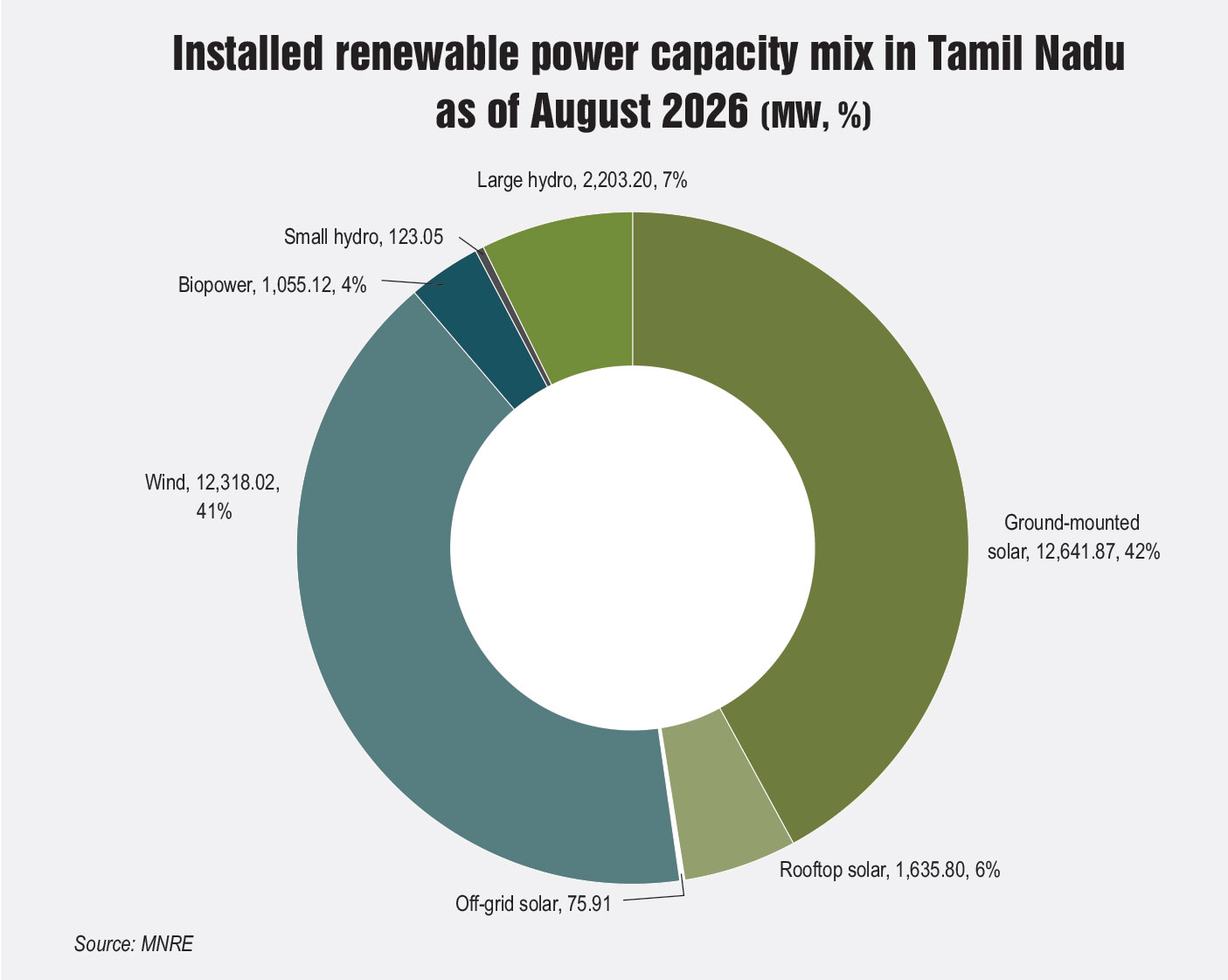
While the development in repowering is a step in the right direction, trends in the offshore wind space have been somewhat disappointing. In February 2024, the Solar Energy Corporation of India invited bids for 4 GW of offshore wind capacity off the Tamil Nadu coast, divided into four 1 GW blocks, with developers expected to sell power through open access without central viability gap funding (VGF) support. The tender was cancelled in August 2025 owing to insufficient developer participation. The state nevertheless remains a key beneficiary of the central government’s offshore wind programme, with 500 MW of the initial 1 GW VGF-supported programme allocated to Tamil Nadu. Eight offshore wind zones with approximately 31 GW of potential have been identified off the state’s coast; thus, offshore wind will be key to meet the state’s renewable resources.
PSP and BESS development accelerates
With high solar and wind penetration, energy storage is becoming an important priority for Tamil Nadu. The state already operates the 400 MW Kadamparai pumped storage project (PSP), managed by TNGECL. TNGECL is also developing the 500 MW Kundah PSP (Stages I, II and III), which is under construction and targeted for commissioning in February 2027.
Meanwhile, BESS procurement has simultaneously gathered pace. During 2025-26, tenders were issued for projects including POWERGRID’s 25 MW/100 MWh and 100 MW/400 MWh systems, NLC India’s 250 MW/500 MWh BESS and a 375 MW/1,500 MWh partner-selection tender. TNGECL subsequently awarded its 375 MW/1,500 MWh VGF-supported standalone BESS tender to three developers. Eagle Construction received 175 MW/700 MWh, Onward Solar Power 25 MW/100 MWh and OPG Power 175 MW/700 MWh, with tariffs of Rs 315,000-Rs 316,000 per MW per month.
Further, industry activity has picked up. In February 2026, Bondada Engineering secured financing for a 200 MW/400 MWh standalone BESS project. In May 2026, Pace Digitek secured a contract from NLC India Renewables for a 250 MW/500 MWh BESS project in Tamil Nadu, to be developed across three locations. In March 2026, Ashok Leyland started work on a new battery pack manufacturing facility near Chennai, with an expected investment of Rs 4 billion-Rs 5 billion.
Green hydrogen projects scale up
Tamil Nadu’s green hydrogen ecosystem moved from planning to project development during 2025-26. At V.O. Chidambaranar (VOC) port, a 10 nm³ per hour green hydrogen pilot plant, developed at an investment of about Rs 38.7 million, was inaugurated in September 2025. The facility is intended to supply hydrogen for port-colony street lighting and an electric vehicle charging station. A 750 m³ green methanol bunkering and refuelling facility, entailing Rs 353.4 million, was also initiated at the port. The port subsequently issued a tender in March 2026 for a 2 MW green hydrogen electrolyser and refuelling station, including seven years of operations and maintenance, at an estimated value of Rs 678.5 million, which was later cancelled for administrative reasons. Meanwhile, Chennai Petroleum Corporation Limited’s Manali refinery has been progressing with a 2 kilotonne per annum (ktpa) green hydrogen unit on a BOO basis, targeted for commissioning by 2027, with plans to progressively scale green hydrogen use.
Large-scale projects are also emerging in Thoothukudi. The National Green Hydrogen Mission portal lists ACME Solar’s Tamil Nadu green ammonia project at 1,500 ktpa, to be developed in three phases. AM Green’s Tuticorin project has a planned green ammonia capacity of about 1,119 ktpa, with commissioning targeted for 2027. The state also has other projects listed on the portal such as NTPC Green Energy’s 1 GW hydrogen project and 55.97 ktpa green ammonia project at VOC port, Sembcorp’s 223.87 ktpa green ammonia Thoothukudi project and CGS Energy’s 122.57 ktpa green ammonia Tuticorin project.
Bioenergy diversification gains momentum
Tamil Nadu’s bioenergy base is increasingly diversifying beyond conventional biomass generation. The state’s renewable portfolio includes nearly 1.06 GW of installed biopower as of August 2026, with bagasse-based cogeneration forming the bulk of the capacity. As of August 2026, 199 compressed biogas (CBG) plants had been registered under the GOBARdhan scheme in Tamil Nadu, of which 165 were functional and 20 completed, while 13 were yet to start construction and one was under construction.
During the past year, REnergy Dynamics secured EPC orders from Refex Renewables for two waste-to-CBG plants in Coimbatore and Salem, with capacities of 12.5 tonnes per day (tpd) and 10 tpd, respectively. Together, these facilities are expected to process about 550 tpd of municipal solid waste. Furthermore, Tamil Nadu is formulating a CBG Policy 2026, which will give a fillip to this sector, going forward.
Waste-to-energy (WtE) activity also gathered pace. In March 2026, the Greater Chennai Corporation tendered a 2,400 tpd WtE facility at Keerappakkam, including a scientific landfill, under a DBFOT-PPP model. The plant is designed to generate at least 45 MW. Also, a 1,000 tpd waste-handling and a 700 tpd composting facility at Perungudi has been tendered.
Status of T&D infrastructure
Strengthening the financial sustainability of power utilities, and increasing distribution efficiency and grid flexibility will be important for Tamil Nadu, besides capacity addition. The restructuring of the erstwhile Tamil Nadu Generation and Distribution Corporation into separate entities for generation, green energy and distribution is intended to improve operational and financial efficiency.
The state government has provided nearly Rs 530 billion as subsidy and Rs 520 billion for loss funding to TNPDCL over the past four years, while the utility continues to face a significant interest burden. The state has, nevertheless, made progress in reducing aggregate technical and commercial losses from 19.47 per cent in 2017-18 to 11.39 per cent in 2023-24, with a target of bringing them down to 10 per cent.
Under the Revamped Distribution Sector Scheme, Rs 89.3 billion has been approved for agricultural feeder segregation, high voltage distribution systems, transformer upgrades and replacement of old conductors. Smart metering is also being scaled up, with 120,000 meters planned initially for the government and local body buildings and another 550,000 meters proposed across TNPDCL’s circles.
Transmission infrastructure is simultaneously expanding to accommodate renewables’ growth. As of March 2026, Tamil Nadu had 1,113 transmission substations and 39,764 circuit km of lines, while 96 additional substations were under execution. A 765 kV network is being developed specifically to evacuate solar, wind and hydro generation from southern Tamil Nadu to load centres. The Green Energy Corridor Phase II is expected to further strengthen intra-state evacuation and reduce renewable curtailment.
Future outlook
Transmission constraints remain a key challenge as renewable generation is concentrated in southern Tamil Nadu, while demand is higher in the northern and industrial regions. Expanding transmission corridors, substations and grid capacity will be essential for efficient power evacuation. The ageing wind fleet also requires a predictable repowering framework covering land aggregation, stakeholder coordination and grid connectivity. Offshore wind should also be treated as a long-term strategic priority despite its higher initial costs, with VGF, dedicated transmission infrastructure and clear procurement frameworks helping support early projects.
Looking ahead, the Tamil Nadu Energy Department’s Policy Note 2026-27 targets increasing the renewable energy share in the state’s power mix to 50 per cent by 2031. The state has also set a renewable purchase obligation of 35.95 per cent for 2026-27, covering solar, wind, hydro, distributed renewable energy and other sources. To support this transition, TNGECL is developing renewable energy zones in Chennai, Tiruchirappalli, Tirunelveli, Coimbatore and Madurai through a single-window mechanism.
The state plans to add 10 GW of solar and 2 GW of wind capacity over the next five years and aims to create a South Asian Renewable Energy Corridor, in collaboration with Sri Lanka and other regional partners, to support round-the-clock renewable power. The pace of solar and wind capacity addition as seen in the past suggests that these targets are achievable. In both the solar and wind sectors, approximately the same capacity has been set up in the past five years, as has been targeted for the next five years. Given the growing demand expected from data centres and clean mobility and the large repowering potential added to nearly 35 GW of identified offshore wind potential, the state should consider overachieving the set targets.
Key Statistics: Tamil Nadu’s renewable energy mix