

 Renewable energy is increasingly shaping India’s power infrastructure. As per the Ministry of New and Renewable Energy, as of August 31, 2026, the country’s total installed renewable energy capacity stood at 295.55 GW, including 52.06 GW of large hydropower capacity. With 8.78 GW of nuclear capacity, the total non-fossil-fuel-based installed capacity reached 304.33 GW. Capacity additions have also remained strong, with 20.86 GW of renewable capacity added during April-August 2026, led by 17.77 GW of solar and 2.42 GW of wind. Renewable Watch provides an overview of the sector’s key developments during August 2025-August 2026…
Solar leads renewables growth
Solar remains the primary driver of India’s renewable energy expansion. As of August 31, 2026, the cumulative solar capacity stood at 168.04 GW. Ground-mounted projects accounted for the largest share at 123.99 GW, followed by grid-connected rooftop systems at 32.59 GW. Hybrid projects contributed 4.83 GW while off-grid systems accounted for 6.63 GW.
India’s utility-scale solar market remained active during August 2025-August 2026, with 13 utility ground-mounted solar auctions totalling 13.92 GW, as tracked by Renewable Watch Research. The discovered tariffs ranged from Rs 2.09 per kWh to Rs 3.07 per kWh for standalone solar auctions. The lowest tariff of Rs 2.09 per kWh was discovered in Madhya Pradesh Jal Nigam Limited’s 100 MW auction and was awarded to DBL-APMPL in October 2025. Other notable standalone solar auctions during the year included the Gujarat Urja Vikas Nigam Limited’s (GUVNL) 625 MW auction at Rs 2.34 per kWh in March 2026, Punjab State Power Corporation Limited’s (PSPCL) 500 MW auction at Rs 3.05-Rs 3.07 per kWh in April 2026, NHPC Limited’s 1.2 GW auction at Rs 2.73 per kWh in July 2026. Overall, the year marked a clear shift towards solar plus storage, larger integrated projects and more competitive tariff discovery.
Wind market sees active tendering
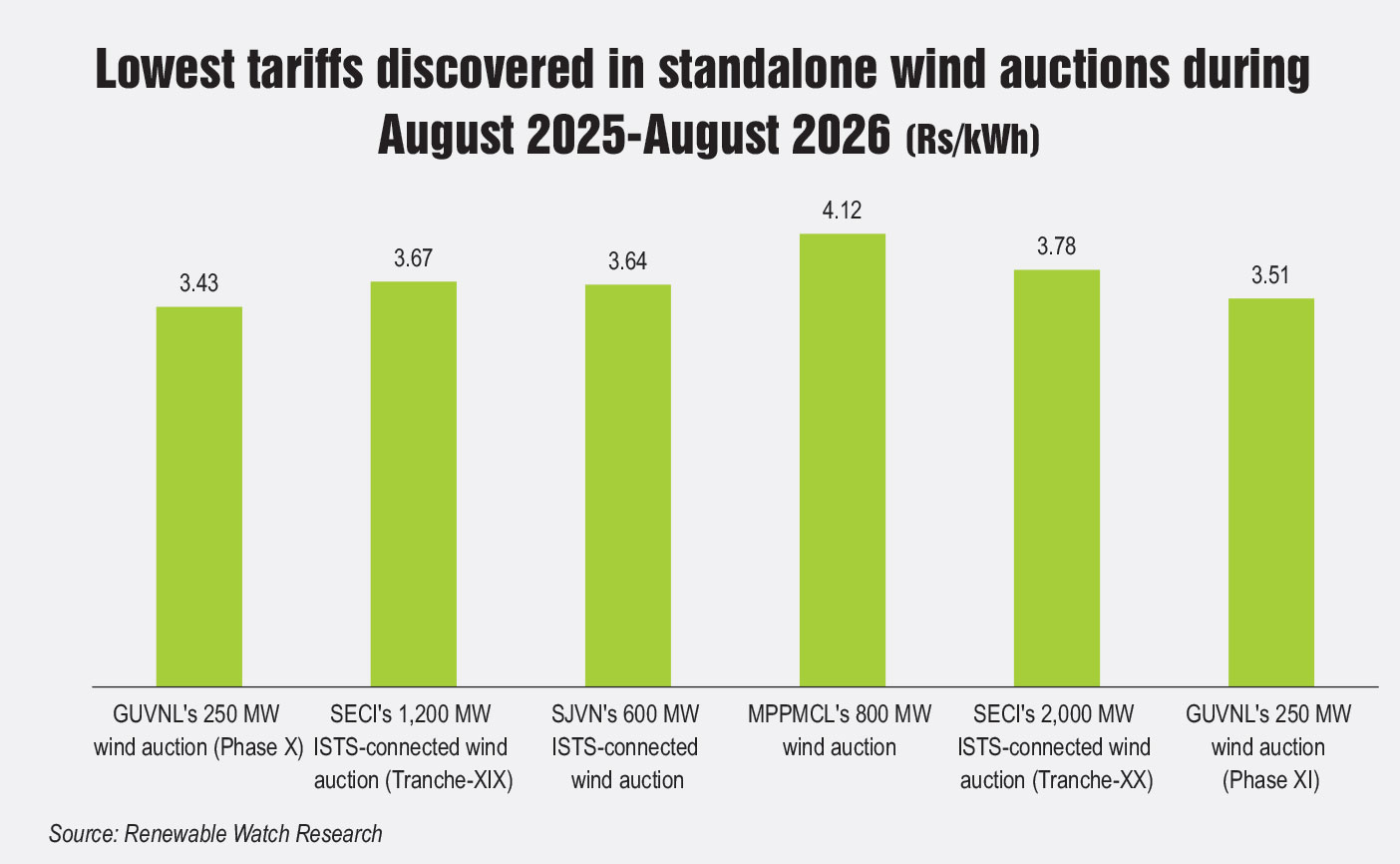
Wind power entered a higher-growth phase during the past year. Installed capacity reached 58.52 GW as of August 31, 2026. During the year, Renewable Watch Research tracked 16 standalone wind tenders, beginning with SJVN Limited’s 600 MW Wind-3 and 600 MW Wind-4 tenders, and GUVNL’s 250 MW Phase X tender in September 2025, followed by SECI’s 600 MW Tranche XIX tender in October 2025 and 2,000 MW tender in May 2026. Other notable tenders included NTPC REL’s 540 MW engineering, procurement and construction tender in Andhra Pradesh in February 2026 and its 813 MW wind turbine generator package in Karnataka in March 2026.
Auction activity accelerated from January 2026, with GUVNL Phase X recording winning tariffs of Rs 3.43-Rs 3.44 per kWh, followed by SECI Tranche XIX at Rs 3.67-Rs 3.69 per kWh in February 2026 and SJVN’s 600 MW auction at Rs 3.64-Rs 3.65 per kWh in March 2026. In July 2026, MPPMCL’s 800 MW auction recorded the highest tariff of Rs 4.12-Rs 4.17 per kWh, while SECI Tranche XX and GUVNL Phase XI awarded 2,000 MW and 250 MW at Rs 3.78-Rs 3.85 per kWh and Rs 3.51-Rs 3.52 per kWh respectively. Overall, wind tariffs during the period ranged from Rs 3.43 per kWh to Rs 4.17 per kWh.
Hydro and PSP projects advance
Hydropower continues to support grid balancing amid rising variable renewable generation. India had 52.06 GW of large hydro capacity and 5.18 GW of small-hydro capacity as of August 2026. Large hydro capacity includes about 7.43 GW of pumped storage project (PSP) capacity, reflecting the growing role of storage within the conventional hydro fleet. A key highlight during the past year was NHPC’s phased commissioning of its 2,000 MW Subansiri Lower hydroelectric project. Unit 1 (250 MW) achieved commercial operations in December 2025, followed by Unit 2 in March 2026, while the remaining units are targeted for phased commissioning by December 2026.
A major milestone in the PSP space was THDC India’s 1,000 MW Tehri variable-speed pumped storage plant, which was commissioned by April 2026. The momentum continued in July 2026, when SECI awarded 1,344 MW under its 1,500 MW/12,000 MWh PSP auction. Greenko Energies secured 720 MW at Rs 13.49 million per MW per year, while Tata Power and Torrent Energy Storage Solutions won 324 MW and 300 MW at Rs 13.51 million per MW per year and Rs 13.50 million per MW per year, respectively. At the state level, several developments also helped advance the PSP pipeline. For instance, Assam approved a 1,000 MW PSP project at a tariff of Rs 10.29 million per MW per year in November 2025, while Bihar shortlisted developers for 2.12 GW of PSPs in December 2025. In February 2026, Andhra Pradesh invited bids for the 950 MW Kamalapadu PSP.
Standalone BESS deployment gathers pace
Battery energy storage systems (BESS) are developing alongside pumped storage. BESS tariffs showed a sharp decline, followed by a moderate recovery during the past year. For two-hour BESS, tariffs fell from Rs 254,000 per MW per month in KPTCL’s August 2025 tender to Rs 148,000 per MW per month in APTRANSCO’s November 2025 tender, before rising to Rs 335,000 per MW per month in PSPCL’s May 2026 auction. For four-hour BESS, tariffs stood at Rs 285,000 per MW per month in RVUNL’s November 2025 tender and Rs 315,000 per MW per month in TNGECL’s February 2026 tender. 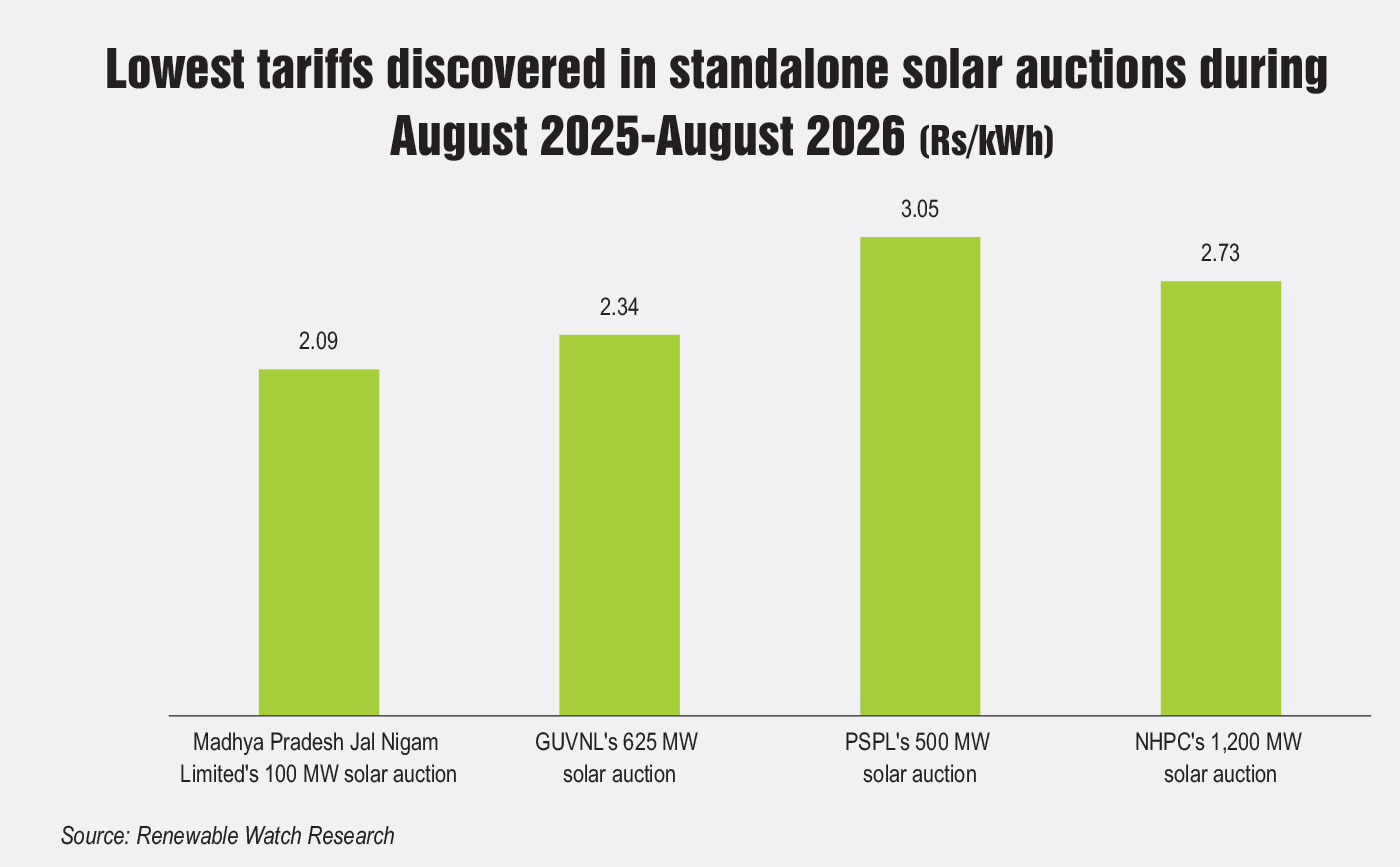
Key recently commissioned standalone projects include ACME Solar’s 155 MW/470.25 MWh BESS in Rajasthan (March 2026) and another 33.33 MW/120.38 MWh commissioned in June 2026; Juniper Green Energy’s 100 MWh merchant BESS in Bikaner, which was commissioned in January 2026; and IndiGrid’s 180 MW/360 MWh BESS in Gujarat in May 2026. Adani Green Energy commissioned 3.37 GWh of BESS capacity at Khavda in May 2026. Maruti Suzuki also commissioned a 1 MWh BESS at its Haryana facility in July 2026.
FDRE, RTC and hybrid auctions pick up
During August 2025-August 2026, renewable energy auctions increasingly shifted towards firm, dispatchable renewable energy (FDRE), hybrids and round-the-clock (RTC) procurement. FDRE auctions included Tata Power-DDL’s 250 MW tender in August 2025, which discovered tariffs of Rs 4.76-Rs 4.77 per kWh, followed by SJVN’s 1,500 MW FDRE auction in October 2025, with tariffs of Rs 6.74-Rs 6.75 per kWh, and SECI’s FDRE-with-BESS auction for assured peak power in February 2026, which recorded tariffs of Rs 6.27-Rs 6.28 per kWh.
Hybrid renewable energy auctions included RUMSL’s 600 MW solar with 440 MW/880 MWh BESS auction in September 2025 at tariffs of Rs 2.70-Rs 2.76 per kWh, SECI’s 2,000 MW solar with 4,000 MWh BESS auction in October 2025 at Rs 2.86-Rs 2.87 per kWh, SECI’s 1,200 MW solar with 600 MW/3,600 MWh BESS auction in January 2026 at Rs 3.12-Rs 3.13 per kWh, SECI’s 10 MW solar with 10 MW/20 MWh BESS auction in February 2026 at Rs 2.6 per kWh, KREDL’s 250 MW solar with 250 MW/1,100 MWh BESS auction in February 2026 at Rs 5.51 per kWh, and CESC’s 600 MW wind-solar hybrid auction in February 2026 at Rs 3.74-Rs 3.75 per kWh.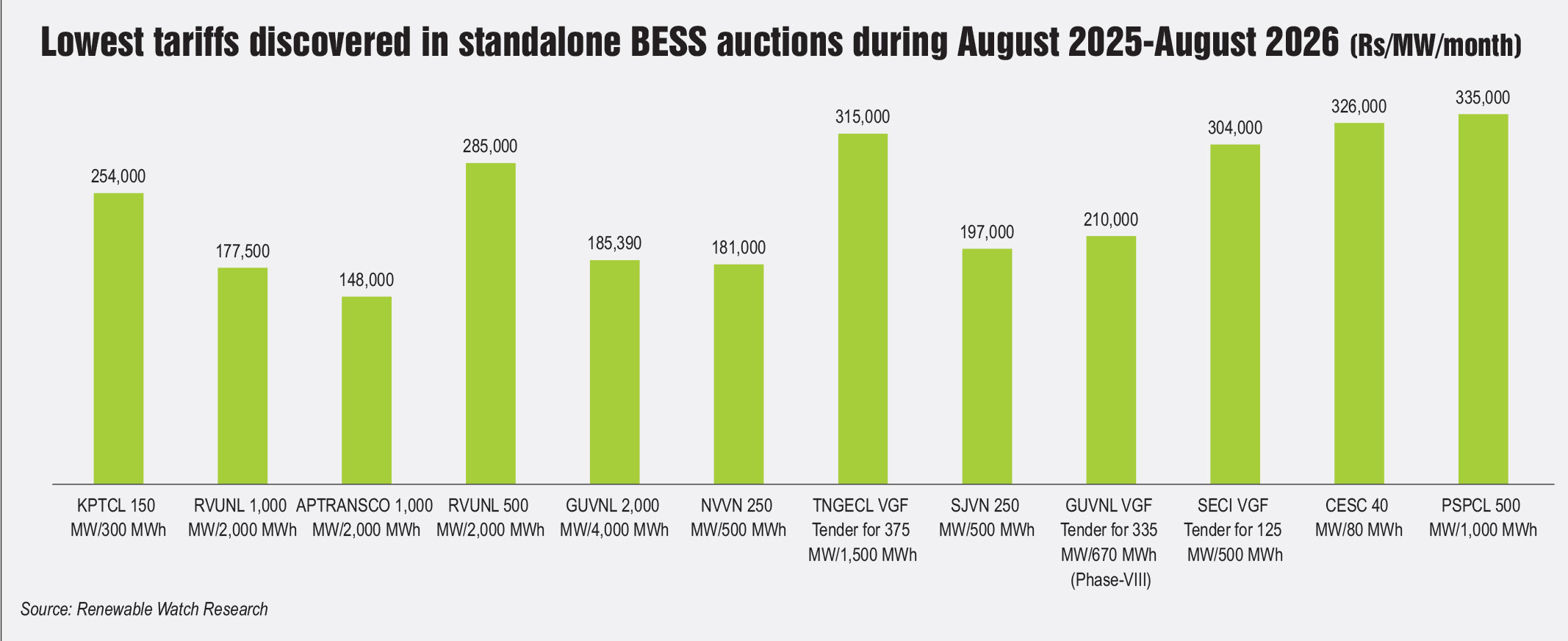
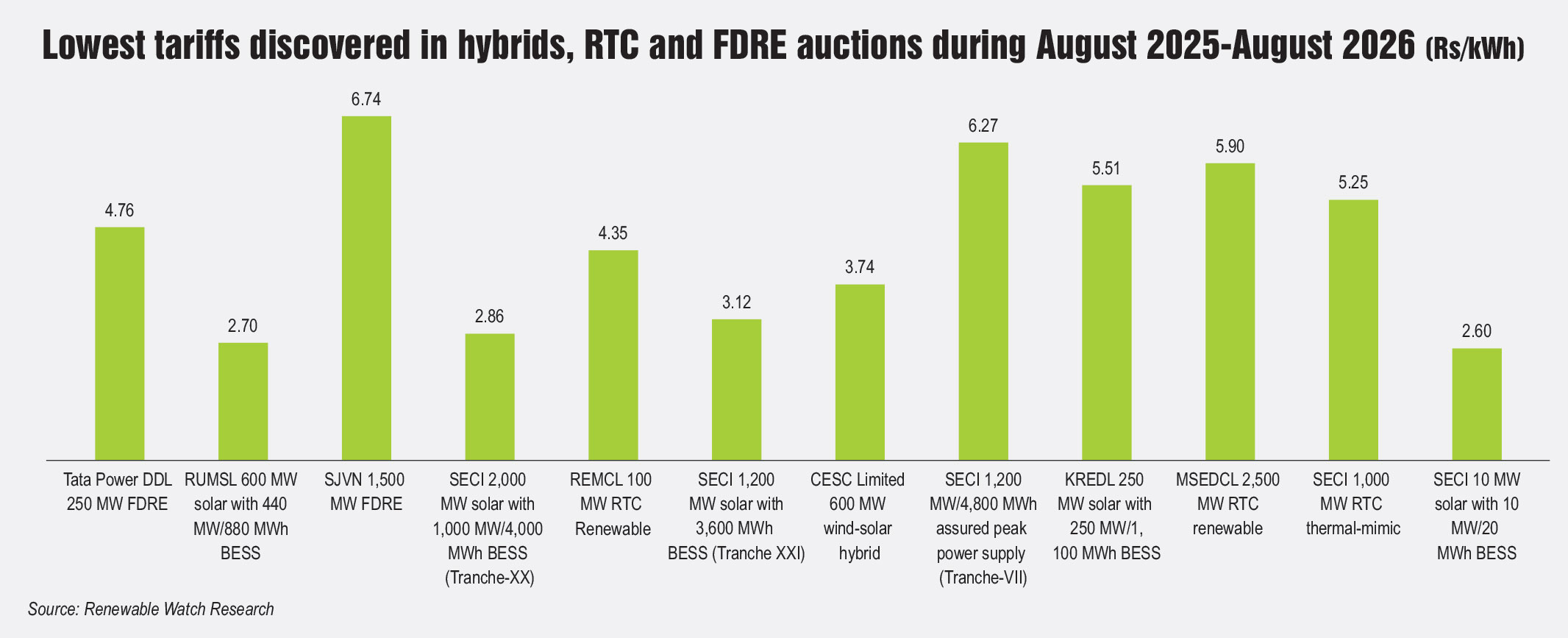
RTC renewable power procurement included REMCL’s 1,000 MW auction in November 2025 at Rs 4.35 per kWh, MSEDCL’s 2,500 MW RTC auction in April 2026 at Rs 5.9 per kWh and SECI’s 1,000 MW RTC-thermal-mimic auction in August 2026 at Rs 5.25-Rs 5.26 per kWh.
CBG and WtE projects scale up
The bioenergy sector has gained momentum during the past year. As of August 31, 2026, the installed capacity included 9.82 GW of biomass and bagasse cogeneration, 1.04 GW of non-bagasse biomass cogeneration, 324.24 MW of grid-connected waste-to-energy (WtE) and 554.16 MW of off-grid WtE capacity. Together, these technologies represent an important but still underdeveloped part of the renewable energy portfolio. Compressed biogas (CBG) adoption has also increased. Renewable Watch Research tracked 1,993 CBG projects, of which 561 have been commissioned, 453 are under construction, 931 are yet to start construction and 48 have been approved.
Select project developments in the past year include the commissioning of three 22.5 tonnes per day (tpd) CBG plants by Reliance Green Energy in Madhya Pradesh in November 2025, BPCL’s 150 tpd Brahmapuram CBG plant in February 2026 and Suzuki’s 1.5 tpd biogas-to-CBG plant in Gujarat in December 2025. In June 2026, SAEL Industries commissioned a 14.9 MW agri-WtE plant in Rajasthan. In August 2025, the Greater Noida Industrial Development Authority started work on a 50 tpd CBG plant at Jalpura and the Tamil Nadu municipal administration laid the foundation stone for a 250 tpd biogas plant at Vellalore. In September 2025, the CEF Group raised Euro 38 million to develop CBG plants in Jammu and Ahmedabad, with capacities of 350 tpd and 500 tpd respectively. In February 2026, Juno Joule Bio Fuels invested Rs 7 billion to establish a CBG cluster Telangana, comprising 10 plants of 100 tpd each. In April 2026, the Bhubaneswar Municipal Corporation and Nexband Renewables announced a 150 tpd CBG plant. In May 2026, Mahanagar Gas and BMC signed an agreement for a 350 tpd CBG plant in Mumbai.
Ethanol is another major component of India’s bioenergy strategy. According to the Petroleum Planning and Analysis Cell, ethanol blending in petrol reached 20 per cent in July 2026. The focus is now shifting towards sustaining the ethanol blending programme and expanding ethanol availability.
Green hydrogen moves towards commercialisation
Green hydrogen is moving from policy planning to industrial use and commercial projects. Notable green hydrogen tenders include NTPC Green Energy’s 2.5 mmtpa green hydrogen/chemicals project at the Pudimadaka Green Hydrogen Hub in Andhra Pradesh launched in September 2025; and ANERT’s tender, issued in November 2025, for a green hydrogen transport pilot project involving hydrogen buses/trucks and two refuelling stations in Kerala, each with a capacity of at least 260 kg per day, with vehicles planned to operate for 24 months. In March 2026, the Deendayal Port Authority tendered a 3 kg green hydrogen storage system, with a 3 kW fuel cell for Kandla port, while the V.O. Chidambaranar Port Authority invited bids for a 600 kg per day, 2 MW electrolyser-based green hydrogen production and refuelling station.
The segment witnessed strong tendering activity during the past year. In September 2025, the Strategic Interventions for Green Hydrogen Transition (SIGHT) green ammonia auction discovered tariffs of Rs 49.75-Rs 64.74 per kg, with ACME Cleantech Solutions winning 315,000 mtpa across multiple allotments. Other awarded developers include the Consortium of SCC Infrastructure and InSolare Energy (100,000 mtpa at Rs 53.05-Rs 57.65 per kg), NTPC Renewable Energy (70,000 mtpa at Rs 51.50 per kg), Jakson Green (55,000 mtpa at Rs 50.75 per kg), Oriana Power (50,000 mtpa at Rs 52.25 per kg), Onix Renewable (50,000 mtpa at Rs 52.50 per kg), and Sunyam International (4,000 mtpa at Rs 50 per kg). In February 2026, Numaligarh Refinery Limited awarded a 10,000 mtpa supply contract to NeuEN Green Energy at a tariff of Rs 279 per kg.
Major green hydrogen projects also witnessed advancements. In August 2025, the Ministry of Road Transport and Highways announced a Rs 6 billion highway pilot for hydrogen mobility, while JSW Energy commissioned its 3,800 tpa plant at Vijaynagar in November 2025. NTPC Limited inaugurated a 3.7 MW solar-hydrogen plant at Chushul in November 2025, and India’s first hydrogen train was flagged off in July 2026. In April 2026, Jakson Green signed a $465 million green ammonia purchase agreement with SECI for 85,000 tpa of green ammonia. In August 2026, Oriana Power signed an MoU with the Maharashtra government to invest around Rs 45 billion in an integrated green hydrogen, green ammonia and green methanol project, while the government awarded 30 ktpa of green hydrogen capacity Under SIGHT Mode 2B across IOCL Panipat, BPCL Bina, HPCL Vizag and NRL Numaligarh. These developments indicate a shift towards large-scale commercial demand.
Future outlook
Going forward, India will need to accelerate transmission infrastructure development, strengthen forecasting and scheduling systems, expand energy storage capacity and build resilient domestic supply chains. Greater coordination between central and state agencies, faster project clearances, enhanced grid flexibility and a stable policy environment will also be critical to supporting the continued expansion of renewable energy.
