

 This article Why underground hydrogen storage matters for a low-carbon energy system? authored by Carole Le Hénaff, Markus Pichler, Verena Friedl, and Siegfried Kiss has been extracted from the the latest Oxford Institute for Energy Studies Energy Forum
Europe’s energy system is entering a decisive transformation. As electrification accelerates and variable renewables expand, maintaining power-system stability is becoming more challenging. Energy storage is therefore increasingly critical. Short-duration options (typically a few hours) smooth intraday variability and support hourly and daily balancing. But when imbalances last beyond roughly 8–10 hours, direct electricity storage hits technical and economic limits.
At that point, only large-scale, long-duration storage can cover overnight, multi-day, or seasonal stress events. Until now, underground gas storage (UGS) has been the primary source of large-scale system resilience, and it continues to play a critical role. In a low-carbon system, underground hydrogen storage (UHS) will take over this role, delivering long-duration flexibility with clean molecules. By linking power and hydrogen systems, UHS also helps manage physical constraints in a renewables-based grid, as it can be operated flexibly to follow variable renewable-generation patterns (e.g. sustained surpluses and multi-day shortfalls).
This paper explains why UHS is essential to system resilience—and why timely investment and coherent policy are needed to realize its full value.
From UGS to UHS: building on a proven infrastructure for a decarbonized energy system
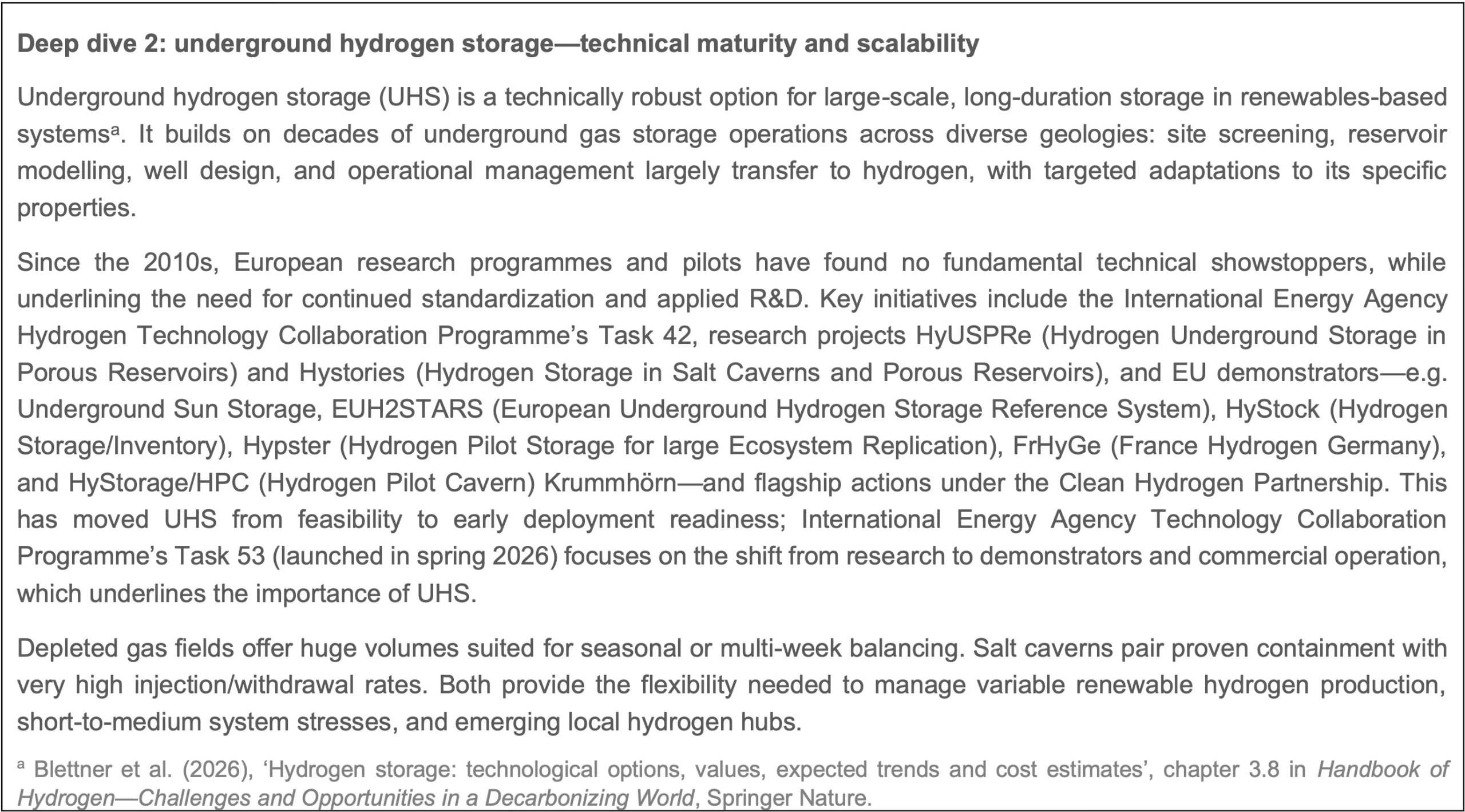
UHS is the natural evolution of UGS, transferring decades of operational experience into a decarbonized energy system. By building on proven UGS know-how, UHS is already a mature technology, ready for early deployment and scale-up—a maturity now confirmed by the first demonstration and scale-up projects.
UHS is uniquely positioned to deliver flexibility across all time horizons
UHS is irreplaceable for seasonal modulation, while its large-scale, long-duration storage capability increasingly enables shorter-term flexibility services to be layered on top of this seasonal role. By accommodating increasingly diverse production and price patterns through repeated injections and withdrawals, UHS creates additional system value that is already visible in multi-cycling—i.e. multiple injection and withdrawal cycles over the year, beyond a single seasonal fill and withdrawal. This role is set to expand as variable renewables grow in the power mix, with UHS scaling in parallel with hydrogen hubs, networks, and market development.
Building on the legacy of gas storage: redefining reliability and sustainability
Reliability is the ability to meet demand when supply is constrained; underestimating this requirement quickly translates into higher costs, security concerns, and political exposure. UGS has provided this system insurance for decades. In a decarbonized system, UHS can carry it forward by storing surplus renewable or low-carbon energy for later use—strengthening security of supply and enabling Europe to make the best use of domestic clean resources within an integrated regional market. As renewables expand, adequacy can increasingly be delivered through coordinated low-carbon resources backed by large-scale storage, rather than carbon-intensive backup capacity. UHS is therefore the evolution of proven reliability principles—anchoring system security in sustainable infrastructure fit for net zero.
 Enabling early and efficient integration of renewable energy
Hydrogen is often presented as a solution for hard-to-abate end-use sectors. Yet its first and most immediate value lies upstream: as a vector for system-level flexibility. By combining electrolysis with UHS, renewable electricity becomes storable at scale. Surplus power can be converted into hydrogen, shifted across hours, days, or seasons, and redeployed when the power system can no longer rely on generation, grids, or short-duration storage alone. In doing so, hydrogen extends the role of renewables far beyond real-time balancing. UHS addresses a core structural gap of electricity systems: the lack of affordable long-duration storage. By decoupling production and consumption over time, it preserves access to clean energy despite network constraints, spatial limits, and weather variability—key bottlenecks to rapid renewable expansion.
Electrolysis and UHS: a single flexibility chain
Electrolysers and UHS should be seen as two complementary components of one integrated flexibility chain. Electrolysers convert surplus renewable and low-carbon electricity into hydrogen; UHS provides the physical capacity to store that energy at scale and over time. Current power-to-gas approaches rightly highlight conversion but tend to overlook where long-duration flexibility actually materializes—when electrolysis is paired with large-scale storage. In this configuration, electrolysers enable flexibility, while UHS delivers it, turning hydrogen into a system-wide flexibility resource rather than a sector-specific solution.
Regulatory blind spots: UHS remains under-recognized
Despite its growing system value, UHS is not yet fully recognized as a cross-vector infrastructure. The EU Gas and Hydrogen Package provides an important regulatory starting point by addressing UHS largely by analogy with UGS and in relation to network balancing needs. Building on this framework, it is equally important to reflect UHS’s broader contribution as a system-wide flexibility and adequacy resource for power systems with high shares of variable renewables. By converting excess renewable electricity into a storable molecule, UHS enables shifting energy across hours, days, and seasons—effectively firming renewables and providing dispatchable supply when needed. This clean energy can be prioritized for hard-to-abate uses and, in certain configurations, mobilized to support the power system during peak-demand periods—either upstream by making electrolysers interruptible (UHS maintaining hydrogen supply when loads are curtailed) or downstream by meeting non-compressible peaks in demand. In that sense, pairing electrolysis with UHS creates an integrated flexibility chain that captures value across the entire energy system, including mid- and long-duration flexibility, energy adequacy, and resilience during prolonged renewable shortfalls or correlated weather events. Recognizing UHS accordingly is also key to avoid inefficient system outcomes (curtailment, overbuilt electricity grids, or continued reliance on fossil backup) and to reflect the benefits of upstream integration of electricity and hydrogen infrastructures in planning and regulation.
UHS: a low-cost system enabler for Europe’s hydrogen scale-up
Market design put to the test: flexibility, not renewable capacity, is now the challenge
As Europe accelerates its exit from fossil fuels, gas storage is already assuming a growing role as a provider of system-critical flexibility, as evidenced by its increasing contribution during peak-demand periods. What was historically designed as a security-of-supply instrument is progressively evolving into a core flexibility pillar of an increasingly electrified energy system. Building on this proven asset base, UHS can extend the same flexibility services to clean molecules, while offering greater adaptability to renewable and low-carbon generation patterns. UHS enables hydrogen to be produced or imported when renewable and low-carbon electricity is abundant and affordable, stored at scale, and delivered when and where it is most valuable—across multiple sectors and for distinct end-user profiles.
The key question is therefore no longer whether flexibility is needed, but how market design should value and prioritize it. Gas infrastructure has long played—and continues to play—a critical role in ensuring system stability. Part of the transition therefore lies in progressively repurposing these assets to hydrogen to the entire energy system based on renewable and low-carbon molecules, building on existing strengths while responding to fundamentally new system needs.
As renewable deployment accelerates, the need for mid- to long-duration flexibility is becoming increasingly visible. A growing number of hours with negative electricity prices signals rising volumes of surplus generation that must be absorbed, while more frequent periods of system stress reveal the limits of short-duration storage and grid-based solutions alone. Future energy systems will therefore require storage assets capable of delivering flexibility across multiple time scales—from hours to days, weeks, and months. The challenge is to anticipate an energy system in which renewable generation becomes, in effect, dispatchable. UHS directly addresses this challenge by allowing renewable energy to be shifted across time at scale.
Figure 2: Different types of value UHS is expected to deliver in the future energy system
Bankability challenge: capturing cross-vector value in contracts and markets
UHS can attract capital as the hydrogen economy scales, but it needs a clearer, bankable revenue stack consistent with its capital-intensive profile. Because much of its value is system-level (across vectors, markets, and time horizons) rather than tied to single offtakers, the priority is to convert its multi-service contribution into investable market signals and contractual revenues.
Available evidence points to a relatively modest direct cost for UHS, with studies and early project assessments typically placing its levelized cost of storage in the range of €0.2–0.4 per kilogram of hydrogen consumed, depending on utilization, geology, and configuration. For instance, analyses conducted in 2025 by RAG Austria AG—one of the early developers of UHS in depleted gas fields—illustrate an indicative storage tariff on the order of €30–40/MWh per year, corresponding to capital expenditure levels of approximately €600–700/MWh, depending on geological conditions and project design. Assuming typical storage requirements of around 20–25% of hydrogen consumption, these values translate into incremental costs per kilogram of hydrogen in the lower range of the levelized cost of hydrogen estimates reported in the literature.
In an internal study conducted by Storengy in collaboration with Artelys, a similar cost range was identified. Similar orders of magnitude are found in recent academic work, including Blettner et al. (2026), ‘Hydrogen storage: technological options, values, expected trends and cost estimates’, chapter 3.8 in Handbook of Hydrogen—Challenges and Opportunities in a Decarbonizing World, Springer Nature.
When set against this limited cost, the system value delivered by UHS is significantly higher, first and foremost through avoided capital expenditure. By reducing the need for extensive electricity grid reinforcements and for the deployment of alternative, often more expensive, flexibility solutions, UHS limits upfront investments elsewhere in the energy system. Beyond these capex savings, additional value materializes over subsequent years through sustained cost avoidance—including reduced exposure to periods of high electricity prices, lower reliance on carbon-intensive fallback options, and easing of compliance with obligations regarding renewable fuels of non-biological origin by allowing better temporal alignment between renewable electricity availability and hydrogen production. In combination, these effects reinforce UHS as a predictable, low-cost component of the hydrogen value chain with a net positive impact on overall system economics (Figure 2).
Quantifying cross-vector flexibility: why hourly multi-energy models matter
Making the system value of UHS visible and decision-relevant requires the use of multi-energy modelling with hourly granularity. When electricity, gas, and hydrogen are assessed together, UHS appears not as a ‘hydrogen-only’ asset but as cross-vector flexibility that can reduce overall investment needs and improve system operations. This requires a market design that captures interactions between vectors, networks, and time horizons.
Enabling conditions: aligning electrolysis, storage, and policy design
Scaling UHS requires coordinated build-out of the electrolysis chain: electrolysers create flexibility opportunities, while UHS delivers flexibility at scale. Planning should therefore treat electrolysis, storage, and networks as a single, integrated energy system, optimized against a set of key system drivers—including renewable resource availability, connection to electricity and hydrogen grids, network constraints, and evolving demand patterns—rather than as stand-alone assets. This depends on a coherent, predictable EU framework: robust carbon pricing and reliable access to renewable/low-carbon electricity (to meet quota compliance), complemented by targeted de-risking for early-stage volume, price, and utilization risk. Clear investment and inter-temporal cost allocation rules can translate system value into bankable revenues, while durable demand-side incentives—especially in emerging hydrogen hubs—anchor utilization and unlock scale.
Lead times make early action non-negotiable
Timing is decisive: if UHS arrives late, Europe risks locking in costly and less efficient resilience substitutes (electricity grid overbuild, higher curtailment, continued fossil backup). Hence, it is essential to integrate UHS into system planning at an early stage. UHS typically needs 6–11 years from development to operation (Figure 3). Permitting is the main bottleneck—and the main acceleration lever. Post–final investment decision delivery usually takes 3–8 years, with repurposing faster than greenfield builds.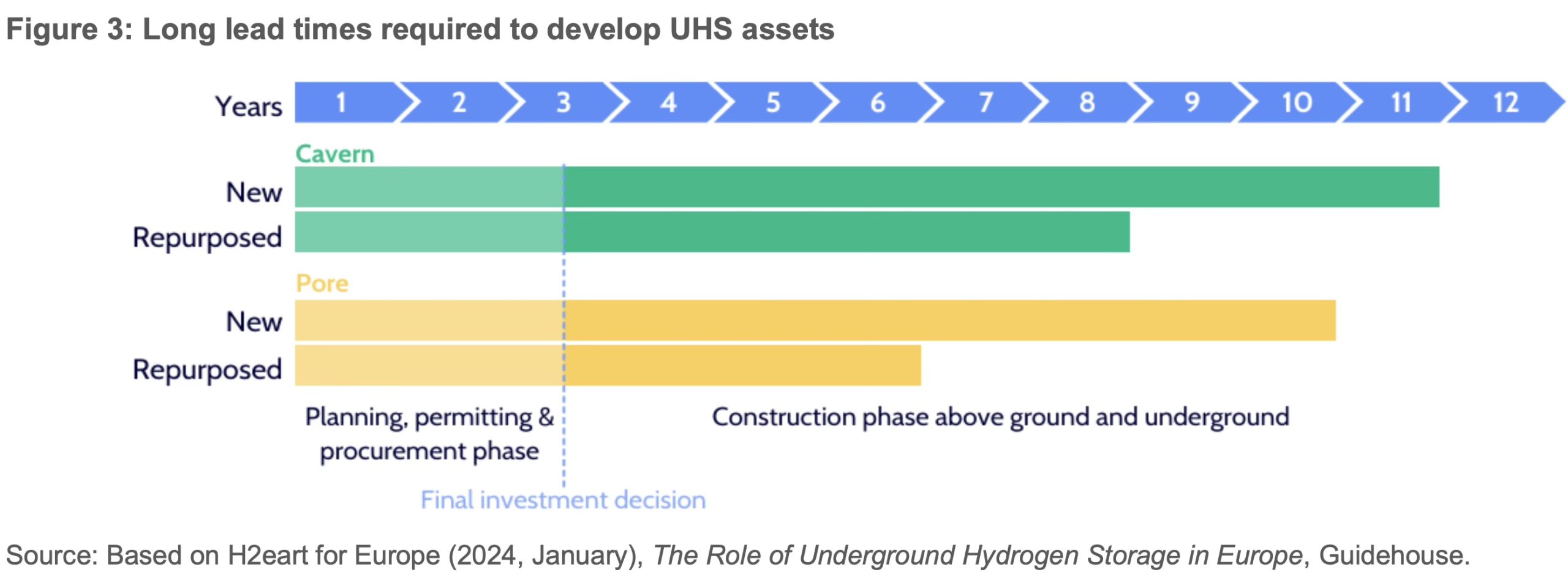
System stress is already increasing gas-to-power call-on, reinforcing the need to better align underground storage with the dynamics of a renewables-based power system. While the conversion of existing UGS sites will play an important role, it will need to be complemented by the timely development of new UHS capacities in order to meet the storage volumes implied by a future hydrogen system and keep pace with tightening markets.
Conclusion
Underground hydrogen storage is not a peripheral option, but essential energy infrastructure. Just as UGS underpins today’s system reliability and price stability, UHS will be critical to keeping a low-carbon energy system secure, affordable, and resilient. By enabling renewable electricity to be stored and redeployed across time horizons—from short-term balancing to seasonal adequacy—it supports a truly integrated energy system linking electricity, gas, and hydrogen, while reducing reliance on carbon-intensive backup and avoiding inefficient over-investment elsewhere.
Evidence shows that this system value can be delivered at relatively low cost, with levelized storage cost typically in the range of €0.2–0.4/kg of hydrogen consumed. This makes UHS an economically manageable component of the hydrogen value chain. However, these benefits will only materialize if key investment barriers are addressed through targeted de-risking and credible demand signals. Above all, UHS must be developed ahead of need, not in response to system stress. Early deployment is a strategic choice to reduce future costs, limit system vulnerabilities, and strengthen the resilience of Europe’s clean energy system.
Access the forum here
