

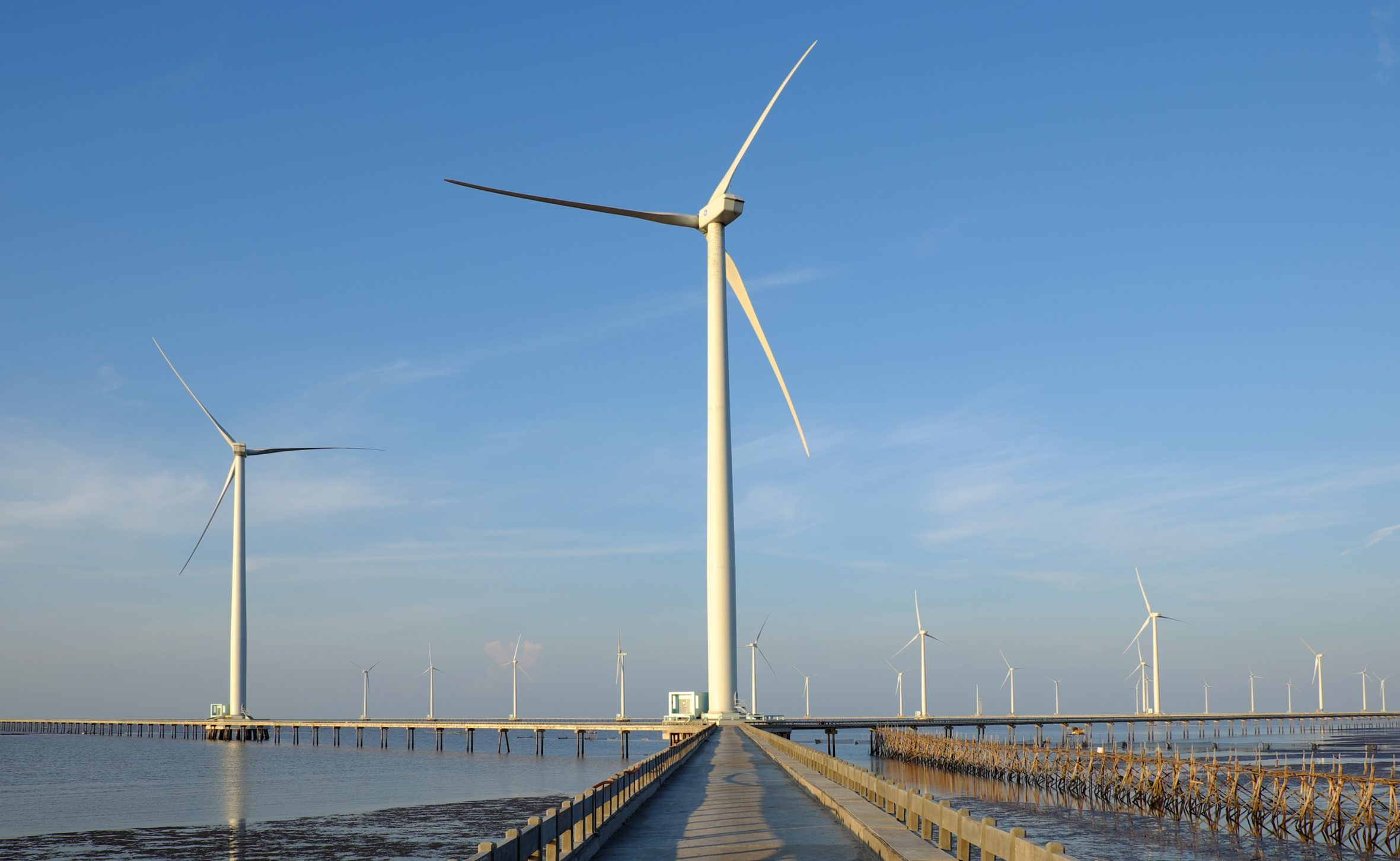
 India has primarily focused on onshore wind energy. As the country looks to expand renewable energy capacity, offshore wind is emerging as a new area of opportunity. With a long coastline and significant wind potential, India is preparing for the development of its first offshore wind projects. However, offshore turbines require specialised components that can withstand harsh marine conditions and operate reliably over long periods. The development of an offshore wind industry will, therefore, require capabilities across turbine manufacturing, foundations, subsea cabling, corrosion protection, digital systems and marine infrastructure. Renewable Watch provides an overview of the key components that comprise an offshore wind turbine…
Rotor and blades
The rotor and blades are among the most visible parts of a wind turbine. Offshore turbines use much larger blades than onshore machines. The offshore blades can be around 100-120 m long, compared to 50-70 m for onshore turbines. Larger blades allow turbines to sweep a wider area and capture more energy from the stronger and more consistent winds available at sea. However, their size also creates challenges related to manufacturing, transportation and installation. Offshore blades are generally made using glass-fibre or carbon-fibre-reinforced composites. These materials provide the required strength while keeping the blades relatively light. The blades must also withstand repeated bending and other loads over more than 25 years of operation.
The scale of offshore turbines has increased significantly in recent years. GE Vernova’s Haliade-X has a 220-m rotor with 107-m blades and is available in ratings ranging from 12-15 MW. Vestas’ V236-15.0 MW turbine has a rotor diameter of 236 m. Siemens Gamesa’s SG 14-236 DD is also in a similar class. China has pushed turbine sizes further, with Goldwind and China Three Gorges commissioning a 20 MW turbine off Fujian in 2024. The increasing size of blades has also created a need for specialised installation vessels and cranes. As a result, manufacturers are exploring modular and segmented blade designs that can be produced in sections and assembled closer to ports. Recyclable resin systems are also being explored to address blade disposal at the end of their operating life.
Nacelles
The nacelle is located at the top of the tower and houses the turbine’s main mechanical and electrical systems. These include the drivetrain, generator, gearbox (in geared turbines), main bearing, yaw system and control electronics. Offshore nacelles need additional protection because they are exposed to salt-laden air and high humidity. They are, therfore, sealed and pressurised and increasingly equipped with cooling and dehumidification systems.
Reliability is particularly important in offshore because repairing a major component can require specialised vessels and take considerable time. This has increased interest in direct-drive and hybrid-drive generator technologies. Direct-drive systems eliminate the gearbox, while hybrid-drive systems simplify it. Reducing the number of moving parts can help lower the number of potential failure points and improve reliability. GE Vernova’s Haliade-X uses a direct-drive nacelle. The turbine is being deployed at the 3.6 GW Dogger Bank Wind Farm in the UK, where 277 units are being installed across three phases.
Towers
The tower supports the nacelle and rotor and transfers their weight and loads to the foundation. Offshore towers have to withstand not only wind loads but also forces resulting from waves and currents. These towers are generally taller and stronger than onshore towers and are made from rolled and welded steel sections. They also require specialised anti-corrosion coatings to protect them from continuous exposure to salt spray. New designs include tapered and segmented towers that can make transportation and installation easier. Hybrid steel-concrete towers are another emerging option, particularly for projects requiring greater hub heights. Such designs can potentially reduce the amount of steel required.
Foundations
Foundations are one of the key areas where offshore wind differs from onshore wind. They support the turbine and must withstand the combined effects of wind, waves and currents. The choice of foundation depends mainly on water depth and seabed conditions.
- Monopiles: These are large steel cylinders driven into the seabed. They are widely used in relatively shallow waters of up to around 30 to 40 metres and account for a large share of installed offshore wind capacity.
- Jacket foundations: These are lattice steel structures similar to those used in the oil and gas industry. They provide greater stability in somewhat deeper waters and under higher wave loads.
- Gravity-based foundations: These use large concrete or steel structures that sit on the seabed under their own weight. They can be used at sites with suitable soil conditions and can avoid the need for pile driving.
- Floating foundations: These are being developed for deeper waters where fixed foundations become less economical. These include semi-submersible platforms, spar buoys and tension-leg platforms. Floating wind can be particularly relevant in areas where water depth increases rapidly away from the coast.
Floating wind has already been demonstrated through projects such as Equinor’s 30 MW Hywind Scotland. The project uses five 6 MW turbines mounted on steel spar-buoy structures and held in position through a three-line mooring system. Equinor has subsequently developed Hywind Tampen in the Norwegian North Sea and is pursuing other floating wind projects. For India, foundation technology will need to reflect local conditions. Parts of the Tamil Nadu coast have relatively shallow waters that could support monopile-based projects, while deeper waters off parts of Gujarat and Maharashtra could eventually require floating solutions.
Mooring systems
Mooring systems are an important component of floating offshore wind turbines. Unlike fixed foundations, floating platforms are connected to the seabed through mooring lines and anchors. Mooring systems can use chains, synthetic ropes or combinations of wires and chains. The lines can be secured using different types of anchors, including drag-embedment anchors, suction piles and gravity anchors. The system needs to keep the floating turbine in position while also providing enough flexibility to absorb the forces created by waves. Mooring technology is still an active area of development globally. For India, developing capabilities in this area could become important as floating offshore wind projects are considered for deeper waters.
Yaw and pitch systems
Yaw and pitch systems help the turbine operate efficiently and safely. The yaw system rotates the nacelle so that the rotor remains aligned with the wind. The pitch system changes the angle of individual blades to optimise energy generation. It can also move the blades into a safer position during high winds to protect the turbine.
Offshore turbines operate in strong and variable wind conditions, making reliable yaw and pitch systems particularly important. Increasingly, these systems are being supported by predictive control software that uses real-time weather information, including data on waves and swells, to adjust turbine operation.
Subsea cables and substations
Generating electricity offshore is only the first step. The power must then be transmitted to the onshore grid. This is done through inter-array cables, export cables and offshore substations. Inter-array cables connect individual turbines and carry the electricity to an offshore substation. The substation increases the voltage before electricity is transmitted to shore through export cables. These export cables can use alternating current or, for longer transmission distances, high-voltage direct current (HVDC).
Subsea cables face several challenges. They are exposed to mechanical stress from currents and can be damaged by activities such as fishing and anchoring. Laying and burying cables across the seabed also requires specialised equipment and careful planning. Cable failures can be expensive to repair, making cable reliability an important consideration for offshore projects. Current innovation includes dynamic cables for floating wind turbines, improved cable burial and monitoring systems and modular offshore substations. HVDC technology is also becoming increasingly relevant for large projects located far from the shore. The 2.9 GW East Anglia Hub in the UK is an example where offshore power is converted from AC to DC for transmission to shore and then converted back to AC for connection to the grid.
Corrosion protection and marine coatings
Corrosion protection is another important part of offshore wind development. Towers, foundations and substations are continuously exposed to saltwater and humid marine air, which can accelerate corrosion of steel structures. Offshore wind components, therefore, use protective coatings and cathodic protection systems. Cathodic protection can involve sacrificial anodes or impressed current systems to reduce corrosion. Corrosion-resistant alloys are also being increasingly considered. India’s coastal conditions, including its tropical climate and exposure to cyclones, make corrosion protection particularly relevant for offshore wind projects. Developing suitable coatings and corrosion management systems could, therefore, be an important area for domestic manufacturing and research.
Control and condition monitoring
Maintenance is more difficult and expensive for offshore components compared to onshore. Turbines are, therefore, equipped with sensors that continuously monitor parameters such as vibration, temperature, oil condition and structural strain. The information is collected through supervisory control and data acquisition systems and can also be analysed using artificial intelligence-based predictive maintenance platforms. These systems can identify signs of component wear before they result in a major failure. For India, developing these digital capabilities alongside physical manufacturing will be important. Effective condition monitoring can help reduce unplanned downtime and improve the operation of offshore assets.
Building a domestic component ecosystem
India’s offshore wind sector is still at an early stage. The government’s viability gap funding scheme, along with plans for upgrading port infrastructure and transmission infrastructure, is expected to support the development of the sector. The experience of countries such as the UK, Germany, Denmark and China shows the importance of developing local component manufacturing. For India, building these capabilities early could support the creation of a wider offshore wind value chain. As the country moves towards its first offshore wind projects, Indian manufacturers will also need to address stark gaps in the availability of offshore wind turbine components and specialised vessels required for project development. This will require greater focus on research and development, along with strengthening engineering, design and manufacturing capabilities, to build a competitive domestic offshore wind component ecosystem.
