By Sakshi Bansal
Solar engineering, procurement and construction (EPC) companies play a pivotal role in driving India’s energy transition. They provide end-to-end solutions – from designing and procuring quality components to constructing and commissioning solar projects – ensuring timely and cost-effective execution. With India targeting 280 GW of solar capacity by 2030, solar EPC firms will be crucial in scaling up utility-scale and distributed solar projects. Their expertise in optimising layouts, integrating advanced technologies, and ensuring compliance with safety and regulatory standards enhances project efficiency and reliability. By bridging the gap between developers, investors and technology providers, solar EPCs help strengthen India’s solar energy ecosystem.
Renewable Watch provides an overview of the solar EPC market in India – recent trends, auctions, key challenges and the way forward…
Recent solar EPC auctions
India’s solar energy sector has witnessed significant growth, with multiple solar EPC projects awarded since January 2025 across rooftop, PM-KUSUM and utility-scale categories in various states.
The accompanying table summarises recent key auctions conducted by both private and government entities over the past seven months. According to the list, Waaree Renewable Technologies secured the largest project (300 MW in Rajasthan) from Purvah Green, while Solarium Green Energy won the smallest capacity (3,319 kW and 3,443 kW at various sites in the north-eastern states). Waaree Renewable Technologies also placed the lowest bid, at Rs 12 million per MW for its 300 MW project, while Hetvi Construction’s bid was the highest at Rs 59 million per MW for its 125 MW solar project in Assam.
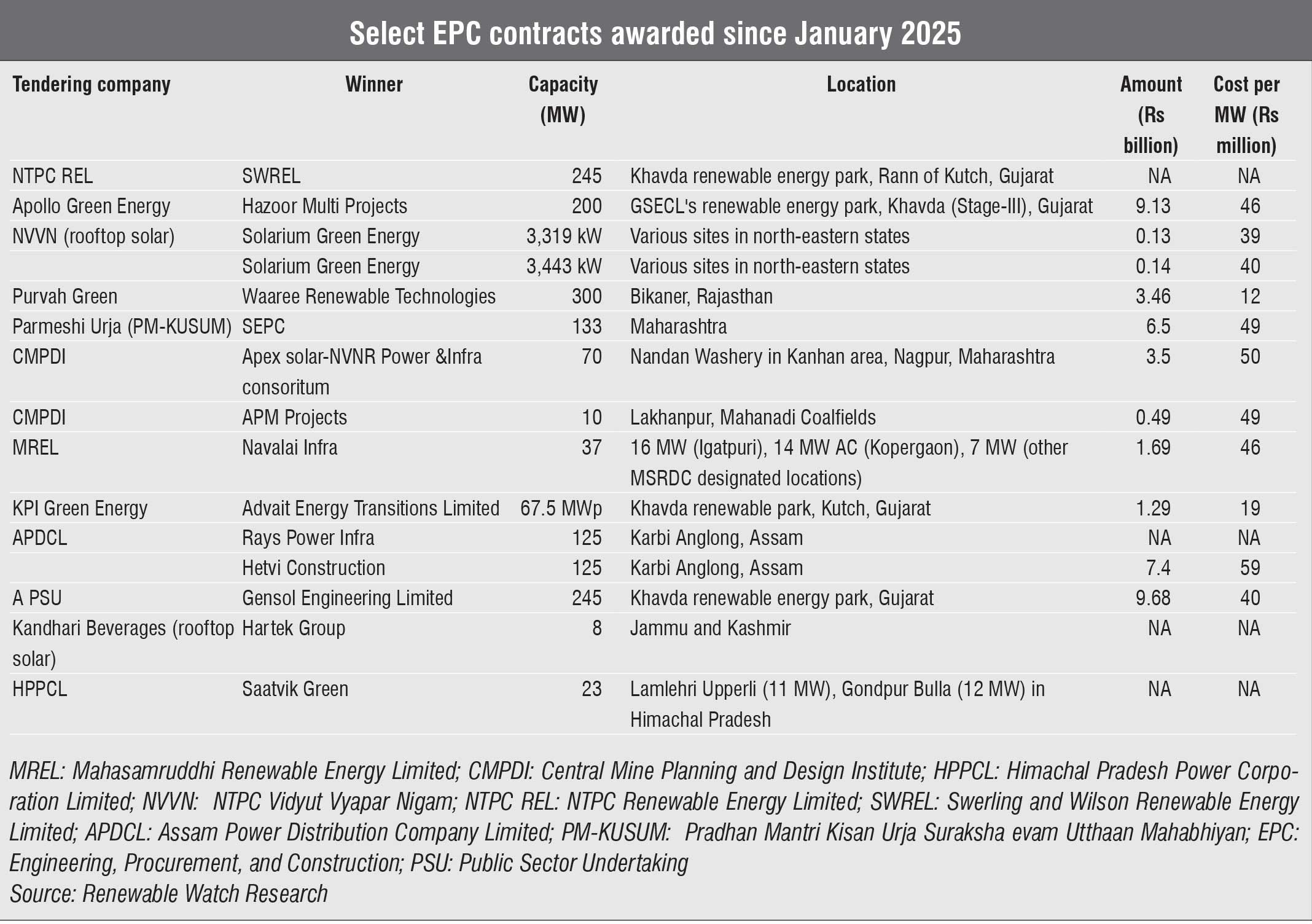
Notably, the PM-KUSUM project for 133 MW was awarded to SEPC in Maharashtra at Rs 49 million per MW, higher than the rooftop EPC projects secured by Solarium Green Energy at Rs 39 million per MW and Rs 40 million per MW. This is unusual as rooftop solar projects typically have higher EPC costs than PM-KUSUM projects. The elevated pricing can be attributed to the distributed nature of PM-KUSUM installations across rural sites, integration with solar pumps and civil works, and longer operations and maintenance commitments included in the EPC scope.
Overall, the auction data reveals a wide variation in per MW EPC pricing – from large, low-cost utility projects that benefit from scale to mid-sized projects with significantly higher costs. The differences are due to project location, scale, technology type, tender requirements (for instance, exclusion of module procurement can reduce the per MW cost) and scheme-specific requirements.
Meanwhile, the market is moving towards larger, more complex projects that integrate advanced technologies such as battery storage. A notable example is Larsen & Toubro’s renewables unit, which recently won Bihar State Power Generation Company Limited’s EPC contract for a 116 MWAC grid-connected solar PV plant integrated with a 241 MWh battery energy storage system in Kajra, Lakhisarai district, Bihar. Valued at Rs 10.64 billion, the project is scheduled for completion within 18 months and reflects the growing convergence of solar generation with storage to enhance grid stability and reliability.
Challenges
Despite the promising growth, the solar EPC market faces several challenges. Land acquisition remains a key bottleneck, often slowed by bureaucratic delays, cumbersome approval processes, non-digitised land records, fragmented ownership and inflated prices once acquisition plans become public. These factors make project execution more complex, with delays particularly acute for large-scale solar developments.
Another significant hurdle is regulatory complexity and policy inconsistency across regions. Solar projects are required to comply with a wide range of local, state and national regulations, which vary widely across regions. For EPC firms, managing this fragmented regulatory landscape can be both time-consuming and expensive, particularly in regions with unstable or unclear energy policies. Securing financing also remains difficult, especially for emerging technologies, where investors remain cautious about returns.
Another issue is the shortage of skilled labour. Although material prices have declined, the limited pool of adequately skilled workforce capable of efficiently designing and installing solar power systems often leads to significant project delays and higher labour expenses.
For Indian solar EPC players, supply chain disruptions are another persistent concern. Delays in sourcing critical components, particularly in import-dependent segments, often lead to project slowdowns, cost escalations and execution inefficiencies. Frequent changes in the Approved List of Models and Manufacturers (ALMM) have directly impacted module and project pricing. In addition, the extension of ALMM to solar cells is expected to add complexity to cost forecasting and project planning.
Solar EPC companies in India face unique challenges in executing floating, canal-top and canal-bank solar projects despite their land-saving advantages. Floating solar requires specialised pontoons, anchoring and waterproof cabling, raising costs and demanding advanced engineering skills. Meanwhile, canal-top and canal-bank projects require complex civil structures, safety clearances and integration with irrigation infrastructure, increasing timelines and risks. Limited domestic experience, higher upfront capital needs, and additional maintenance requirements add to execution hurdles. Moreover, tender designs often underestimate site-specific challenges, placing added responsibility on EPC players to innovate while balancing cost efficiency and long-term reliability.
Solar pumps, solar street lights and other off-grid solar applications are spread across remote, rural locations, making logistics, installation and after-sales service difficult and expensive. Dependence on government subsidy schemes delays fund disbursals and impacts cash flows for EPC players. Inconsistent product quality, lack of standardization, limited awareness among end-users and inadequate local technical support further complicate adoption and maintenance. These challenges impact scalability and discourage private investment, despite the strong potential of off-grid solar solutions.
The way forward
Going forward, the solar EPC market is expected to expand steadily, driven by a strong project pipeline, ambitious capacity targets, technological advancements and supportive policy measures. To fully capitalise on these opportunities, EPC-related challenges must be addressed. Key priorities include streamlining approval processes, strengthening supply chain resilience, building a skilled workforce and promoting standardisation in project execution. Enhancing local manufacturing capabilities for key components, fostering innovation through research and development incentives and encouraging long-term financing models will also be crucial. By addressing these structural and operational hurdles, the solar EPC industry can accelerate project deployment, improve profitability, and play a pivotal role in advancing India’s clean energy transition.