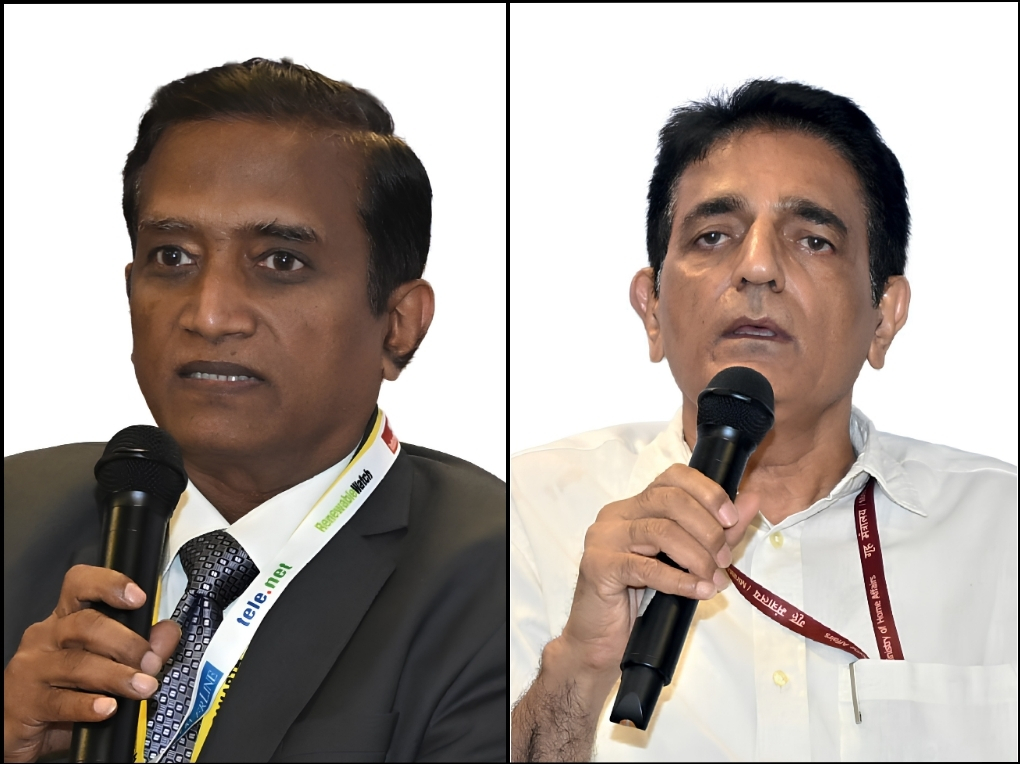
 At Renewable Watch’s “Compressed Biogas in India” conference, the session on the role of biomass co-firing and compressed biogas (CBG) uptake in reducing air pollution in Delhi-NCR examined the progress of biomass utilisation in thermal power plants, the challenges in meeting co-firing targets and the need to strengthen biomass aggregation and supply chains. Ravi Prakash Agrawal, Mission Director, SAMARTH, Ministry of Power (MoP) and Dr Virinder Sharma, Member (Technical), Commission for Air Quality Management (CAQM), discussed policy developments, biomass availability, co-firing trends, environmental compensation and the way forward. Edited excerpts…
Strengthening biomass utilisation
The Sustainable Agrarian Mission on use of Agri-Residue in Thermal Power Plants (SAMARTH) was initiated in the context of the air quality problem in the NCR region, particularly during the months of October, November and part of December, when stagnant atmospheric conditions can cause pollutants from stubble burning to accumulate. The mission was formally constituted by the MoP in July 2021, building on earlier policy initiatives for biomass use in thermal power plants. Its objectives include addressing air pollution from farm stubble burning, reducing the carbon footprint of thermal power generation and creating an appropriate market mechanism for biomass-to-power utilisation.
A study commissioned by the MoP and undertaken by the Asian Institute of Scientific Research indicates a total biomass generation of around 903 million metric tonnes (mmt) in India, of which approximately 206 mmt is estimated to be surplus and available for utilisation. The assessment covered 62 districts and involved primary and secondary surveys, interactions with around 2,600 farmers and 250 stakeholders. However, the availability of biomass does not automatically translate into availability at the plant level. With CBG and pellet plants being established across the country, there is currently no comprehensive agency-level record of how much agricultural residue is available, how much is being aggregated and how much is being committed to different end-uses.
Evolution of the co-firing policy
The MoP issued an advisory on biomass pellet consumption in power plants in 2017. The National Mission on Use of Biomass in Thermal Power Plants was subsequently constituted in July 2021, followed by the revised biomass policy in October 2021, which mandated 5 per cent biomass pellet co-firing for 2024-25 and 7 per cent for 2025-26 in coal-based thermal power plants. Bamboo and its by-products were subsequently included as eligible biomass feedstock in May 2023. The modified policy issued in June 2023 also differentiated between torrefied and non-torrefied pellets based on the requirements of different mills. Biomass energy has been recognised as renewable energy eligible for renewable purchase obligation compliance. The policy also provided for the additional cost of biomass co-firing to be included in the energy charge and passed through to consumers.
The Comprehensive Policy for Biomass and Torrefied MSW Co-firing in Coal Based Thermal Power Plants, introduced in 2025, further expanded the framework. For thermal power plants in the NCR, a minimum 5 per cent biomass pellet blend is mandated, effective 2025-26, with an additional 2 per cent blend that can comprise biomass- or municipal solid waste (MSW)-based charcoal. For the rest of India, a blend of up to 5 per cent biomass and/or MSW charcoal is permitted. The policy is intended to reduce stubble burning and greenhouse gas emissions while strengthening the biomass supply chain, utilising agricultural residue and MSW, supporting the Swachh Bharat Mission and generating additional income for farmers.
Co-firing progress and supply constraints
The NCR has emerged as the main centre of biomass co-firing. Cumulative biomass pellet usage by NCR thermal power plants reached 4.38 million tonnes (mt) by June 15, 2026. During 2025-26, these plants utilised about 2.16 mt, compared to 1.3 mt in 2024-25. Average biomass co-firing increased from 2.6 per cent in 2024-25 to 4.61 per cent in 2025-26. In 2026-27, the average had reached 5.28 per cent by June 15, 2026, based on usage of approximately 634,271 tonnes. The seasonal nature of agricultural residue remains an important operational constraint. A large proportion of the biomass being used is non-torrefied, making it vulnerable to moisture during the monsoon. Co-firing therefore tends to decline during July-September before increasing again after the harvest season.
Across India, 75 thermal power plants have used biomass pellets at least once, including 22 NTPC Limited plants and 53 plants belonging to other groups. Cumulative biomass usage across these plants stood at about 6.10 mt as of June 15, 2026, of which 4.38 mt had been used in NCR. The relatively lower uptake elsewhere reflects the higher cost of biomass pellets compared to coal, additional handling requirements and the absence of the environmental compensation mechanism applicable in NCR.
Pellet manufacturing capacity in NCR has also expanded substantially. Rated capacity increased significantly between April 2025 and May 2026, with non-torrefied capacity accounting for the larger share. At 80 per cent capacity utilisation, torrefied pellet manufacturing capacity was estimated at about 3,057 tonnes per day (tpd), against a requirement of approximately 3,371 tpd if the full 7 per cent co-firing level were to be achieved, representing a torrefied pellet availability of 91 per cent. However, only four plants have so far opted to use torrefied pellets, keeping demand for this segment relatively low.
Compliance, compensation and implementation gaps
Environmental compensation has been an important component of the NCR framework. Under the Environment (Utilisation of Crop Residue by Thermal Power Plants) Rules, NCR thermal power plants are required to maintain the prescribed biomass blend, with environmental compensation imposed for non-compliance. For 2024-25, the minimum requirement was 3 per cent, increasing to 5 per cent from 2025-26. The compensation rate rises as the level of biomass utilisation falls. During 2024-25, around Rs 610 million in environmental compensation was imposed. In 2025-26, seven of the 11 plants that undertook co-firing achieved their targets, although several plants continued to face constraints.
The implementation gaps extend beyond generation capacity. Complete aggregation of agricultural residue has not yet been achieved, meaning that stubble is still being burned even when thermal power plants are meeting part of their co-firing requirements. Data on biomass aggregation hubs is also unavailable, making it difficult to assess how much residue is actually being collected and from where. Other challenges include inconsistent biomass quality, needing to be addressed via Bureau of Indian Standards certifications; delays in tendering and contract finalisation; and significant seasonal variation in raw biomass prices. The aggregation of agricultural residue therefore needs to be developed as a regulated sector. Aggregators could be registered, assigned defined catchment areas and made responsible for collecting available biomass within those areas. They could also be provided with appropriate storage facilities and machinery.
Linking co-firing with CBG and circularity
The available biomass resource is significantly larger than the current thermal power sector requirement. This indicates that even if power plants meet their mandated targets, significant quantities of residue could remain available for CBG and other applications. However, simply converting stubble into pellets and co-firing them does not capture the full value of the resource. Greater emphasis is therefore being placed on torrefaction and other conversion pathways that can produce additional products and improve circularity. Torrefaction is more expensive at present, creating a dilemma: demand needs to increase to bring down costs, while lower costs are needed to create demand.
CAQM is pursuing a two-track approach to residue management, comprising in-situ and ex-situ measures. The ex-situ pathway includes pelletisation and co-firing, while the in-situ approach involves machinery and field-level interventions supported by the Ministry of Agriculture and Farmers Welfare (MoAFN). Future thermal plants may have greater scope to adopt torrefied pellets, while existing plants are constrained by boiler configurations. Two new plants in Uttar Pradesh are expected to use torrefied pellets, increasing the number of relevant plants from 11 to 14. The same value-chain approach can extend beyond thermal power plants.
Building institutional coordination
Environmental compensation remains an important deterrent, but penalties alone cannot provide a long-term solution. A committee comprising the MoP, Central Pollution Control Board (CPCB) and CAQM is examining cases where plants have not met targets despite efforts. However, the committee has found that inadequate advance procurement and poor sequencing of pellet availability were important factors in several cases, over pellet availability alone. The progress in NCR has been supported by coordination between CAQM, the MoP, the MoAFW, the Ministry of Petroleum and Natural Gas, the Ministry of New and Renewable Energy, and the CPCB. CAQM has also been directly involved in action plans covering Punjab, Haryana and the NCR areas of Uttar Pradesh. Regular visits to the 12 NCR plants have been conducted to identify operational bottlenecks and work with state governments on corrective measures. n
Based on a presentation delivered at Renewable Watch’s “Compressed Biogas in India” conference