By Sarthak Takyar
It is important to look back at past events and learn from them in order take positive strides forward. With the beginning of the new year, we decided to revisit Renewable Watch’s cover stories from the past year, to get a perspective on the events gone by, examine the key issues that dominated the sector, and identify the priority areas for the future. In this article, we present our key takeaways and outline the topics we would like to explore in the coming issues as well as the questions we hope to address…
Renewable capacity additions and current status
We began 2024 with a cover story titled, “The Road Ahead: Review of 2023 and the way forward for 2024”. It took stock of the capacity additions across different renewable energy segments in 2023 and the key trends expected to emerge in the coming years. While the performance in 2023 was impressive, it was even more stellar in 2024, in terms of renewable energy capacity additions. The past year witnessed record-breaking additions of 24.5 GW in solar capacity and 3.4 GW in wind capacity, marking a more than twofold increase in solar installations compared to 2023. Solar energy led the renewable energy expansion, contributing 47 per cent of the total installed renewable energy capacity. Utility-scale solar installations grew by 18.5 GW, an increase of 2.8 times from 2023, with Rajasthan, Gujarat and Tamil Nadu contributing 71 per cent to the total utility-scale solar capacity.
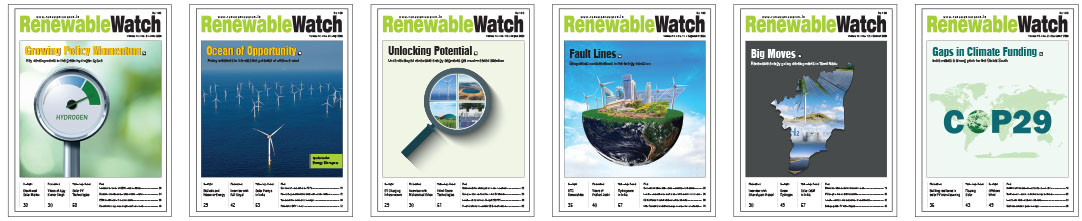
The rooftop solar segment also saw significant expansion, with 4.59 GW of new capacity added in 2024, reflecting a 53 per cent growth over the previous year. In this space, the PM Surya Ghar: Muft Bijli Yojana, launched in February 2024, played a pivotal role, enabling 700,000 rooftop solar installations in just 10 months. Off-grid solar installations grew by 182 per cent, with an addition of 1.48 GW in 2024, further advancing energy access in rural areas. The residential rooftop solar segment received special attention, and we highlighted the policy initiatives in this space in Renewable Watch’s August 2024 cover story titled, “Unlocking Potential: Underdeveloped renewable segments get much-needed attention”.
In the wind energy space, India added 3.4 GW of new capacity in 2024, a 21 per cent increase over 2023, with Gujarat (1,250 MW), Karnataka (1,135 MW) and Tamil Nadu (980 MW) leading the additions. These states accounted for 98 per cent of the new wind capacity. Although India does not currently have any installed offshore wind capacity, we covered the segment in July 2024, in light of the growing attention being given to it and the strong government push to the segment with the announcement of the viability gap funding scheme.
Meanwhile, the bioenergy and small-hydro sectors witnessed tepid growth in capacity in the past year. Small-hydro capacity increased from 4.99 GW in 2023 to 5.1 GW in 2024, representing an increase of only 2.2 per cent. Meanwhile, bioenergy capacity rose from 10.84 GW in December 2023 to 11.35 GW in December 2024, reflecting a 4.7 per cent increase. As of November 30, 2024, 80 compressed biogas (CBG) plants had been commissioned while 72 CBG plants are at various stages of construction. The CBG segment gained significant attention with key policy initiatives focusing on the injection of CBG in the city gas distribution network and blending obligations for CBG in compressed natural gas and piped natural gas. Consequently, we dedicated our April 2024 cover story to
this segment.
As we enter 2025, the country’s total installed renewable capacity has reached 209.44 GW, with 97.86 GW of solar, 48.16 GW of wind, 46.97 GW of large hydro, 11.35 GW of biopower and 5.1 GW of small-hydro. In these pages, we will analyse how the country can accelerate its capacity additions to achieve 50 per cent of the total electricity generation from non-fossil fuel sources by 2030.

Increased focus on RTC renewables
One of the key trends highlighted in several cover stories over the years is the rise of round-the-clock (RTC) renewable energy as a critical energy source, on par with thermal, hydro and nuclear power, for meeting baseload requirements. Thus, the cover story of the February 2024 issue titled, “Transition Time: Navigating the shift from standalone renewables to RTC renewables”, delved into the policy implications for RTC renewables and the challenges faced by different stakeholders in the transition from standalone to RTC renewables. During the past year, there was an increased focus on the uptake of RTC, firm and despatchable renewable energy (FDRE), and hybrid projects. Over 26 auctions took place in this space in the past year, witnessing a wide range of tariffs. The lowest tariff recorded was Rs 2.99 per kWh in Gujarat Urja Vikas Nigam Limited’s 500 MW wind-solar hybrid auction, which was conducted in January 2024. Meanwhile, the highest tariff of Rs 5.59 per kWh was observed in Solar Energy Corporation of India Limited’s Tranche II 1,500 MW FDRE auction (March 2024).
While the momentum in tendering activity is commendable, the transition to RTC renewables faces several challenges. The high cost of energy storage implies that its use will be minimal, with a primary focus on renewables and thermal power in RTC tenders. As a result, oversized renewable energy plants are being developed to meet RTC demands. Since the plants are set up at multiple locations, ensuring transmission connectivity becomes a hurdle. Going forward, supply chain disruptions, duties and taxes on solar components, and an increase in input costs may increase the cost of solar and renewable energy projects. This raises concerns about the willingness of discoms to purchase RTC power to meet their peak power demand, especially as they are obligated to pay fixed costs for thermal power. The issue of expensive RTC power persists, as the cost of storage technologies has not reduced as anticipated. In addition, there are concerns regarding the complicated nature of rules and provisions for RTC tenders, making developers’ tasks tedious and subject to stringent penalties, particularly as they are already struggling with accurate forecasting and scheduling. The cover story ended with several questions that need to be considered going forward. In scenarios where RTC renewables are cheaper than other sources, should the must-run status of renewables be re-evaluated? If the uptake of RTC renewables for meeting baseload needs proves to be costly and complicated, can policymakers consider promoting nuclear power as an alternative clean baseload option? In addition, if RTC renewables, including storage, are consistently priced lower than RTC conventional power, do stringent renewable purchase obligations remain relevant? Will they become the default choice for discoms? We hope to answer these questions in the cover stories of 2025. However, the issue of RPO compliance, the reasons for the lack of adherence, and the future relevance of the policy were analysed in detail in the following month’s (March 2024) cover story, “Missed Targets: Low RPO compliance calls for a policy relook”.
Geopolitics of renewable energy
With growing global complexities, the geopolitics surrounding renewable energy piqued our interest, and we dedicated two cover stories to this topic in the past year.
In the May 2024 cover story, “Securing Critical Minerals: Geopolitical dynamics and implications for India”, the escalating geopolitical tensions surrounding critical minerals were examined. These tensions are driven by two key factors – first, the limited supply volume relative to the demand forecast, and second, the concentrated supply in select countries, raising concerns for countries like India with ambitious renewable energy targets.
To put things in perspective, the demand for critical materials is expected to more than triple by 2030. However, the lack of strong measures to enhance material efficiency, recycling and mined supply could result in significant supply shortages (an average of 20 per cent by 2030) for six materials crucial for the energy transition – cobalt, copper, graphite, lithium, neodymium and nickel.
As per the World Economic Forum, the top three producers of these six critical materials dominate 50-90 per cent of mining and processing operations. This is a point of concern. For context, the Organisation of the Petroleum Exporting Countries accounts for just 40 per cent of global oil production, yet it sparks much more concern regarding its influence over global oil supplies and prices.
Policies by various countries aimed at securing a monopolistic position have also led to geopolitical tensions among nations competing for better access to minerals. For instance, China uses its geopolitical power to secure supplies by implementing robust policies targeted at maintaining stable supplies across Chinese industries.
The story further noted that, in such a landscape, India needs to invest heavily in mineral exploration, develop resilient and diversified supply chains, gradually reduce its reliance on imports, forge trade agreements and acquire mining assets abroad. Further, developing mineral and metal recycling facilities will help reduce the need for mining large quantities.
In the September 2024 issue, the cover story, “Fault Lines: Geopolitical considerations in the energy transition”, revisited this dilemma, reiterating how despite the far-reaching consequences of deviating from the global energy transition, the wide-ranging geopolitical threats have received less attention. It further explored several ongoing risks, including trade protectionism, physical threats to power infrastructure, digital and cybersecurity threats to power projects and the power grid, the race among countries to secure the supply of critical minerals needed for the energy transition, and differing political ideologies across countries that hinder progress in the energy transition.
The story also covered India’s response to these threats. For instance, amid these concerns, the Indian government intensified its focus on increasing the mining of critical minerals in the country, securing overseas supplies and ensuring a stable supply chain, thereby minimising geopolitical risks in this space. To ensure the domestic supply and manufacture of components using critical minerals, the centre has resorted to tariff barriers; non-tariff barriers in the form of the Approved List of Models and Manufacturers (whose scope has now been extended to include solar cells); and subsidies in the form of production-linked incentives. In Union Budget 2024-25, the government also proposed establishing a Critical Mineral Mission aimed at boosting domestic production, recycling critical minerals and acquiring critical mineral assets overseas.
The issue also highlighted the importance of developing a more nuanced understanding of the interplay between political ideologies, public opinion and environmental policy implementation. Geopolitics surrounding renewable energy is expected to become more interesting, especially with the new US president signing an executive order withdrawing the country – for the second time – from the Paris climate agreement.
From COP28 and COP29 to COP30
Our focus on global geopolitics included a critique of the COPs, highlighting the major announcements as well as the key shortcomings, especially from India’s perspective.
Back in December 2023, the cover story, “Promises and Pledges: COP28 reaches a consensus but falls short of expectations”, examined the key aspects of COP28. Despite initial controversies, the conference achieved notable outcomes, although it fell short of expectations. The summit produced the significant UAE Consensus, which included the first-ever Global Stocktake and the decision to “transition away” from fossil fuels. However, the issue of climate finance remained unresolved. The problem of acute finance gaps was even more prominent at COP29, where India categorically stated its concerns about the widening gap. The story on COP29 made note of India’s bold statements and unequivocal stance while voicing its concerns at the event. While addressing the long-standing $100 billion annual commitment from developed countries, India criticised the delay and insufficiency of funds mobilised, noting that they fell significantly short of the growing needs of developing countries. It further criticised the new $300 billion finance deal as “abysmally poor” and “too little and too distant”, particularly objecting to its inclusion of private funding sources and voluntary contributions from developing countries, denouncing it as “a deflection of the responsibility of developed countries”.
Despite criticisms, COP29 achieved a key victory in the form of an agreement on carbon markets, which several prior COPs had been unable to achieve. India’s strong stance at COP29 can also be deemed a positive development, with many other developing economies pinning their hopes on its leadership. Moving forward, with this mixed bag of developments, it will be interesting to see what the future of climate change diplomacy holds. We look forward to writing another cover story on COP30, which will be held in Belém, Brazil. In the climate space, we hope to extensively cover carbon markets and India’s updated nationally determined contributions, which will be released soon.
Concluding remarks
Renewable Watch will celebrate its 15th anniversary in November 2025. As a lead-up to that special issue, we look forward to bringing to our readers interesting and informative stories that are topical, add value to ongoing discussions, address legacy issues in the sector and provide policy suggestions. We hope you will enjoy reading them as much as we enjoy writing them.