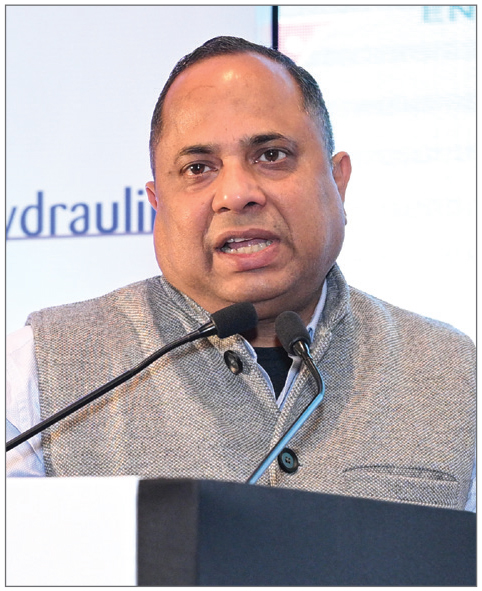
 Hydropower is expected to play a key role in India’s energy transition. To this end, an enabling policy framework for harnessing the country’s hydropower potential, including pumped storage, has been put in place. At Renewable Watch’s recent conference on “Hydropower in India”, Ghanshyam Prasad, Chairperson, Central Electricity Authority (CEA), shared his perspective on various issues, including the potential of pumped storage in India, the comprehensive policy measures being implemented to fast-track projects, new hydropower technologies, growth outlook and opportunities in the segment. Excerpts…
All of us are aware of the energy transition taking place globally, including in India. The world is observing India due to the initiatives we have undertaken, particularly in the power sector, which have accelerated the pace of energy transition.
We have successfully surpassed 200 GW of renewable energy capacity and are now targeting around 500 GW of renewable energy by 2030, 600 GW by 2032 and potentially around 2,000 GW by 2047 or 2050. This will be driven by a combination of various technologies, including solar, wind, storage, hydropower and nuclear.
To achieve these targets, India has made significant commitments to the international community to achieve up to 50 per cent of installed capacity of fossil fuel by 2030. At present, the share has reached around 47 per cent and we will definitely definitely be crossing 50 per cent much before that. India has also committed to achieving net zero emissions by 2070. For the power sector, this target might be accelerated to 2060 or possibly even 2050 with the adoption of new technologies.
While these are significant milestones to aim for, hydro is set to play a much bigger role in this journey. However, its share in the energy basket has declined over the years from a high of 35-40 per cent around 20-25 years ago. With the emphasis on adding more capacity, the focus in early years has shifted to baseload power from coal, and to some extent, gas. Today, we have approximately 217 GW of thermal power capacity, accounting for about 50 per cent of the total installed capacity of 456 GW. In terms of energy consumption, over 70 per cent comes from the thermal segment.
In the past five to six years, capacity addition in hydro, particularly conventional hydro, has been very low. Hydro pumped storage technology has stagnated at around 4.7 GW as of now. Approximately 1.5 GW of this capacity is not operational in the pumping mode due to various reasons. Therefore, the operational pumped storage capacity is at around 3.2 GW.
Over the past two to three years, we have focused on finding ways to accelerate the pace of development, particularly in the hydro pumped storage space.
Initially, the potential of pumped storage was conservatively estimated at around 90 GW, mostly concentrated on the stream side. However, after studying the Purulia pumped storage plant (PSP), which is an off-river closed-loop PSP project, we have further explored the potential of this application. A growing number of industry players are entering this segment. The pipeline of hydro PSP projects is growing every month, with self-identified projects as of now. Approximately 183 GW of potential hydro PSP capacity has already been identified.
This has given confidence to planners, developers and stakeholders in the value chain. From around 4.7 GW, we are now targeting around 50 GW of PSP capacity by 2030, or at the most by 2032. More projects are expected to be added to the pipeline. The first unit of the Tehri PSP has already been synchronised and we expect more projects to be commissioned by 2026-27.
We are yet to explore mine areas that already have reservoirs that could be utilised for pumped storage hydro projects.
The CEA has also given concurrence to six projects with a capacity of around 10 GW. The developers have assured that they will complete these projects in 40-44 months, which is very promising. This includes the Pinnapuram PSP project, which will be commissioned approximately three years from the date of approval.
Enabling policy initiatives
To achieve an accelerated pace of development, several policy measures have been undertaken. The process for granting early excavation permission to developers has been streamlined so that advance action can be taken by them at their own risk and cost to begin work at the site. This is expected to save approximately six to eight months in project execution time.
Approval timelines for appraisal of the detailed project reports (DPRs) have also been reduced. Due to their complex nature, DPRs are required to be submitted for appraisal and clearance from various relevant organisations like CMRS, GSI and CWC. From about 23-24 chapters that were earlier required, developers are now allowed to submit the DPR online after completing the first 12 design chapters. Some chapters have been dispensed with, making the DPR process shorter and more streamlined. Other chapters may be submitted for review as soon as they are prepared.
We have also introduced a process to ensure transparency. After the preparation of DPRs, chapters are uploaded on an online portal, giving clear visibility to developers.
Apart from this, we have received support from the Ministry of Environment, Forest and Climate Change, which has relaxed a number of conditions, particularly in terms of forest clearance and environmental clearances for off-stream closed-loop PSP projects.
These measures have resulted in significant interest in the PSP segment. Compared to other technologies, today, PSP tariffs are particularly lucrative, as seen in the recent bid in Maharashtra. This makes PSPs a highly marketable product for states or discoms looking to secure such power. PSPs also offer significantly longer lifetime compared to chemical batteries, which require replacement every 12-15 years. With all the projects being taken up by central public sector undertakings (PSUs), state PSUs or private players, I believe the future of PSP hydropower development looks promising as we move forward.
On the conventional hydro front, in the Himalayan geology where significant projects are concentrated, there are some unique challenges, due to which development has slowed down. We have been taking measures to improve the pace of development for conventional hydropower projects as well.
A key initiative has been the appointment of independent engineers to resolve cases and disputes between developers and contractors. This has helped in the expeditious elimination of disagreements in a just and fair manner, which earlier used to go to court for arbitration.
Another initiative is the conciliation mechanism through the Conciliation Committees of Independent Experts (CCIE). Three CCEIs have been constituted with a mandate to resolve disputes within a maximum of five hearings and a time limit of 90 days. These committees have been able to successfully resolve many of the disputes referred to them. This has helped in avoiding cost and time overruns in projects.
Around 14,000 MW of conventional hydropower projects are expected to be commissioned by 2030, while a few more are under construction for benefit beyond 2032.
Another promising area we are trying to harness is kinetic hydro turbines. This is still at the inception stage but it is quite promising. Several pilot projects are underway to test its feasibility. Based on a preliminary assessment conducted at our canals, a potential of around 10,000 MW has been identified. We are working to collaborate with some PSUs and private players for proof of concept of this technology. The advantages of this technology are immense, with minimal environmental impact compared to traditional hydropower plants, as there is no need for geological surveys or dam construction. In addition, as these are small turbines located close to rural areas, it eliminates the need to construct long transmission lines often passing through dense forests. The cost of this technology is also very promising and significantly cheaper than conventional hydro.
Another measure undertaken has been to support some of the initial activities to assist developers reach the project site. Budgetary support for constructing enabling infrastructure, such as roads and bridges, is provided at Rs 10 million per MW for projects up to 200 MW, with an additional support of Rs 7.5 million per MW for projects above 200 MW. Provisions have also been made for flood moderation.
Ultimately, our target is to enhance the ease of doing business, ensuring that projects are appraised and approved more quickly; streamline the process for environmental and forest clearances; and simplify access to financial support to tap the immense investment potential of the hydropower sector.