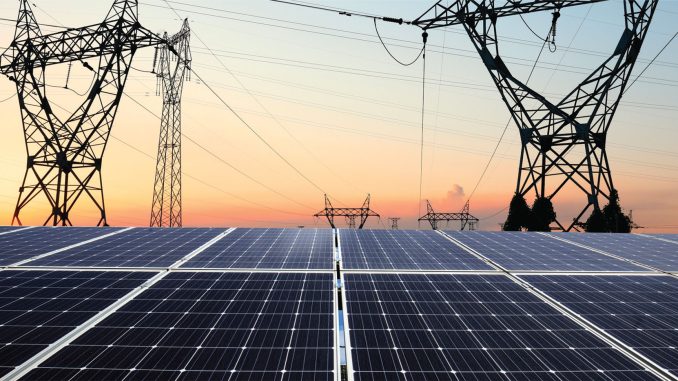
As India moves towards deployment of 500 GW of non-fossil fuel power by 2030, deploying adequate transmission infrastructure is becoming a critical part of the journey. Historically, large solar and wind power projects have faced delays due to inadequate transmission and power evacuation systems. Transmission projects have longer gestation periods than renewable power projects. Further, large renewable power projects have been allocated mostly in regions with ample available land and good resources but sparse populations, located far from major load centres. Thus, a massive transmission expansion is required to bring online the thousands of MWs of renewable installations coming up in remote locations in the country. The country’s transmission infrastructure has grown rapidly over the past few years, with 453,141 ckt. km of transmission lines and 1,059,762 MVA of substation capacity completed as of January 2022. Further, 11,320 ckt. km of transmission lines and 63,794 MVA of substation capacity have been completed in 2021-22. Various technology developments are also taking place in the transmission space including high voltage direct current (HVDC) systems and increasing uptake of digital tools.
This article focuses on the important components of transmission infrastructure, as well as emerging technologies in this segment…
Towers
In India, utilities prefer self-supporting and lightweight lattice transmission line towers. While installation of lattice guyed V transmission towers is quite cost-effective, they may require a larger area. Monopole structures are also being widely used now, as they take less time to erect owing to fewer components.
Other tower types include multicircuit towers and emergency restoration systems (ERSs). Multicircuit towers, as the name suggests, can carry three, four or even six circuits, thus transferring more power over a particular distance. Meanwhile, ERS towers are lightweight, modular, and reusable systems that can quickly bypass permanent transmission towers to act as temporary support after a fault or collapse of the transmission tower. In certain cases, compact delta configuration towers with electrical conductors in an equilateral triangle, and small and light-weight chainette towers consisting of two small masses supported by guy wires and hanging insulators are also used.
Cables and conductors
In the conductor space, advanced solutions such as superconducting transmission lines (SCTLs), gas-insulated lines (GILs) and high temperature low sag (HTLS) lines are slowly gaining traction. SCTLs are non-resistive and compact, and can transmit bulk power at low voltage. GILs, as the name suggests, use gas instead of air as the insulating medium to reduce electrical clearance. HTLS conductors have high temperature resistance and greater ampacity than conventional aluminium conductor steel reinforced and all-aluminium alloy conductors, and as a result, can withstand much higher temperatures.
Meanwhile, underground cables and e-beam cables are becoming popular in the cable space. Other solutions include the use of high surge impedance loading (HSIL) lines and cross-linked polyethylene (XLPE) cables. HSIL lines help increase the power transfer capability by limiting the voltage drop. Meanwhile, XLPE cables are deployed underground in places where overhead construction is not suitable.
Transformers
Advanced transformers have improved core materials, better safety levels, space optimisation, lower costs, reduced failure rates, lower noise levels, adaptability with the smart grid and increased asset life. There are a variety of advanced transformer solutions available today. For instance, smart transformers can regulate voltage independently and allow remote operation, and thus are increasingly being used in digital switchgear. Phase-shifting transformers are used to control active power flow on three-phase networks and improve the stability of grids. HVDC convertor transformers are used to convert alternating current (AC) from power generating units to DC, and then DC back to AC for power consumption.
Other transformer types include energy efficient transformers, ester-filled transformers and dry-type transformers. Energy efficient transformers can be used by utilities to decrease transmission and distribution losses and improve the overall efficiency of transmission systems. Ester-filled transformers use natural esters for liquid insulation of the transformer, which gives them the advantage of being fire resistant. Meanwhile, dry-type transformers are motionless, solid-state devices that have no moving parts, and are a fast emerging technology. In these transformers, the windings with the core are kept within an air-filled, pressurised, sealed tank. They do not need to be kept in fire-resistant vaults and do not emit toxic gasses.
Switchgear and substations
In the substation space, there has been a significant growth in the deployment of gas-insulated substations (GIS) and hybrid substations in place of conventional air-insulated substations. GIS are indoor type, with the equipment being placed inside modules filled with sulphur hexafluoride gas, which acts as the insulating medium. They require substantially less space, have lower maintenance costs and a lower outage rate, and their high cost is compensated by savings on land costs. Meanwhile, hybrid switchgear is a combination of AIS and GIS technologies and is compact, with the AIS functionality integrated in a gas-insulated enclosure. Such a hybrid system helps in achieving a balance between the land cost and the facility cost. Vacuum switchgear, initially used in medium voltage applications where the arc quenching takes place in a vacuum, is now being used for high voltage applications as well due to their compact size and higher reliability.
Like all other aspects of the power sector, digitalisation is increasingly being adopted in switchgear as well for improved performance monitoring, diagnostics and fault rectification. Advanced digital tools help carry out remote real-time monitoring of assets and the data collected can help in analysis to prevent faults and reduce downtime.
Other technology advancements
One of the most critical technology advancements of recent years is the focus on HVDC, which helps transmit electricity over long distances with about 50 per cent less losses than high voltage AC. In addition, digital switchgear and substations with sensors and intelligent electronic devices that help identify, prevent and rectify faults are gaining traction.
Digital tools are not only employed in substations. These days, advanced drones are being used for the inspection and construction of transmission lines, while artificial intelligence-enabled software is being deployed for operations and maintenance. Utilities are now increasingly using digital asset management tools with advanced monitoring and analysis software to improve efficiency.
The way forward
India’s renewable energy ambition relies on timely creation of adequate transmission infrastructure to transport this power from large-scale wind and solar parks, for which intra- and interstate transmission system (ISTS) capacity needs to be ramped up. This, however, is a mammoth task involving many stakeholders, and will take a few years to achieve. The complications in creating large transmission assets for renewable power transport have long been a cause for concern, leading to postponement of bids and deferment of project commissioning. In many cases, developers must wait a long time for clearances and approvals from different agencies, further complicating matters.
The government, on its part, has been trying to resolve some of these issues and has recently launched the second phase of the Green Energy Corridors project to expedite the evacuation of 20 GW of renewable energy from seven states across the country. Further, in October 2021, the Ministry of Power introduced general network access (GNA) under the Electricity (Transmission System Planning, Development and Recovery of Inter-State Transmission Charges) Rules, 2021, to give power sector constituents easier access to the transmission network across the country. GNA is non-discriminatory access to the ISTS provided to a designated interstate customer and granted by the central transmission utility for a maximum injection or drawal for a specific period. These steps will surely help resolve certain issues in the transmission space and further the country’s renewable energy agenda.