

 By Pankhudi Jha
Renewable energy has become an integral part of Telangana’s long-term development strategy. Under the Telangana Rising Vision 2047, the state aims to become a $1 trillion economy by 2034 and further expand into a $3 trillion economy by 2047, with sustainable development identified as one of its three core pillars. The strategy envisages the development of a green economy supported by renewable energy, advanced manufacturing, electric mobility, climate-resilient infrastructure and digital technologies. Major infrastructure projects, including the Bharat Future City, clean energy corridors, manufacturing zones and electric mobility initiatives, have been identified as key drivers of this transformation.
The state’s electricity network has also expanded significantly. Telangana now serves nearly 1.98 million electricity consumers, spanning domestic, agricultural, commercial and industrial categories. The government’s flagship Gruha Jyothi Scheme, which provides eligible households with up to 200 units of free electricity every month, has further strengthened electricity access. As of 2025-26, more than 5.3 million households had benefited from the programme, with over 10.97 million zero-electricity bills issued and subsidies exceeding Rs 3.9 billion.
Within the renewables’ space (total of around 8 GW installed), while reliance remains more on solar power (over 5 GW) and large hydro (2.4 GW), the state is proactively diversifying into battery storage, pumped storage and green hydrogen projects, with several announced and ongoing projects. Dependence on non-renewable generation is still present (14.5 GW installed) with a lion’s share coming from coal power (almost 14 GW). 
Solar surge
Solar power remains the cornerstone of Telangana’s renewable energy expansion. As of July 2026, Telangana had 5,165.1 MW of installed solar capacity, accounting for around 64 per cent of its total renewable energy capacity of 8,030.58 MW, excluding large hydro. Ground-mounted projects constituted 4,360.49 MW, while rooftop solar, including PM Surya Ghar installations, accounted for 795.9 MW, with a further 8.71 MW from off-grid systems. Solar generation also dominated renewable electricity output, producing 741.71 MUs out of the 899.66 MUs generated from renewable sources in June 2026.
During the year, Telangana Renewable Energy Development Corporation Limited (TGREDCO) expanded decentralised solar deployment across the residential, agricultural and institutional segments. Under the Model Solar Villages Programme, bids were invited for approximately 80.7 MW of rooftop solar capacity across 80 villages, covering more than 40,000 households.
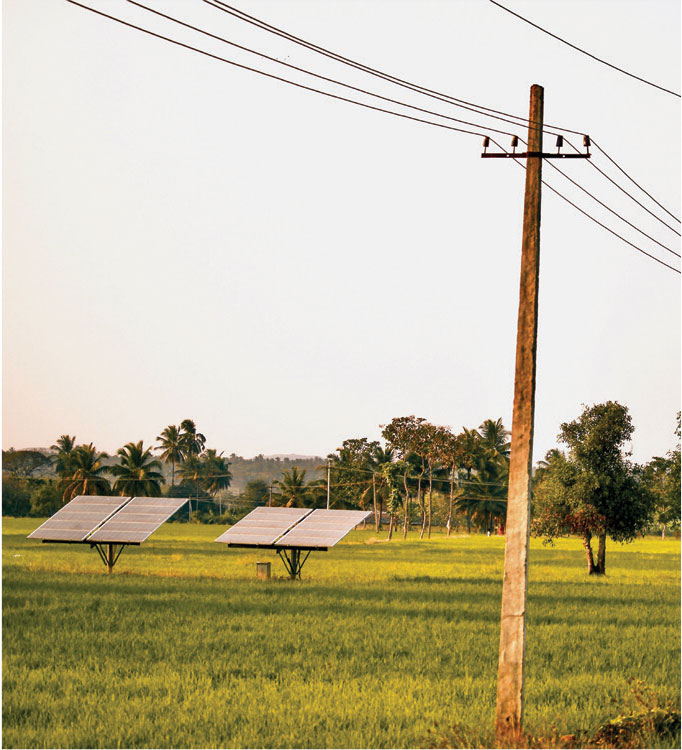
Agricultural solarisation has emerged as another major growth area. Under PM-KUSUM Component C, TGREDCO initiated solarisation of nearly 126 MW over more than 16,800 agricultural pump sets. Meanwhile, Component A represents a much larger future opportunity, with Telangana targeting 4,000 MW of decentralised, grid-connected solar plants, typically ranging from 500 kW to 2 MW and located within 5 km of 33/11 kV substations.
Rooftop deployment has also expanded under PM Surya Ghar, with 84,853 applications, 58,111 installations and 74,061 households covered as of the latest figures, representing 213.84 MW of installed capacity and Rs 3,424 million in released subsidy. Telangana is also exploring floating solar, with reservoirs estimated to offer nearly 6,700 MW of potential. NTPC Limited has announced plans to invest around Rs 80 billion in renewable energy and associated infrastructure in the state, including floating solar.
Telangana is also developing a stronger clean energy manufacturing base. Premier Energies’ 5.6 GW solar module facility at Seetharampur, inaugurated in July 2026, is one such example. In June 2025, the company had commissioned a 1.2 GW TOPCon solar cell manufacturing line at Fab City, Hyderabad, and its existing manufacturing footprint in the state has also expanded to 3.6 GW of solar cells and 5.4 GW of module capacity.
Hydro and PSP ambitions
Hydropower remains an important component of Telangana’s renewable energy portfolio, providing firm and flexible generation alongside the state’s rapidly expanding solar capacity. As of July 2026, Telangana has 2,495.27 MW of installed hydro capacity, comprising 2,405.60 MW of large hydro and 89.67 MW of small hydro. Hydro generation stood at 65.86 MUs in June 2026, including 64.36 MUs from large hydro and 1.5 MUs from small hydro.
The sector is also gradually shifting towards pumped storage projects (PSPs) with several announcements being made recently. Telangana Power Generation Corporation Limited floated a tender in December 2025 to procure 2,000 MW of pumped hydro storage capacity, while the broader pipeline is estimated at around 11,460 MW, requiring potential investments of about Rs 951.5 billion. In January 2025, Sun Petrochemicals signed an MoU with the Telangana government for three PSPs totalling 3,400 MW, integrated with 5,440 MW of solar capacity across Nagarkurnool, Mancherial and Mulugu.
The state is, therefore, positioning PSPs as a key balancing resource, while reducing curtailment and dependence on thermal generation. The state’s abundant reservoir network also offers favourable conditions for developing integrated floating solar-cum-PSPs, allowing better utilisation of existing water infrastructure.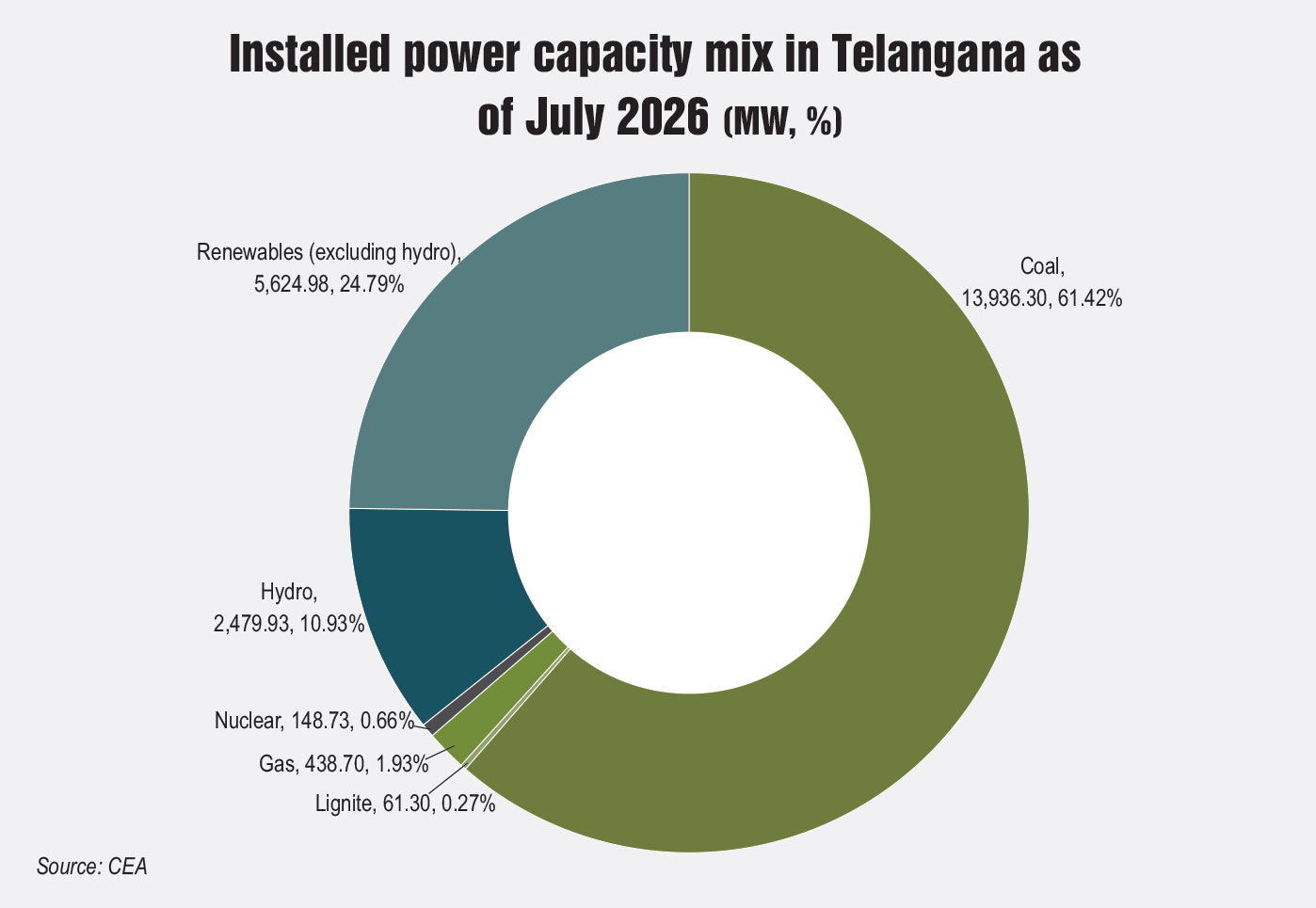
Tapping BESS
Telangana is increasingly exploring battery energy storage systems (BESSs) to support the integration of its rapidly growing solar capacity and improve grid flexibility. The combination of BESS distributed solar and PM-KUSUM projects could also improve supply quality in rural areas.
In 2026, the Telangana Electricity Regulatory Commission approved the procurement and tariff adoption for 1,500 MWh of power through BESSs. BESS deployment has also been proposed at Transmission Corporation of Telangana (TGTRANSCO) substations in Maheswaram. TGREDCO has proposed a 100 kW solar system, with a 100 kW/400 kWh BESS at Cheekupally village in Mulugu district as a pilot for improving supply reliability and rural energy resilience.
Wind power remains a relatively small component of Telangana’s renewable energy portfolio compared with solar. As of July 2026, the state had 128.1 MW of installed wind capacity, while wind generation stood at 28.28 MUs in June 2026. While large-scale wind-solar-BESS hybrid projects remain limited in Telangana, future development is likely to focus increasingly on hybrid projects, combined with solar-wind and energy storage, rather than standalone wind or solar farms.
WtE expansion
Rapid urbanisation has resulted in a substantial increase in municipal solid waste generation. According to the Telangana Socio Economic Outlook 2026, Hyderabad currently generates between 7,000 and 8,300 tonnes of municipal solid waste every day. Scientific waste processing has, therefore, become an important component of the city’s environmental management strategy. Hyderabad currently operates three waste-to-energy (WtE) plants, with a combined installed capacity of 62.5 MW. Together, these facilities have generated over 813 MUs of electricity, while simultaneously reducing the quantity of waste disposed of in landfills. Besides generating renewable electricity, these projects contribute to improved solid waste management, lower methane emissions and better urban sanitation. 
Future outlook
Telangana’s electricity demand is rising rapidly. The state’s peak power demand reached 18,139 MW in March 2026 and is projected to reach 24,215 MW by 2030-31. Hyderabad will be an important driver of this growth because of its expanding commercial, industrial, artificial intelligence (AI) and data centre activities. The city’s data centre capacity is estimated at around 1,093 MW in 2026 and could increase to approximately 4,641 MW by 2032. The proposed 100 MW AI-ready data centre by UPC Volt at Bharat Future City, along with a proposed 100 MW round-the-clock renewable energy project, is an example of how renewable generation could be directly linked with large electricity consumers.
However, such projects will need strong transmission networks and storage to ensure that power is available even when solar generation is low.
Transmission availability is one of the biggest challenges facing renewable developers across states. Developers face delays in approvals, grid connections and construction of transmission infrastructure. To this end, Transmission Corporation of Telangana Limited has proposed eight green energy corridor projects involving an estimated investment of around Rs 6.89 billion.
The state is increasingly using substation-level solarisation to ease renewable power evacuation. In May 2026, TGREDCO invited bids for 19 MW of ground-mounted solar projects across 18 substations in nine districts, with remote monitoring and five-year operations and maintenance included. Under PM-KUSUM Component A, the state is also targeting 4,000 MW of decentralised solar projects of 500 kW-2 MW closer to substations. These projects complement Telangana’s broader effort to strengthen distributed renewable generation and make better use of existing grid infrastructure.
The Telangana Clean and Green Energy Policy 2025 is also encouraging green hydrogen and electrolyser development, with the Research and Innovation Circle of Hyderabad (RICH)-led Green Hydrogen Valley being developed around applications in fertilisers, mobility, mining and cement. More recently, RICH has been working with Singareni Collieries Company Limited and the hydrogen start-up Sohhytec to develop a consortium for photo-electrochemical hydrogen technology, following discussions held in September 2025. The state is also supporting early-stage innovation through Energy Leap, a green hydrogen technology accelerator targeting around 40 start-ups. Additionally, the National Green Hydrogen Mission portal lists the Hyderabad Metropolitan Water Supply and Sewerage Board Amberpet hydrogen project in Hyderabad as an announced project, with implementation targeted for 2028.
Telangana’s distribution sector continues to face financial and operational pressures despite its expanding power infrastructure. According to NITI Aayog, the state’s aggregate technical and commercial losses stood at 19.84 per cent as of 2024-25, higher than the all-India level of 15.04 per cent. Telangana also recorded an average cost of supply-average revenue realised gap of Re 0.31 per kWh as of 2024-25, compared with minus Re 0.04 per kWh nationally, indicating greater pressure on cost recovery. The data highlights the need for improvements in metering, billing, collection efficiency and discom finances as renewable procurement expands.
Telangana is aiming for a major expansion of renewable energy, with a target of adding 20 GW of renewable energy and storage capacity by 2030 under its Clean and Green Energy Policy 2025. However, Telangana added only around 1,200 MW of renewable capacity between 2020-21 and 2024-25, including just about 83 MW in 2024-25. Meeting this target would require faster project approvals, easier land acquisition, stronger transmission infrastructure, financially healthier discoms and greater use of solar-plus-storage and hybrid projects.
