

 By Nidhi Dua
The cover story of Renewable Watch’s August 2026 issue, titled “Finding the Right Balance: Solutions to Address the Land-Energy Debate”, highlighted the growing land requirements of India’s clean energy transition and the need to balance renewable energy development with competing land uses. The scale of this requirement is significant. The Institute for Energy Economics and Financial Analysis estimates that achieving a mid-century net zero target could require 50,000-75,000 square km for solar projects and another 1,500-2,000 square km for direct wind infrastructure. Right of way (RoW) for transmission infrastructure adds to this footprint. As projects expand, ensuring fair and transparent compensation for communities dependent on the affected land will become increasingly important.
Given the scale and growing complexity of the issue, this story revisits the land-energy debate. It digs deeper into the legal and regulatory dimensions and challenges that arise across the project life cycle, from site identification and land procurement to approvals, construction, operations and decommissioning. It also compares state-level policies for land acquisition, leasing and transmission RoW compensation, highlighting how differences across states can affect project costs, timelines and implementation. It also draws inputs from sector experts on how these challenges can be addressed while maintaining the pace of India’s clean energy transition.
Legal risks across the project life cycle
The legal exposure to renewable energy and transmission projects varies across different stages of development. According to Pallavi Bedi, Partner, Phoenix Legal, the development and construction phase of project development are most vulnerable to litigation. The first challenge arises at the site identification stage, when developers must verify land availability and title, including ownership records, past transactions, mortgages, leases and competing claims. Land classification is equally important, as agricultural, forest, grazing and government land may face different restrictions. Fragmented ownership, inheritance claims and disputes among co-owners can further complicate the process, particularly when large parcels are required. Once developers identify the land and establish title, they must navigate the procurement process, which can add further legal and commercial challenges.
Securing land rights, however, is only one part of the process. Developers must also establish whether the land can legally be used for the proposed project. Agricultural land may require conversion for non-agricultural use, while other categories may be subject to additional restrictions. These considerations become particularly important during construction, when physical work can affect crops, trees, access roads, drainage systems and other existing land uses. According to Bedi, the identification and notification of affected landowners and determination of compensation can also become key sources of litigation. The legal obligations continue during operations, when transmission assets require periodic access for inspection and maintenance and RoW restrictions may remain for the life of the project. Changes in land-ownership can further complicate projects operating under long-term leases or requiring access through third-party land.
State-wise variations in land policies add to the complexity
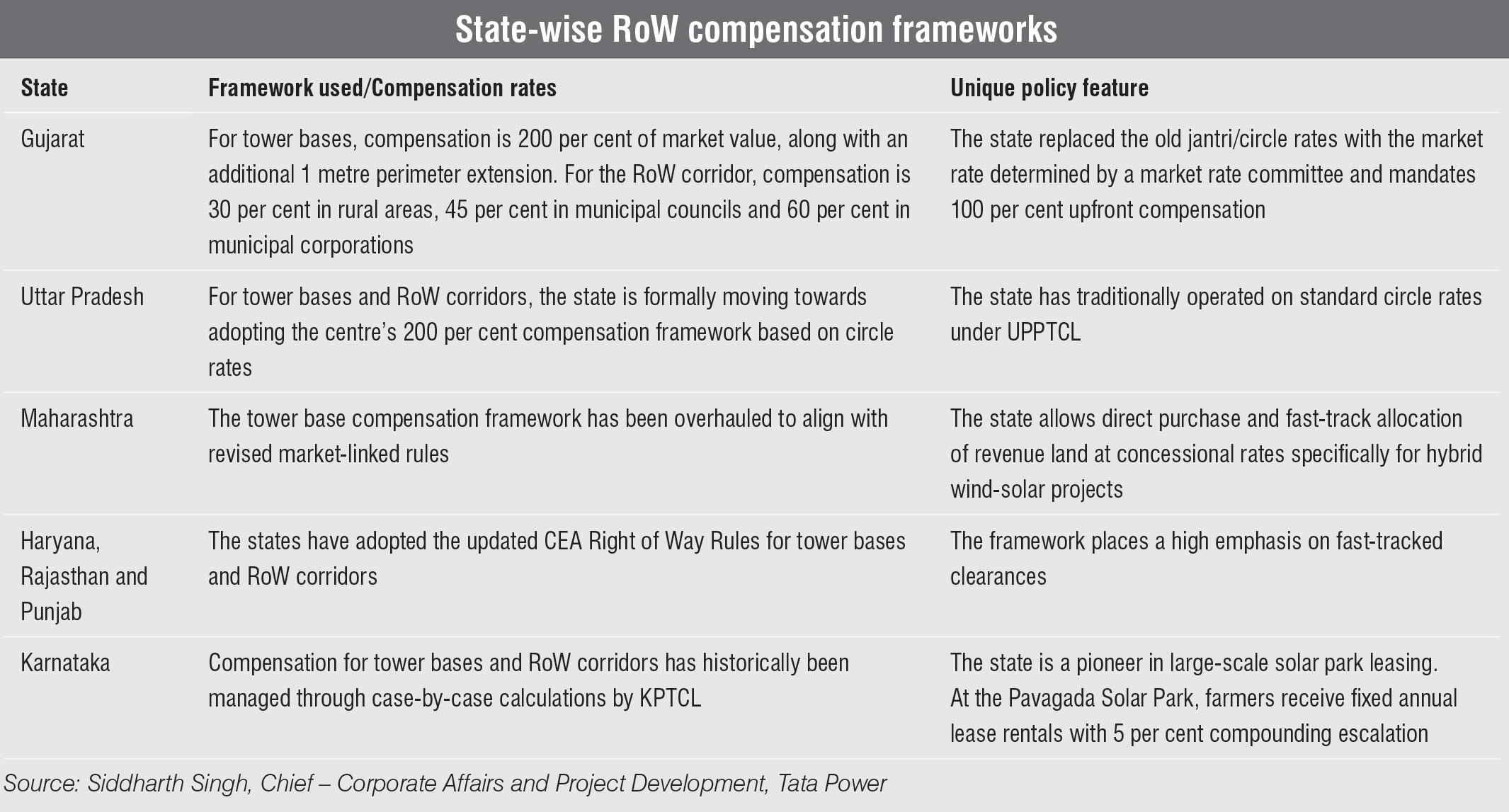
State-level differences in policies are particularly important for land leasing and transmission RoW compensation, with provisions on land ceilings, conversion, consent and compensation varying significantly across states. For developers, this can mean different land procurement strategies and project economics from one state to another. Siddharth Singh, Chief – Corporate Affairs and Project Development, Tata Power, highlights the variations in state-level policies and compensation frameworks. A summary of select states has been provided in Table 1. According to Singh, the selection of these states is primarily based on the ease of land acquisition, fewer complex land categories and the availability of renewable energy potential to justify investment. State-specific policies for RoW of transmission projects have been highlighted in Table 2. These variations in state policies differ on the basis of compensation calculation and the escalation mechanisms adopted. Gujarat, for instance, has moved towards a market-linked framework, with RoW compensation determined by a market rate committee and 100 per cent of the compensation paid upfront. Uttar Pradesh, in contrast, has traditionally relied on standard circle rates, although it is moving towards the centre’s 200 per cent compensation framework for tower bases and RoW corridors. Maharashtra has also overhauled its tower base compensation framework to align with revised market-linked rules, while Haryana, Rajasthan and Punjab have adopted the updated Central Electricity Authority RoW Rules. These differences, alongside variations in land-lease rates and escalation mechanisms, underline the fragmented nature of land and RoW frameworks across states and can affect the cost and timelines of renewable energy project development.
Reducing litigation risks
Early legal due diligence can help identify potential land-related issues before they delay projects. Beyond project-level due diligence, greater consistency in compensation frameworks is needed, particularly for transmission projects crossing state boundaries, to avoid different compensation requirements for similar impacts and the resulting disputes and delays faced by developers. This issue becomes more pronounced when a single transmission line passes through multiple states. Dr R.K. Tyagi, Director General, Power Foundation of India, while speaking at the Power line Summit 2026, noted that the same transmission line can face different compensation rules across states, resulting in different payments for similar impacts. A central compensation mechanism or a more standardised national framework could, therefore, provide a common basis for compensation, while retaining flexibility to account for state-specific considerations.
Better transmission planning and greater use of existing infrastructure could also help reduce land-related disputes. Speaking at the same summit, Ghanshyam Prasad, Chairperson, Central Electricity Authority (CEA), pointed to the possibility of supplying electricity locally by tapping high voltage transmission lines directly to the low tension (LT) network. Such technology could help reduce the need for additional transmission and distribution networks to supply electricity to rural areas. An initial experiment has already been undertaken with Tata Power, using a 66 kV line to directly supply the LT network. Prasad noted that if the technology can be developed for higher voltage lines of around 220 kV or 400 kV, it could significantly change transmission and distribution planning.
Dr Tyagi also suggested optimising existing transmission corridors by using the same corridor for 765 kV, 400 kV, 220 kV and 33 kV lines, with the same tower carrying different voltage levels wherever required. This approach could reduce the need for separate RoW corridors.
New tenders focus on acquisition of land near substations and long-term land leasing
An important change in project tenders is the growing emphasis on the location of land in relation to transmission infrastructure. Earlier, the availability and cost of land were generally among the primary considerations, whereas recent tenders increasingly specify that land should be located in the vicinity of identified substations. For example, Terra Clean’s September 2025 tender for a 300 MW solar project in Morena, Madhya Pradesh, sought land aggregation near the 220 kV Morena interstate transmission system substation. Similarly, Terra Clean’s January 2026 tender for a 300 MW intra-state transmission system-connected solar project sought land aggregation near the 220 kV Bhalgamda GETCO substation in Morbi district.
Tenders are also becoming more specific about land tenure and the legal due diligence required. Long-term leases are increasingly being built into tender requirements. For instance, in May 2026, NLC India invited bids to lease land for a large-scale solar energy project in Gujarat. The project involves securing approximately 1,500 acres of suitable land to support the development of solar PV power plants. The selected bidder will be responsible for arranging land through government or private lease and ensuring that it is transferred in the name of NLC India Renewables Limited for a minimum lease period of 29 years and 11 months. A similar focus can be seen in the Solar Energy Corporation of India Limited’s September 2026 requests for proposal for leasing two parcels of agricultural land in Delhi for agri-PV power plants. The tender objective is to identify and lease two suitable parcels of agricultural land, each measuring approximately 10 acres, for 27 years, extendable by mutual consent, for development of agri-PV power plants along with associated power evacuation and ancillary infrastructure.
The way forward
As India pursues its renewable energy and non-fossil capacity targets, pressure on land and transmission corridors is set to rise. The transmission network has crossed 500,000 ckt km and is projected to reach 648,000 ckt km by 2032, with plans to integrate over 900 GW of non-fossil capacity by 2035-36. To support this expansion, greater consistency in state-level compensation frameworks could help address challenges faced by transmission projects, particularly those spanning multiple states. At the policy level, a central compensation mechanism could provide a clearer baseline for landowners and developers. Dr Tyagi suggests that the central government should frame clear compensation rules under Section 164 of the Electricity Act for crops, land diminution, and impacts on farmers and villages, similar to the provisions under Section 68 for losses or damages to the local authorities. He notes that leaving such provisions to individual states can result in delays and differences in implementation, as states may take considerable time to adopt central guidelines.
At the project level, developers need to plan land and transmission requirements well in advance. Inadequate transmission capacity can constrain projects even after completion if the generated power cannot be fully evacuated. Assessing land and grid connectivity two to three years in advance can, therefore, help avoid delays and ensure the required infrastructure is ready for commissioning.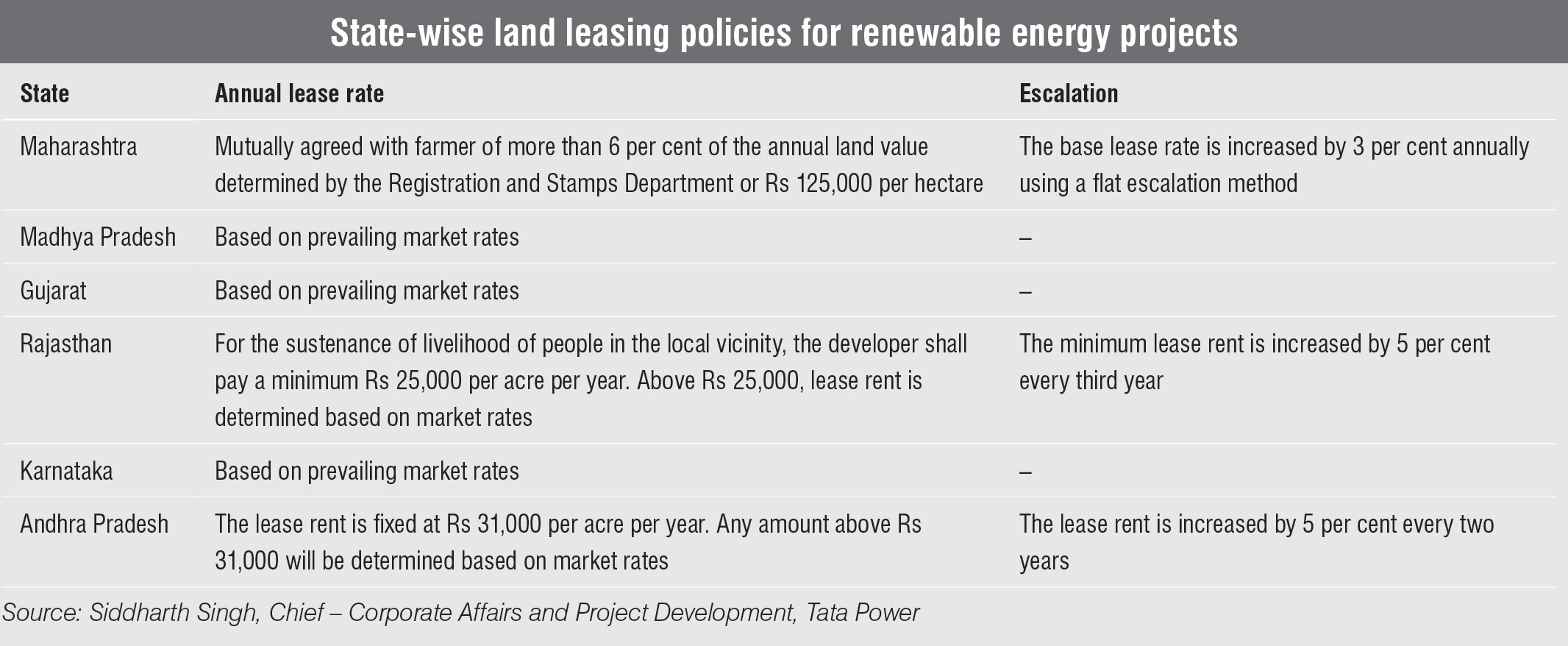
This early planning also needs to extend to engagement with local communities. Narendra Somoshi, Chief Asset Creation and Performance Management Officer, Aditya Birla Renewables Limited, highlights that community engagement from the early stages of project development is important. “The focus should be on creating a sustainable impact at the local level through initiatives covering education, healthcare, water conservation, infrastructure and livelihoods. Communities are considered key stakeholders alongside employees, vendors and customers. The objective is not only to develop a power project but also to contribute to the socio-economic development of the regions where the projects are located. Community engagement, therefore, takes place before project execution, during construction, and throughout the lifetime of the asset,” he says.
The focus should, therefore, be on early planning, better coordination of land and transmission requirements, fair compensation and meaningful community engagement. These measures can help reduce disputes and delays and ensure that land and grid availability do not constrain India’s clean energy expansion.
