

 By Nidhi Dua
India’s renewable energy transition is highly capital-intensive. Around $300 billion is required to achieve 500 GW of renewable energy capacity by 2030, as per Ember. However, current annual funding levels remain comparatively lower. As per Renewable Watch Research, in financial year 2026, the sector received around $12.98 billion, of which $8.63 billion came through debt instruments (excluding refinancing) and around $4.34 billion through equity. In addition, about $740.51 million was raised via initial public offerings (IPOs), reflecting the gradual emergence of public markets as a funding source.
Currently, debt continues to dominate the financing mix in India. However, a growing IPO pipeline is adding another layer to fund mobilisation. IPOs are enabling companies to improve debt-to-equity ratios and reduce interest burdens over time, while also providing access to a wider pool of investors.
This article analyses the post-IPO performance of six renewable energy companies that went public in calendar year 2025. The assessment covers the period from stock listing to the first week of April 2026, examining fundraising trends, utilisation of proceeds and the outlook ahead.
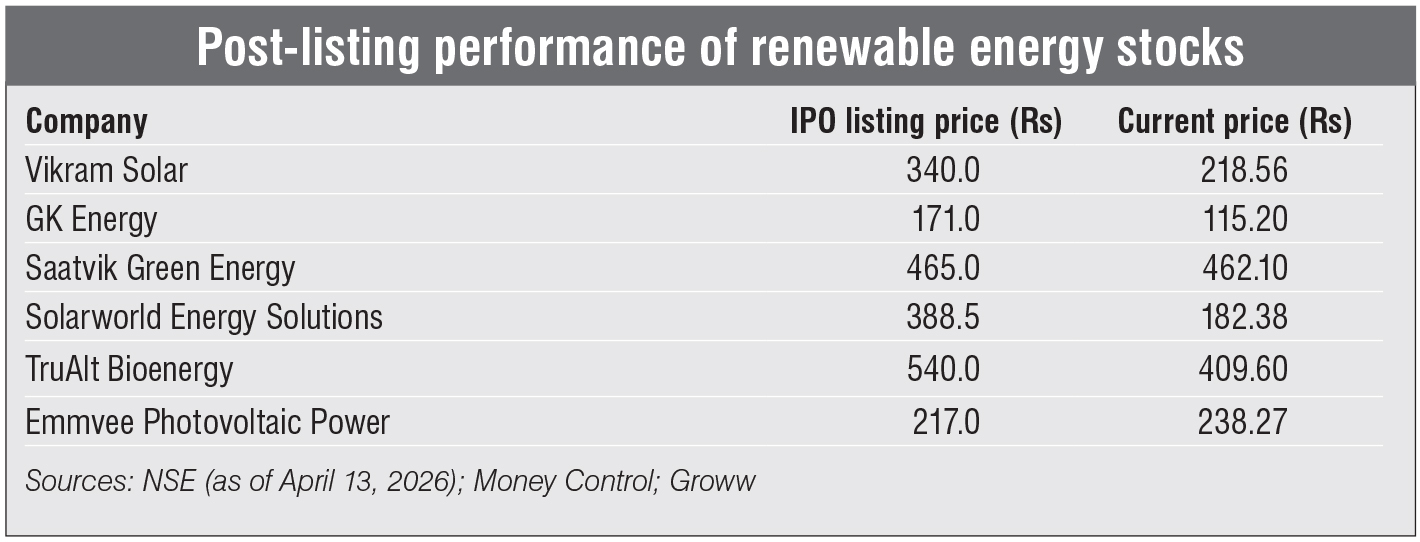
Across the companies studied, two key trends have emerged. First, stock prices declined after initial oversubscription, as seen in Saatvik Green Energy and Emmvee Photovoltaic Power. Second, even for companies that recorded listing gains, the early price rise was not sustained. These include firms such as Vikram Solar, GK Energy, Solarworld Energy Solutions and TruAlt Bioenergy. Overall, as accessed on April 13, 2026, apart from Emmvee, current stock prices were significantly lower than their IPO listing levels.
Vikram Solar
Vikram Solar Limited fixed the price band of Rs 315-Rs 332 per equity share at a face value of Rs 10 each for its IPO. Investors were allowed to bid for a minimum of 45 equity shares and in multiples of 45 equity shares thereafter. The IPO was oversubscribed 54.63 times.
Despite the oversubscription, the stock delivered a muted listing gain of around 1.8 per cent. Its post-listing performance has been volatile. The stock debuted around the Rs 340 mark and initially rallied to the Rs 380-Rs 400 zone. However, it soon entered a sustained downtrend. Between September 2025 and October 2025, prices corrected to the Rs 300-Rs 330 range. From November 2025 through January 2026, the stock witnessed a further decline to the Rs 190-Rs 200 range. In recent weeks (March 2026-April 2026), the stock has stabilised within the Rs 180-Rs 200 band.
From an IPO performance perspective, the stock is now trading significantly below its listing price of Rs 340, implying a decline of roughly 40-45 per cent from IPO levels and a nearly 50 per cent correction from peak levels.
GK Energy
The IPO of GK Energy received bids for 1,987,778,982 shares as against the 22,180,828 shares on offer, resulting in an oversubscription of 89.62 times. The IPO price band was fixed at Rs 145-Rs 153 per share. The issue comprised both a fresh issue of equity shares of up to Rs 4 billion and an OFS of up to 4,200,000 equity shares. Of the net proceeds from the fresh issue, Rs 3.22 billion was planned to be used for funding long-term working capital requirements, and the balance for general corporate purposes. GK Energy Limited debuted on the exchanges at around Rs 171. Post listing, the stock rallied sharply to the Rs 230-Rs 240 zone; however, this upmove proved unsustainable. During November-December 2025, prices fell below the Rs 200 mark. The weakness intensified in early 2026, with the stock falling sharply towards the Rs 95-Rs 100 range in February 2026. Since then, it has shown a gradual recovery, with prices moving back towards the Rs 110-Rs 115 zone.
From a listing performance perspective, the stock is currently trading well below its debut price of Rs 171, implying a decline of 30-35 per cent from listing levels and a correction of over 50 per cent from peak levels.
Saatvik Green Energy
Saatvik Green Energy Limited’s IPO comprises equity shares worth up to Rs 9 billion, including a fresh issue of up to Rs 7 billion and an offer for sale of up to Rs 2 billion by the selling shareholders. Furthermore, the IPO price band was set at Rs 442-Rs 465 per share. The IPO was oversubscribed 6.57 times at the end of the bidding window. The company experienced a volatile post-listing journey after debuting on the exchanges at Rs 465. Shortly after listing, the stock rallied sharply towards the Rs 550-Rs 570 zone, but this upmove proved unsustainable. By November-December 2025, the stock steadily declined to Rs 370-Rs 380, and hit its lowest point in March 2026 at Rs 330-Rs 340. From there, its recovery began, pushing prices back to Rs 420-Rs 440, indicating improving short-term momentum.
From an IPO performance perspective, the stock is currently trading below its issue price of Rs 465, reflecting a decline of 8-12 per cent from IPO levels and a drawdown of 35-40 per cent from peak levels.
Solarworld Energy Solutions
Solarworld Energy Solutions Limited’s IPO comprises equity shares worth up to Rs 4.9 billion. This includes a fresh issue worth up to Rs 4.4 billion and an offer for sale of up to Rs 0.5 billion by existing shareholders. Furthermore, the price band for the IPO was set at Rs 333-Rs 351 per equity share.
Solarworld Energy Solutions Limited witnessed a strong stock market debut, listing at Rs 388.50 against an issue price of Rs 351, reflecting a premium of 10-11 per cent. However, the initial optimism faded quickly, and the stock entered a sustained downtrend. During October-November 2025, prices slipped below Rs 350 and continued forming lower highs. The decline intensified during December 2025-January 2026, with the stock falling towards the Rs 250-Rs 270 range. This bearish momentum extended into February-March 2026, when the stock traded in the Rs 140-Rs 150 range. Recently, the stock has shown a modest recovery towards Rs 170-Rs 180.
From an IPO performance perspective, the stock is currently trading significantly below its listing price of Rs 388.50, implying a decline of 50-55 per cent from listing levels, highlighting sharp post-listing erosion.
TruAlt Bioenergy
TruAlt Bioenergy Limited’s IPO consisted of equity shares worth up to Rs 8.39 billion, including a fresh issue of up to Rs 7.5 billion and an offer for sale of 1.8 million shares by promoters. Furthermore, the price band for the IPO has been set at Rs 472-Rs 496 per share. The company made a strong market debut, listing around the Rs 540-Rs 550 zone, reflecting investor enthusiasm for the bioenergy and ethanol blending segments. However, the stock failed to sustain these elevated levels. Through November-December 2025, persistent selling pressure dragged the stock lower, slipping below Rs 500. The decline intensified into early 2026, with the stock price falling sharply to Rs 310-Rs 330 in January 2026. From this bottom, the stock witnessed a meaningful recovery, rebounding towards Rs 420-Rs 440. Currently, prices are consolidating in the Rs 400-Rs 420 band.
From a listing performance perspective, the stock is now trading 20-25 per cent below its listing price and has corrected nearly 40 per cent from peak levels.
 Emmvee Photovoltaic Power
Emmvee Photovoltaic Power’s Rs 30 billion IPO was subscribed 0.97 times at the end of the bidding window on November 13, 2025. The price band for the IPO was set at Rs 206-Rs 217 per equity share with a face value of Rs 2.
Emmvee Photovoltaic Power Limited was listed on the exchanges at around Rs 217, a relatively stable debut without extreme listing volatility. Post listing, the stock initially moved higher to the Rs 240-Rs 250 zone. However, this upmove failed to sustain. In December 2025-January 2026, prices declined to the Rs 180-Rs 190 range. In recent weeks (March-April 2026), the stock has moved back to the Rs 220-Rs 230 range and is now consolidating just above its listing price, with intermittent spikes towards Rs 240, which remains a supply zone.
From a listing performance perspective, the stock is currently trading slightly above its listing price, implying largely flat returns since listing, although it has recovered meaningfully from its lows.
Overall analysis and outlook
The overall trend in renewable energy IPOs in 2025 points to a clear shift from initial optimism to a more fundamentals-driven phase. While most companies witnessed strong subscription levels and early listing gains, these were not sustained, with many stocks undergoing price corrections over time.
Was the downward momentum in stock prices of these companies due to the overall weak performance of the energy index? Trends in the National Stock Exchange (NSE) energy index – the thematic index on the NSE that tracks the performance of top Indian companies in the energy sector – do not suggest that. The index remained relatively stable and range-bound through 2025: within the Rs 30,000-Rs 32,000 range (January 2025-March 2025), the Rs 33,000-Rs 37,500 range (April 2025-December 2025) and then upwards towards Rs 38,000 (in April 2026), reflecting improving momentum. In contrast, the stocks covered witnessed sharper declines from their peak levels during the same period.
This further clarifies that while investor interest in renewable energy companies remains strong, as reflected in IPO oversubscription, the post-IPO performance of these stocks is being shaped more by company-specific factors than overall sector conditions.
Net, net, the outlook remains cautiously optimistic. If companies are able to deploy capital efficiently and handle the fundamental challenges, IPOs can play a key role in accelerating India’s energy transition.
