 By Sarthak Takyar
Previous articles in this magazine on air pollution in Delhi-NCR (“Clearing the Air”, January 2026; and “Pollution Predicament”, February 2026) discussed the different reasons for toxic air in the state, and the way forward. The articles highlighted the need to manage legacy waste at Delhi’s landfills by expanding waste-to-energy (WtE) capacity. This article delves deeper into this aspect and also discusses the state’s two-front challenge of solving the legacy waste issue at its landfills and handling the growing municipal solid waste (MSW).
Apart from deliberating on this topic from time to time, Renewable Watch organised a conference on Solid Waste Management with a focus on WtE in March 2026. This article uses data points shared by speakers at the conference as well as from the Economic Survey of Delhi 2025-26, released in March 2026…
Current scale of MSW generation and processing
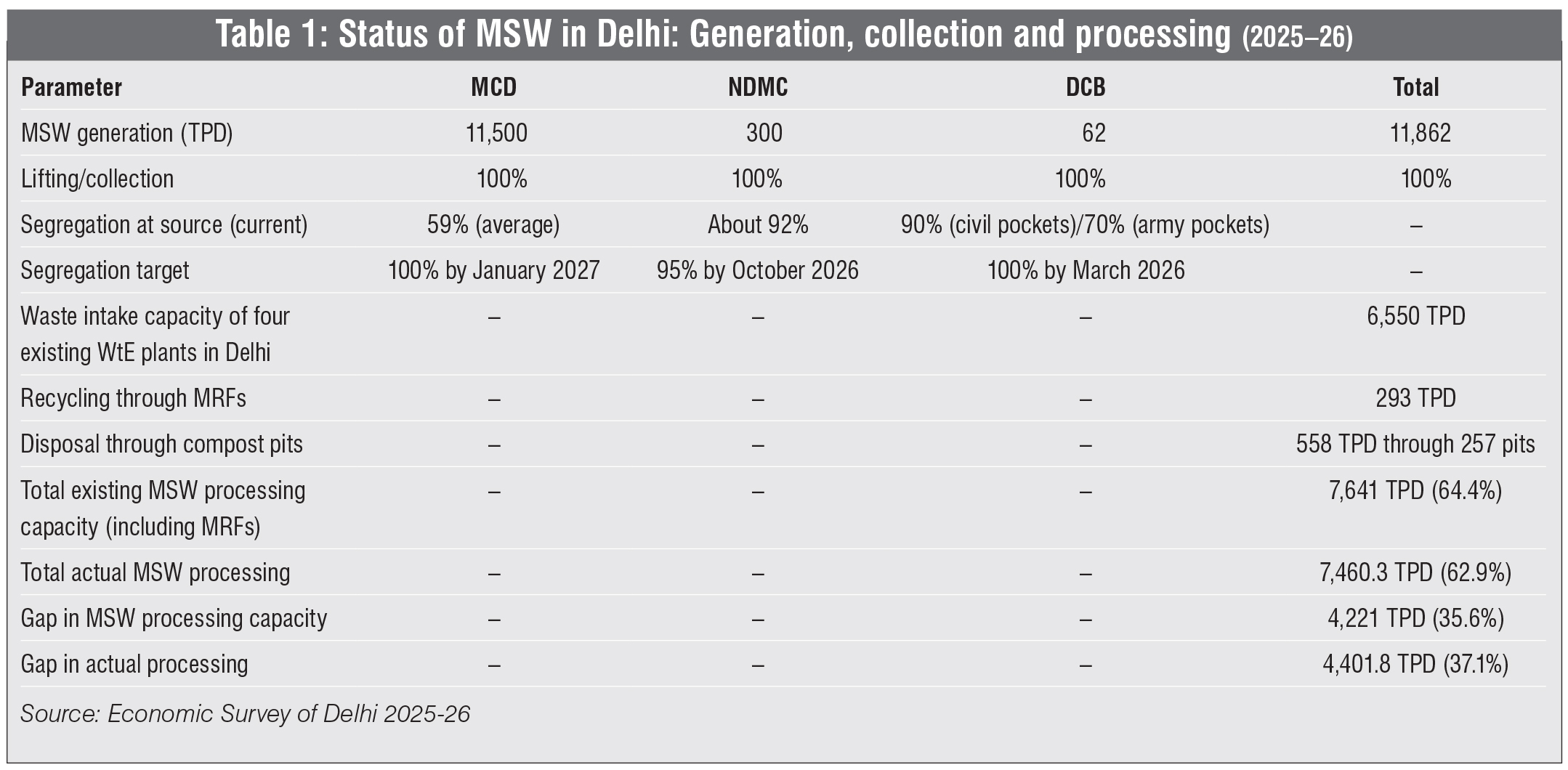
Delhi generates approximately 11,862 tonnes per day (TPD) of MSW across its three civic bodies: the Municipal Corporation of Delhi (MCD), the New Delhi Municipal Council (NDMC) and the Delhi Cantonment Board (DCB). MCD alone accounts for 11,500 TPD, with NDMC contributing 300 TPD and DCB, 62 TPD (Table 1).
All three bodies report 100 per cent waste lifting and collection. However, segregation at source, a prerequisite for efficient processing, remains work in progress. MCD’s current segregation rate averages 59 per cent, with a target of 85 per cent by February 2026, 90 per cent by August 2026 and 100 per cent by January 2027. NDMC has achieved approximately 92 per cent across its 14 circles and is targeting 95 per cent by October 2026. DCB stands at 90 per cent for civil pockets and 70 per cent for army pockets, aiming for full compliance by March 2026.
Against a total generation of around 11,862 TPD, the current MSW processing capacity, including material recovery facilities (MRFs), is approximately 7,460 TPD – a coverage of 62.9 per cent. The four existing WtE plants, with a combined capacity of 6,550 TPD, form the backbone of this processing infrastructure, supplemented by 257 compost pits (558 TPD) and an MRF recycling capacity of 293 TPD. Overall, this leaves a processing gap of roughly 4,401 TPD (37 per cent of the MSW generated) at Delhi’s already over-utilised landfill sites.
Operational WtE plants in Delhi
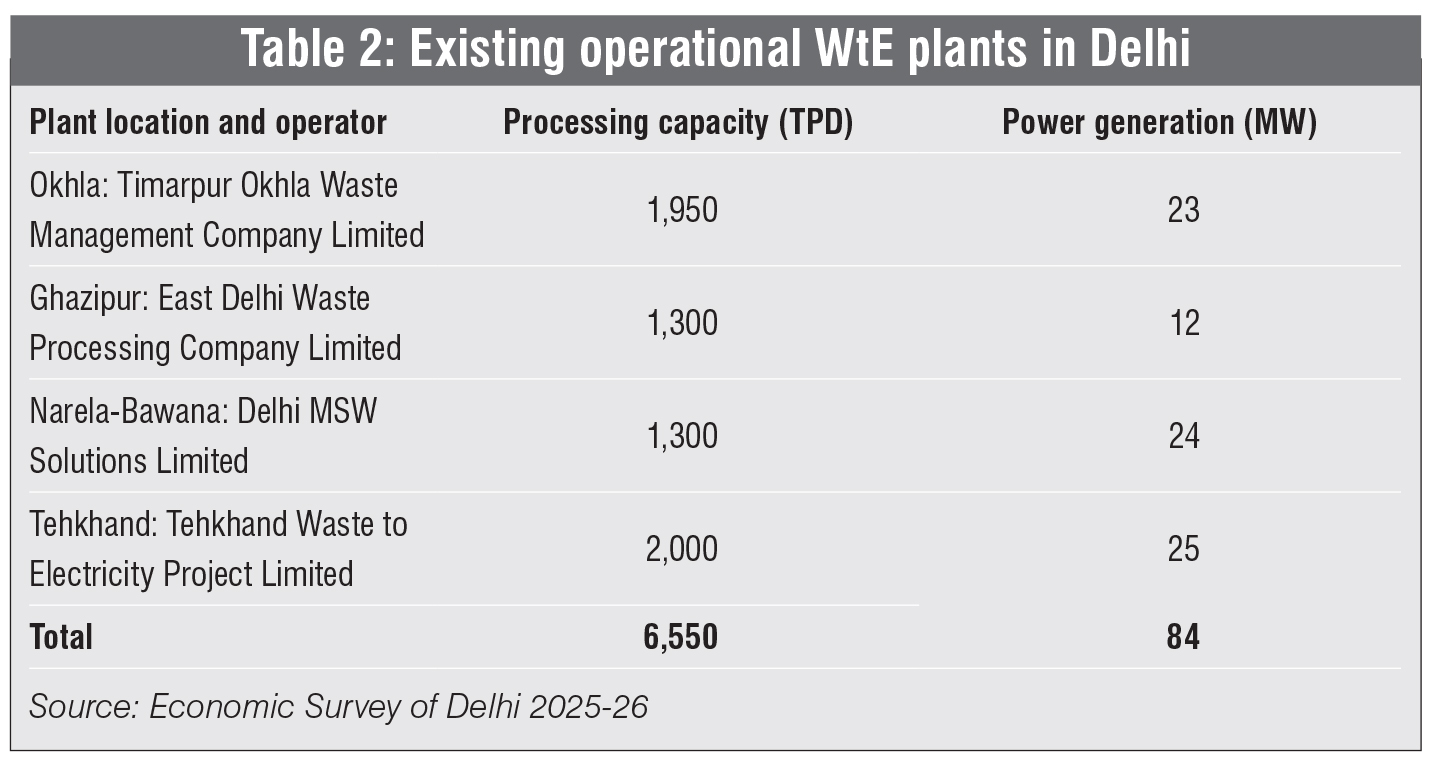
Delhi currently operates four WtE plants with a combined processing capacity of 6,550 TPD and an installed power generation capacity of 84 MW (Table 2). The plants are located at Okhla, Ghazipur, Bawana and Tehkhand, and are operated by private developers under agreements with the MCD. The key details, strengths and operational challenges faced by the projects are as follows…
Okhla (1,950 TPD waste intake; 23 MW generating capacity)
The Okhla plant, operated by Timarpur Okhla Waste Management Company Limited, is the oldest (set up in 2012) and one of the largest in terms of waste intake (1,950 TPD), generating 23 MW. The project cost was approximately Rs 2 billion. As per the MCD, the levellised tariff for the project stands at Rs 2.83 per kWh.
Developed under a public-private partnership (PPP) framework on a build-own-operate-transfer basis, the project has a 25-year concession period and was funded through debt. The project also received support from the Ministry of New and Renewable Energy. A major strength of the project lies in its long-term power purchase agreement (PPA) with BSES Rajdhani Power Limited at a tariff of Rs 6.50 per kWh.
Despite these advantages, the project has encountered operational and social challenges. The feedstock quality has remained inconsistent, with the calorific value ranging between 1,500 kCal per kg and 2,000 kCal per kg, affecting operational efficiency. In addition, the project has faced significant public resistance, including protests related to environmental concerns, which have posed implementation and operational challenges over
the years.
 Bawana (1,300 TPD; 24 MW)
The Bawana facility, run by Delhi MSW Solutions Limited, is part of an integrated solid waste management complex that also includes a compost plant and an engineered sanitary landfill, and has the highest power generation capacity of 24 MW, processing 1,300 TPD. The plant was built in 2017 with a capital expenditure of around Rs 6 billion. The levellised tariff for the plant stands at Rs 7.03 per kWh.
A major strength of the project is its PPP funding model, structured around a 20-year concession period and a grant from the Ministry of New and Renewable Energy, which improved its financial viability. In addition, a long-term PPA with discoms provided revenue certainty, while a tipping fee of Rs 1,950 per tonne set by the Delhi municipality offered additional operational support. Minimal public resistance, aided by prior stakeholder engagement, also contributed to the project’s smooth implementation.
However, the project has faced operational challenges. The incoming waste often contains 50-60 per cent moisture and has a mixed composition, making it unsuitable for direct refuse-derived fuel (RDF) processing. Poor feedstock quality also reduces the calorific value of RDF, which can lower actual power output below the rated 24 MW capacity.
 Ghazipur (1,300 TPD; 12 MW)
The Ghazipur plant (set up in 2017), operated by East Delhi Waste Processing Company Limited, contributes 1,300 TPD in waste intake and has a capacity of 12 MW. As per the MCD, the levellised tariff for the project is in the range of Rs 4.50-Rs 5.50 per kWh.
A key operational challenge for the project after commissioning is that generation levels have remained moderate, driven mainly by resource unavailability and lack of maintenance at the project site. In addition, waste heterogeneity remains a concern, with monsoon-related increases in moisture content and transportation difficulties affecting the availability and quality of MSW.
Tehkhand (2,000 TPD; 25 MW)
The Tehkhand plant, commissioned more recently in 2023 and operated by Tehkhand Waste to Electricity Project Limited, processes 2,000 TPD and has a generation capacity of 25 MW. It also includes a separate engineered sanitary landfill, commissioned in March 2024. These facilities are positioned as the acceptable interim disposal option for residual waste that cannot be processed as the city works towards its stated objective of eliminating conventional dumping. The project cost is approximately Rs 4.65 billion, supported by a viability gap funding (VGF) of Rs 1.05 billion and structured with a debt-to-equity ratio of 70:30. The levellised tariff for the project stands at Rs 5.13 per kWh.
One of the project’s key strengths is its implementation under a PPP framework on approximately 15 acres of land provided by the MCD, with a 25-year concession period. Electricity generated by the plant is sold to discoms through long-term PPAs, ensuring revenue visibility. In addition, the concession structure includes reject handling charges and land lease payments linked to landfill usage and land occupancy.
However, the project faces challenges associated with waste heterogeneity, particularly during the monsoon season, when moisture content rises and transportation becomes more difficult.
 Expansion plans
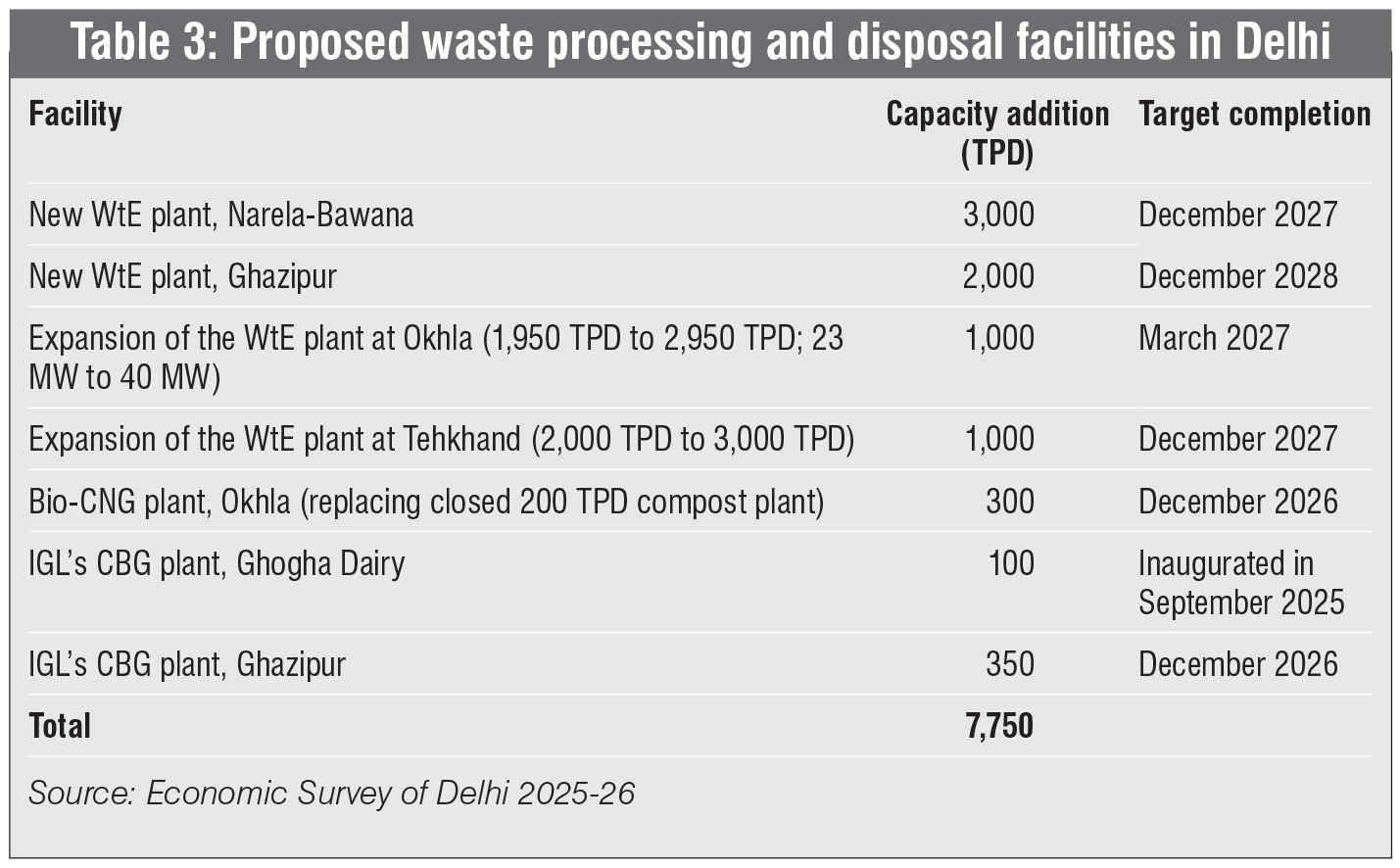
An initiative to significantly scale up WtE and waste processing infrastructure is currently at various stages of planning and regulatory clearance. Seven new facilities, comprising four WtE additions and three compressed biogas (CBG) plants, have been proposed, to add 7,750 TPD of processing capacity by December 2028. Of this, 7,000 TPD will come from the commissioning of the new WtEs and the expansion of existing WtEs (Table 3).
New WtE plant at Narela-Bawana (3,000 TPD, 30 MW by December 2027)
A new 3,000 TPD WtE plant at Narela-Bawana received environmental clearance from the Ministry of Environment, Forest and Climate Change in June 2025. A key precondition is the relocation of three 400 kV transmission lines that traverse the proposed site. The transmission line work is expected to be completed by June 2026, after which approximately two years will be needed to commission the plant, putting the expected commissioning date at December 2027. The estimated project cost is Rs 6.04 billion and a VGF of Rs 1.51 billion has been sanctioned.
New WtE plant at Ghazipur (2,000 TPD, 25 MW by December 2028)
A second WtE plant with 2,000 TPD capacity has been proposed at Ghazipur. In June 2025, the Delhi Electricity Regulatory Commission permitted the MCD to proceed with a transparent bidding process. Approximately three years will be required from the date of tender award to commission the plant, putting the completion date at December 2028. The estimated project cost is Rs 4.88 billion, with a VGF of Rs 1.22 billion.
Expansion of Okhla WtE (1,950 TPD to 2,950 TPD, 23 MW to 40 MW by March 2027)
The Okhla plant has been proposed to be expanded from the existing 1,950 TPD (23 MW) to 2,950 TPD (40 MW). The Delhi government has approved a VGF of Rs 500 million. The MCD has submitted its City Solid Waste Action Plan to the Delhi Government. The supplementary concession agreement is under processing, following which 18 months will be required for commissioning. The deadline for completion is March 2027. The estimated cost of this expansion is Rs 3.61 billion, with a VGF of Rs 500 million.
Expansion of Tehkhand WtE (2,000 TPD to 3,000 TPD, 45 MW provisional by December 2027)
The Tehkhand plant has been proposed to be expanded from 2,000 TPD to 3,000 TPD. Following environmental clearance, the developer will approach the Delhi Electricity Regulatory Commission for tariff determination, after which supplementary concession and land lease agreements will be signed. The target completion date is December 2027. The estimated cost for this expansion is Rs 3 billion.
 Solving legacy waste and preparing for growing MSW waste
Going forward, Delhi has to solve the twin issue of legacy waste at its landfills, which have already exceeded their capacity, while also preparing for the significant MSW waste that will be generated by the city’s burgeoning population.
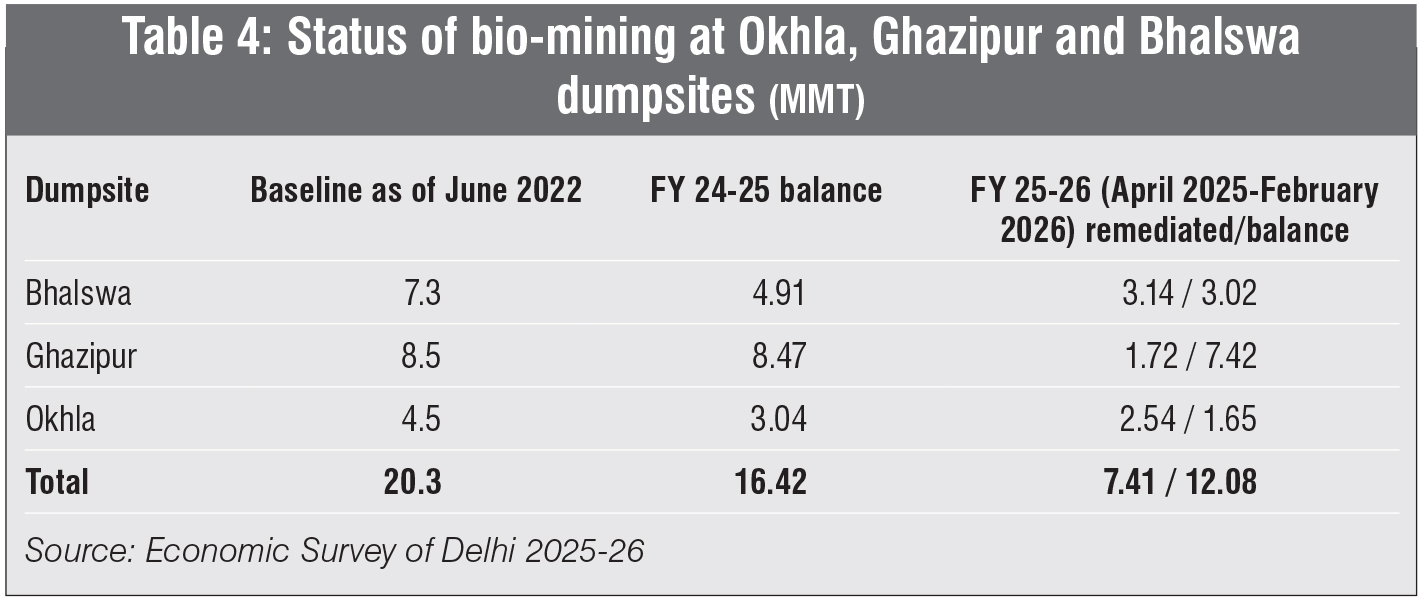
The challenge of overflowing legacy dumpsites at Bhalswa, Ghazipur and Okhla is being addressed through systematic bio-mining. A drone-based volumetric assessment conducted in June 2022 established a baseline of 20.3 million metric tonnes (MMT) of legacy waste across the three sites: 7.3 MMT at Bhalswa, 8.5 MMT at Ghazipur and 4.5 MMT at Okhla (Table 4).
Remediation has accelerated significantly, with 2025–26 (April 2025-February 2026) registering the highest annual processing on record: 7.41 MMT of legacy waste remediated within a single year. This has reduced the combined balance across all three sites to 12.08 MMT, after accounting for around 3.07 MMT of fresh waste deposited at the same sites during the period.
The survey notes that landfill fires – a major source of toxic air pollutants – have reduced from 159 incidents in 2017 to zero in 2025, which is attributed to a detailed fire-control protocol that is now in place at all three sites. The target dates for 100 per cent remediation are: July 2026 for Okhla, December 2026 for Bhalswa and December 2027 for Ghazipur.
As per the draft Master Plan for Delhi 2041 (MPD 41), the city will have a population of 29.1 million by 2041. Based on 650 gm of MSW generated per capita, the total MSW will reach 18,915 TPD (from 11,862 TPD in 2026). The proposed expansion of waste processing through WtE and CBG plants is 7,750 TPD by December 2028. The total waste processing capacity will thus become 15,210.3 TPD by the end of 2028, given the current total actual MSW processing capacity of 7,460.3 TPD. This is assuming that there is no change in the capacity for recycling processing and composting pits, and that all the proposed WtE and CBG expansion plans are commissioned on time.
 Is this processing capacity sufficient going forward? Well, for the 2041 target, the waste processing capacity is still short by around 3,700 TPD, but for the next few years it will be sufficient. Based on the MPD 41, the MCD has calculated that MSW generation will cross 15,000 TPD around 2032-33. Based on this back-of-the-envelope calculation, the total waste processing capacity of 15,210.3 TPD envisaged by the end of 2028 will be sufficient to manage the MSW till 2032-33. A good buffer thus exists on paper, but policy-makers should not become complacent. WtE players continue to face a lot of technical, operational, financial and byproduct offtake-related challenges that need to be addressed. Feedstock quality is often low, with high moisture and poor segregation. The waste impurities cause equipment corrosion, entailing high O&M costs and adding to the already high capital costs incurred by developers. In parallel, revenue volatility is high, and despite long-term PPAs with discoms, plants often require tipping fees and offtake of byproducts to become viable. VGF from government schemes, low-cost financing, long-term PPAs and must-run status are indeed helpful, but urban local bodies (ULBs) must ensure full segregation of waste, going forward. This is the most pressing ask of WtE developers from ULBs.
Delhi’s waste management challenge is perhaps the most pressing among India’s metropolitan cities. As the national capital, Delhi’s progress in waste management and WtE will be closely watched, with its successes and shortcomings likely to shape approaches in other cities across the country.