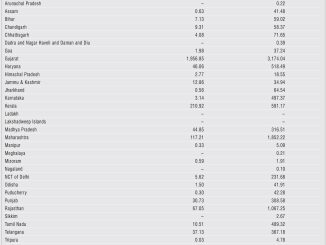
The Economic Survey 2023-24 has been published. According to the survey, 190.57 GW of renewable energy capacity has been installed in the country. Out of the total installed capacity in the year, renewable energy accounted for 43.12 per cent of total installation.
In the last ten years, there was an investment of Rs 8.5 trillion in the renewable energy sector. Expected clean energy investment in the next six years stands at Rs 30.5 trillion. This will cause a significant increase in employment in the energy sector.
In addition, the Economic Survey 2023-24 stated that India’s power transmission system operates on a single grid with a unified frequency and can transfer up to 118,740 MW. This system is becoming one of the largest interconnected electricity grids globally. By March 31, 2024, the transmission infrastructure has grown to include 485,544 circuit km of transmission lines and 1,251,080 MVA of transformation capacity.
The Indian government has intensified its efforts to improve the electricity sector to meet the growing demand for power in the country. The peak electricity demand rose by 13 per cent to 243 GW in the financial year 2023-24. The Economic Survey highlights that the most significant increase in electricity generation during this period came from renewable energy sources used by utilities.
Since the inception of the Saubhagya scheme in October 2017, a total of 28.6 million households have been connected to electricity through various programmes. Additionally, the implementation of the Electricity (late payment surcharge and related matters) Rules, 2022 has provided relief to power distribution companies, electricity consumers, and generating firms, as indicated in the survey.
The government press release states that according to the National Electricity Plan, the current non-fossil fuel capacity is approximately 203.4 GW out of the total installed capacity of 441.9 GW in 2023-24. It is estimated to increase to 349 GW in 2026-27 and 500.6 GW in 2029-30.