The solar power segment has emerged as one of the most attractive infrastructure sectors for investment. It has witnessed significant growth in recent years, driven by favourable government policies and increasing interest from investors and financiers. However, several challenges persist, including land acquisition, policy-related issues and frequent regulatory changes, which financiers are trying to navigate. Despite these challenges, the Indian solar sector presents a compelling investment opportunity, driven by the country’s ambitious renewable energy targets and the decreasing cost of solar power. At Renewable Watch’s recent conference on “Solar Power in India”, a panel of senior experts from top financing institutions shared their plans, challenges and evolving trends for solar power financing. Edited excerpts…
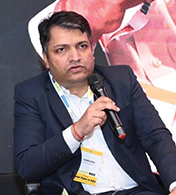 Kumar Bibhu, Vice President, SBI Capital Markets
Initially, financing solar projects was challenging, but with time, technology matured and policies became firmer. With the government’s support and policy initiatives, financing green energy has become a standard practice for every financing institution. The solar sector has become the most preferred sector despite certain policy-related challenges. The cost of capital in the sector is very competitive as compared to other infrastructure sectors. Financial support in the form of viability gap funding or production-linked incentives is crucial to make projects viable in the initial years.
Last year, we arranged a standby line of credit for a public sector renewable energy company. It is a lump-sum line and is not tied to any specific project, and is short term rather than spanning three to four years. It is available for the company to use on any project they are developing.
We believe that increasing domestic manufacturing will provide greater comfort in lending as we would be assured that the equipment is sourced from India itself. This will reduce challenges related to the supply of equipment. Institutions like PFC Limited and REC Limited have been the driving force behind the sector, and now even foreign banks are engaging positively. Greater preference is given to utility projects than C&I projects. In C&I projects, the evaluation process is more rigorous.
 Aakanksha Joshi, Partner, Economic Laws Practice
There is a lot of enthusiasm and significant investment in the green energy space. Although project risks must be considered when deciding whether to finance a project, at the end of the day, investors decide to go ahead and take the risks.
The main obstacle from a policy and regulatory standpoint in financing renewable energy projects is the lack of consistency. Development risks become financing risks. Developers are particularly concerned about the curtailment of renewable energy generation, which impacts the consistency of energy generation and receivables. This is also a criterion that financiers consider.
The government can take several steps to resolve policy-related issues, particularly around tendering and land acquisition. In previous tenders where more land was given, there was more certainty. The government has land, so policies could be implemented to make it available. Resolving the issues around connectivity, open access and transmission would also make financing more secure.
A recent feature in financing arrangements is C&I funding through virtual power purchase agreements (VPPAs). However, the regulatory landscape is still unclear. Many clients interested in VPPAs do not have clarity on the structure. This is likely to change in the next couple of years.
 Dr Nitin Kumar, Senior General Manager (Project), PFC
PFC started its journey of funding solar projects in 2011. At PFC, we have a dedicated team of 10-15 people focused on funding solar and wind projects. We have set a target of 300 GW from the solar segment and we are currently at 82 GW. Thus, there is a huge potential for growth. We have a minimum size cut-off for projects, and do not finance projects below 10 MW. There is no limit on the upper side.
Recently, we have financed projects for players like Adani and ACME. In most cases, we are the sole lender and sometimes we form a consortium. We do not prefer to lend money to projects that do not have power purchase agreements (PPAs) in place. We are also hesitant to lend to projects with weak EPC contracts and uncertain land availability. We are confident about lending to state and government projects. Around 82 per cent of our total portfolio is in the state sector.
 Robert W. Sexton, Director, Office of Energy, U.S. International Development Finance Corporation
The US International Development Finance Corporation is a US government agency operating in 125 countries. Its predecessor, the Overseas Private Investment Corporation, was expanded five years ago through the BUILD Act in the US, to increase development and financing services. The aim was to increase the amount of money we can lend to developing countries. While we are involved with many countries, we are not present in every country because we are a development finance agency. We do not do business in upper-middle income and upper income countries. We are active in Eastern European countries, Turkey, Africa and some parts of Asia.
India is one of our major markets. We have been active in the Indian energy sector since 2011. We like to work in the sandbox with other lenders, but we are usually the sole lender for utility-scale projects. We have the capacity to lend up to $1 billion for a single project, with our highest project so far being $750 million. Recently, we have also become very active in the solar manufacturing sector in India, providing $500 million in senior debt for building a solar plant, and $450 million for Tata Power Solar’s manufacturing facility. Currently, we are in discussions with other Indian solar manufacturers for providing senior debt.
In India, we can expect more of hybrids and combination projects, round-the-clock projects, and solar manufacturing projects. As a development agency, we are more involved on the front end, bringing in private capital. Once the industry takes off, we move to another sector. We are currently exploring new areas like clean equipment manufacturing, green hydrogen and green ammonia, and might also get involved in transmission systems and related equipment.
We can fund for a very long period. If it is a 25-year PPA, we can provide up to 23 years of long-term financing. We generally offer fixed-rate financing though floating rates are also an option. We fund in US dollars and do not currently have the ability to fund in local Indian currency, but we are hoping that this will change in the future. We must work with developers on currency swaps. The market for currency swaps is typically three to five years. We work with a programme of rolling currency swaps for long-term financing and every three to five years have the swap rollover. We are comfortable doing that.