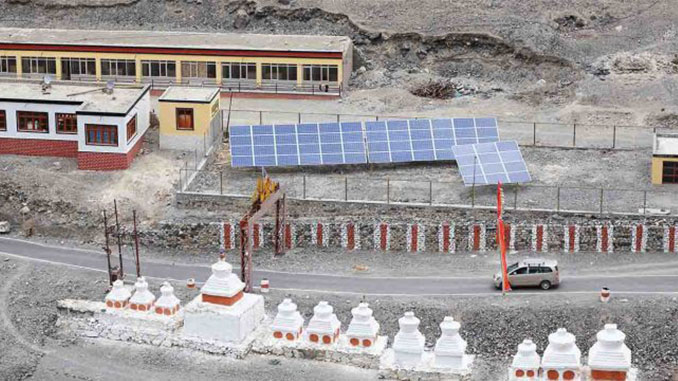
The union territories (UTs) of Jammu & Kashmir and Ladakh, despite their harsh climatic conditions, complex terrain and fragile security landscape, have made significant strides in advancing their renewable energy initiatives. Historically constrained by weak transmission infrastructure and limited grid access, the region has been on a determined path to improve electricity access and integrate clean energy solutions. Hydropower continues to form the backbone of the region’s renewable capacity, while solar energy has gained momentum through both large-scale and decentralised installations.
The Jammu & Kashmir Energy Development Agency’s ambitious target of installing rooftop solar on 20,000 buildings by the end of 2025, along with tenders for 344 MW of rooftop solar capacity under both capex and opex models, reflects the growing institutional push. Under PM Surya Ghar: Muft Bijli Yojana, over 83,000 households across Jammu & Kashmir have been targeted for rooftop solarisation by 2027. Further, Jammu city has been selected as one of 34 cities to be developed as solar cities.
Ladakh has also witnessed commendable activity in the renewables space. A proposed 13 GW hybrid renewable energy park, spanning Pang, Debring and Kharnak, is set to integrate solar, wind and battery energy storage systems (BESSs). Moreover, a 25 MWac/50 MWdc grid-connected solar photo voltaic project with a 40 MWh BESS is being implemented in Taru, Leh, by the Solar Energy Corporation of India. To support the evacuation of renewable power from such high-altitude zones, the interstate transmission system under Green Energy Corridor Phase II is being implemented, with an estimated investment of Rs 207.73 billion.
In a landmark development, Ladakh launched India’s first hydrogen fuel cell bus service at the high-altitude station in Leh in June 2025, with five buses handed over by NTPC Limited to the State Industrial Development Corporation. This was followed by the commissioning of a hydrogen fuelling station and green hydrogen mobility station in Leh in November 2024.
Despite these positives, the UTs still need to address persistent issues such as high aggregate technical and commercial losses, limited last-mile connectivity and infrastructure bottlenecks. The planned renewable energy and grid enhancement projects are expected to go a long way in easing these constraints and strengthening the region’s energy ecosystem. Renewable Watch provides an overview of the power sector in the UTs of Jammu & Kashmir and Ladakh. The data in the graphs is cumulative of both UTs….