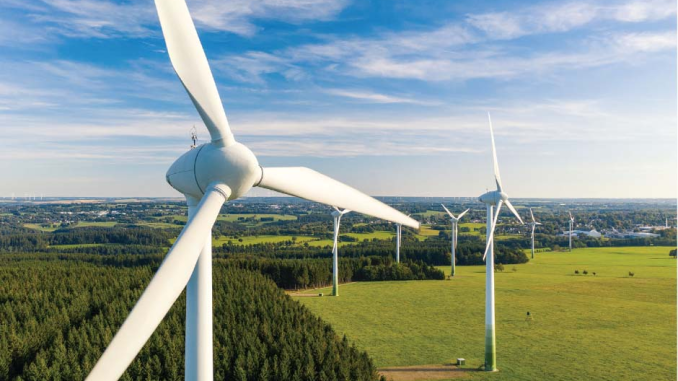
India ranks fourth, globally, in installed wind power capacity, with over 45.9 GW as of March 2024, according to the Ministry of New and Renewable Energy (MNRE). Wind energy is a critical component of India’s clean energy transition, with the country aiming to reach 500 GW of non-fossil-fuel based energy and net-zero emissions by 2070. As India’s wind market matures, optimising the performance of the existing fleet will be as important as developing greenfield projects.
In this article, Renewable Watch provides an overview of the current state of the Indian wind market and emerging O&M trends that will be pivotal to maximising energy production and financial returns from this segment…
Market landscape
In 2023-24, India added 3.25 GW of new wind capacity, a significant increase from the 2.27 GW added in 2022-23. This recovery was driven by a series of policy changes in 2022-23:
- Revising the wind tender mechanism from reverse bidding to a closed envelope model
- Carving out a specific wind renewable purchase obligation (RPO) trajectory, increasing it to 6.94 per cent by 2030
- Announcing a bidding trajectory of 50 GW of renewable auctions annually till 2027-28, with 10 GW earmarked for wind
- Publishing a roadmap for quarterly wind auctions in 2023-24 by different agencies.
Central and state wind tenders have picked up steam in the past couple of years. As of December 2023, India’s active wind project pipeline stands at 19.2 GW. The RPO trajectory introduced by the Ministry of Power is expected to drive significant additional wind demand from discoms, compared to the current installed capacity. Many key states have already committed to procuring substantial new wind power volumes in their RPO budgets.
Based on a “base case” scenario, the Global Wind Energy Council (GWEC) has forecasted 21.7 GW of new onshore wind installations in India from 2023 to 2027, bringing the cumulative capacity to 63.6 GW. Annual installations are expected to increase steadily from 2023 levels, peaking in the middle of the decade before the expiration of key incentives such as interstate transmission charge waivers. An “ambitious case” is possible if RPO demand fully aligns with central targets and commercial and industrial (C&I) procurement accelerates. A more conservative case accounts for potential challenges around the new bidding mechanism, transmission charges and project delays.
In addition to onshore wind, the emerging offshore wind segment holds promise, though it is unlikely to yield the commissioned capacity by 2027. The MNRE released an ambitious offshore wind strategy in 2022, targeting tenders for multi-GW capacity by 2030, primarily in Gujarat and Tamil Nadu. This has laid the groundwork for offshore to play a larger role in India’s energy mix in the 2030s. All of this upcoming and installed capacity presents a significant market opportunity for players in the wind O&M space.
Wind O&M segment
The wind industry’s aftermarket service offerings encompass various components, ranging from basic corrective maintenance to scheduled preventive maintenance, as well as specialised repair and replacement services for critical components such as blades and gearboxes. Additionally, this service segment incorporates advanced predictive maintenance techniques that leverage SCADA systems and other digital asset management tools to optimise performance and generate revenue opportunities. Furthermore, it includes services for extending the operational lifetime of wind turbines and partial repowering.
As the wind energy sector matures, the aftermarket service business has emerged as a significant secondary revenue stream for the industry to rely upon. As per statistics reported by GWEC, leading wind turbine original equipment manufacturers (OEMs) derive 8-19 per cent of their revenues from the service business, which exhibits significantly higher profitability, typically with double-digit earnings before interest and taxes margins (exceeding 20 per cent in some cases). This contrasts with the turbine production business, where major Western turbine OEMs have experienced negative margins in 2022.
Global O&M trends
Offshore wind accounts for a disproportionately high share of the global O&M market by value vis-a-vis its share of total installed capacity, as offshore O&M is much more complex and costly than onshore. However, onshore wind still comprises the majority of the overall O&M market. Europe is currently the largest regional market for wind O&M services, followed by Asia Pacific and North America. China is expected to become the single largest country market for wind O&M by the middle of the decade, driven by its massive and rapidly expanding installed base. The US, Germany, India and the UK are other key O&M markets.
A major global trend is the increasing use of predictive maintenance approaches, supported by AI, machine learning (ML) and drone inspections, to improve O&M efficiency. There is also a focus on product innovations in turbine components and materials to reduce failure rates and extend operational life. For the offshore sector, the increasing water depth and distance from shore of new projects will pose O&M challenges.
At the same time, there is a trend towards consolidation among O&M service providers, as leading OEMs seek to acquire independent players. Staying competitive will require companies to invest in digital O&M solutions and expand their geographic footprints.
India’s O&M market
The O&M market in India has traditionally been dominated by local and international wind turbine OEMs, controlling over 75 per cent of the market share. However, in recent years, the number of independent service providers (ISPs) has increased, allowing them to capture up to 25 per cent of the O&M market share. Currently, more than 10 ISPs offer comprehensive O&M services for various wind turbine generator (WTG) models across India, while a few others are active in specific states such as Tamil Nadu, Gujarat, Rajasthan, Karnataka and Madhya Pradesh.
Indian ISPs and OEMs have adopted proven technologies and best practices for O&M, including techniques for handling heavy equipment, nacelle-mounted wind monitoring units, crane-less technology, central monitoring systems (CMS), lasers, and advanced AI and ML for predictive maintenance through deep data analytics. The adoption of technological advancements, along with the trend of comprehensive service agreements between developers and O&M contractors, has led to a decrease in per MW O&M costs, covering various components such as repair works, spare parts and insurance.
Nearly all asset owner-operators (IPPs) have established partial in-house O&M set-ups with CMS or open operation platforms. Major IPPs such as ReNew Power and Sembcorp have their own service units with full O&M capabilities to reduce their dependence on OEMs for long-term O&M, and improve the performance of their wind turbines.
Due to supply chain disruptions over recent years, a demand for reverse engineering has emerged within India, particularly for components such as gearboxes and bearings. This is aimed at addressing procurement delays and reducing dependence on imported components and spare parts.
With an already substantial installation base of over 45 GW in operation, India’s recently announced 8 GW annual wind power auction plan for 2023-30 is likely to present additional opportunities for O&M service providers, once the existing turbines come out of warranty. However, to capitalise on these opportunities in the growing service market, both ISPs and IPPs will need to enhance their capabilities and resources to cover new WTG models with power ratings ranging from 3.x to 5.x MW.
Conclusion
With stronger policy support, renewable purchase obligations and growing C&I demand, India’s wind market is poised for a resurgence. Achieving the country’s 140 GW wind target by 2030 will require sustaining a significantly higher rate of annual installations for the rest of the decade. Capturing this potential is critical for India’s clean energy transition, energy security and decarbonisation goals.
However, this ambitious growth must be matched by a strong focus on operational excellence across India’s expanding wind fleet. As projects age and new installations accelerate, adopting O&M best practices will be essential, including building out a competitive independent services market, leveraging digital solutions for condition monitoring and predictive maintenance, optimising project life through extension and repowering, enhancing logistics and inventory management, and strengthening the local supply chain for O&M.
Proactive asset management and O&M strategies to maximise the performance, reliability and longevity of wind farms will be crucial to delivering on India’s bold renewable energy vision. The health of the country’s wind O&M ecosystem will be a major factor in determining the long-term viability and investment potential of this vital clean energy resource.