

 Situated amidst the Himalayas, the northeastern region (NER) of India comprises seven sister states of Arunachal Pradesh, Assam, Manipur, Meghalaya, Mizoram, Nagaland and Tripura, along with the state of Sikkim. The NER, characterised by mountainous terrain and perennial streams, is abundant in natural resources. It, therefore, has significant hydropower potential. At present, the northeastern states are striving to increase their renewable energy capacity to align with the rest of the country. However, considering the existing infrastructure conditions and the region’s environmental sensitivity, it is essential to redirect these efforts to specifically address its unique energy challenges.
Current status
As per a Rajya Sabha question (April 7, 2022), the NER is estimated to have a renewable energy potential of around 129 GW from various sources. According to the Ministry of New and Renewable Energy (MNRE), as of February 29, 2024, only 4,943.31 MW of renewable capacity has been installed in the region, constituting less than 4 per cent of its total potential. Of this, 83 per cent is accounted by hydropower plants. The northeastern states have a combined hydropower potential of around 55,930 MW (for projects larger than 25 MW). Of this, Arunachal Pradesh alone has the largest potential of 50,328 MW. Of the large hydro plants installed, the highest installed capacity has been set up in Sikkim with 2,282 MW, followed by Arunachal Pradesh (1,115 MW), Assam (350 MW), Meghalaya (322 MW), Manipur (105 MW), Nagaland (75 MW) and Mizoram (60 MW). Meanwhile, the estimated potential for small-hydro projects in the region stands at 3,261.49 MW, with major potential in Arunachal Pradesh (2,064.92 MW), followed by Sikkim (266.64 MW), Meghalaya (230.05 MW) and Assam (201.99 MW). Against this, the combined installed small-hydro capacity across the states stands at 321.85 MW as of February 29, 2024.
Moreover, the renewable energy capacity potential in the NER, encompassing solar, small hydro and bioenergy, is estimated to be approximately 65,837 MW, of which only 610 MW has been realised, according to North Eastern Electric Power Corporation Limited (NEEPCO). Assam has a significant bioenergy potential of 276 MW. Additionally, despite a solar power potential of around 62,300 MW in the NER, particularly in Assam, Manipur and Mizoram, only 236.87 MW has been harnessed. Furthermore, the wind power potential is 300-500 MW, especially at low hub heights of 50 and 80 metres. This potential too remains unexploited in the states of Arunachal Pradesh, Assam, Manipur and Meghalaya.
Key developments
The focus on renewable energy development in the NER has been ongoing since the 1990s. However, progress was somewhat sluggish until 2019, when the government announced plans for the development of large hydropower plants to harness the previously unexplored areas of the Northeast and fully tap the region’s green energy potential. In order to establish conducive regulatory frameworks and encourage private sector involvement, the Arunachal Pradesh and Sikkim governments implemented power policies aimed at facilitating private participation and attracting capital investments. Additionally, the central government extended support for renewable power generation in the NER by offering special incentives. This includes a capital grant of Rs 22.5 million per MW for small-hydro projects. Substantial investments, amounting to £980 million, have already been allocated for the enhancement of power systems in the northeastern states, as per Invest India.
Furthermore, the Power Grid Corporation of India is implementing two major schemes aimed at enhancing the transmission network in the region. These include the North Eastern Region Power System Improvement Project, focusing on strengthening the 33 kV and above intra-state transmission and distribution systems in six states (Assam, Manipur, Meghalaya, Mizoram, Tripura and Nagaland) with an approved budget of about Rs 67 billion. Additionally, there is a comprehensive scheme for strengthening the transmission and distribution system in Arunachal Pradesh and Sikkim, approved at an estimated cost of Rs 91.29 billion. To enhance the reliability, capacity and security of the power transmission network in the NER, India and the Asian Infrastructure Investment Bank entered into a loan agreement worth $304 million for the Assam intra-state transmission system enhancement project. The state cabinet also sanctioned the execution of the Revamped Distribution Sector Scheme in Assam, involving an investment of Rs 87.27 billion. This includes the development of a high voltage distribution system and the establishment of new substations and lines, among other components. Moreover, the government allocated a tariff subsidy of Rs 1.37 billion to Assam Power Distribution Company Limited.
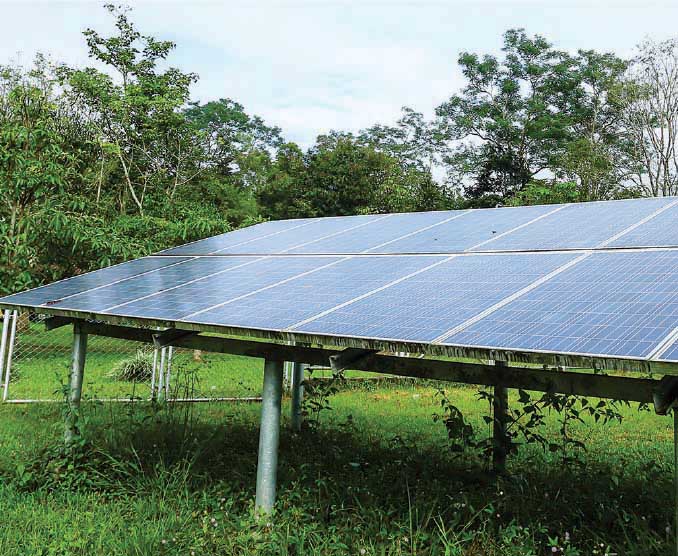
The NER has also made some positive strides in the solar energy space. As of March 31, 2019, the MNRE has granted approval for setting up projects worth more than 55 MWp capacity in different northeastern states. Additionally, progress has been made in promoting solar energy through the deployment of solar stree lights, with over 1 million functional lights reported. As of March 31, 2021, the Saubhagya scheme has resulted in the electrification of 2,614,659 households since its initiation in the region. Furthermore, the MNRE is currently executing multiple schemes aimed at harnessing renewable energy, particularly solar energy. One such initiative involves increasing the residential rooftop solar capacity by 4,000 MW in the states, supported by central financial assistance. Additionally, financial support of up to Rs 2.5 million per solar park is being provided for detailed project report preparation and up to Rs 3 million per MW or 30 per cent of the project cost (whichever is lower) for infrastructure development. Further, under the grid-connected solar rooftops scheme in Assam, solar energy companies receive a 70 per cent subsidy from the government.
As of January 2024, out of the total large hydro capacity installed in the NER, including Sikkim, more than 50 per cent has been installed by the centre, around 30 per cent by the state governments, and only 8 per cent has been set up by the private sector. The projects have primarily been set up by public sector undertakings such as NHPC Limited, state utilities and NEEPCO. The private sector is concentrated mainly in Sikkim, with Gati Infra, Sneha Kinetic Power Projects, Shiga Energy, DANS Energy and MBPC having installed 512 MW large hydro projects across the state. Additionally, Virtuaal Infrapower is implementing small-hydro projects with a total capacity of 37.5 MW in Keyi and Pareng districts. Recently, Kundan Green won bids to set up a 21 MW and an 18 MW small hydroelectric project (HEP) at Rellichu and Myong Chu respectively in the state. Moreover, construction work has recently commenced for 120 MW of solar power projects of SJVN Limited in Khudigaon and Sonitpur districts in the state. Further, NTPC has signed an MoU with the Tripura government for setting up a 130 MW floating solar power project on Dumbur lake at an investment of Rs 7 billion. There has been some development in the biomass sector, with the Nagaland government signing a PPA with Hutah Industries for setting up a 10 MW biomass power project at Ganesh Nagar in Dimapur district. Moreover, the Arunachal Pradesh government has signed an MoU with the Norwegian Geotechnical Institute to collaborate and explore the feasibility of harnessing geothermal energy from the state’s hot springs. At present, there are eight HEPs being built in the NER, with a combined installed capacity of 6,037 MW. Additionally, the Central Electricity Authority (CEA) has approved 17 HEPs in the NER, totalling 14,589 MW in capacity.
The way forward
As per CEA estimates, the NER is anticipated to reach a renewable energy capacity of 10,256 MW by 2031-32. Meanwhile, the projected growth in electrical energy consumption is estimated to increase from 16,858 MUs in 2023-24 to 27,573 MUs in 2031-32. To achieve this potential, the region must explore the adoption of alternative power sources. With 64 per cent forest cover and hilly terrain in the NER, the utilisation of small-scale decentralised renewable energy microgrids has the potential to significantly boost the adoption of renewable energy. The region also boasts substantial small-hydro power capacity, constituting around 7 per cent of the total small-hydro capacity installed in India. Therefore, the government can encourage the development of small-hydro projects, known for their cost-effectiveness and speedy implementation, augmenting the power generation capacity in the region. Also, given the region’s terrain, there is a need to revamp resource mapping using advanced technologies such as drones, remote sensing and geographical information systems so that the region’s renewable energy potential can be efficiently tapped.
There are several challenges and issues that must be addressed for the NER to increase its share of clean energy. Due to its poor infrastructure, harsh climate, protracted land acquisition processes, restricted access to capital and advanced technology, high transportation costs, inadequate renewable energy policies, and political sensitivity, the NER currently has the lowest per capita energy consumption in the nation, with figures equivalent to one-third of the national average (488 kWh in 2021). Moreover, the challenging topography results in higher infrastructure expenses. As such, the region considers procuring energy from states with higher generation capacity a more cost-effective option, given the exemption from inter state transmission system charges. This situation and the scarcity of lucrative PPAs have led to a lack of enthusiasm among private developers. The NER depends heavily on hydropower to meet the majority of its power requirements. This dependence may become a concern, especially given that climate change has led to a decline in rainfall, resulting in consistently decreasing reservoir levels and causing prolonged power outages. Another significant limitation arises from limited solar irradiation and the lack of wind energy potential.
Nonetheless, the MNRE is actively planning to launch a comprehensive scheme designed specifically to boost renewable energy in the Northeast. A concept note is expected to be unveiled, outlining the vision for the NER to attain energy independence by 2030 and lower its dependence on other states to meet its renewable purchase obligation target.
Overall, the northeastern states have made progress in adopting renewable energy in recent years. Going forward, a comprehensive strategy and collaboration among all stakeholders is imperative for the region to not only tap its full hydro potential but also diversify its energy mix by promoting decentralised renewable energy sources.
By Sakshi Bansal

