 By Gaurav Patel, Manager (Energy & Utilities), and Manan Thapar, Director (Energy & Utilities), Research Triangle Institute International India
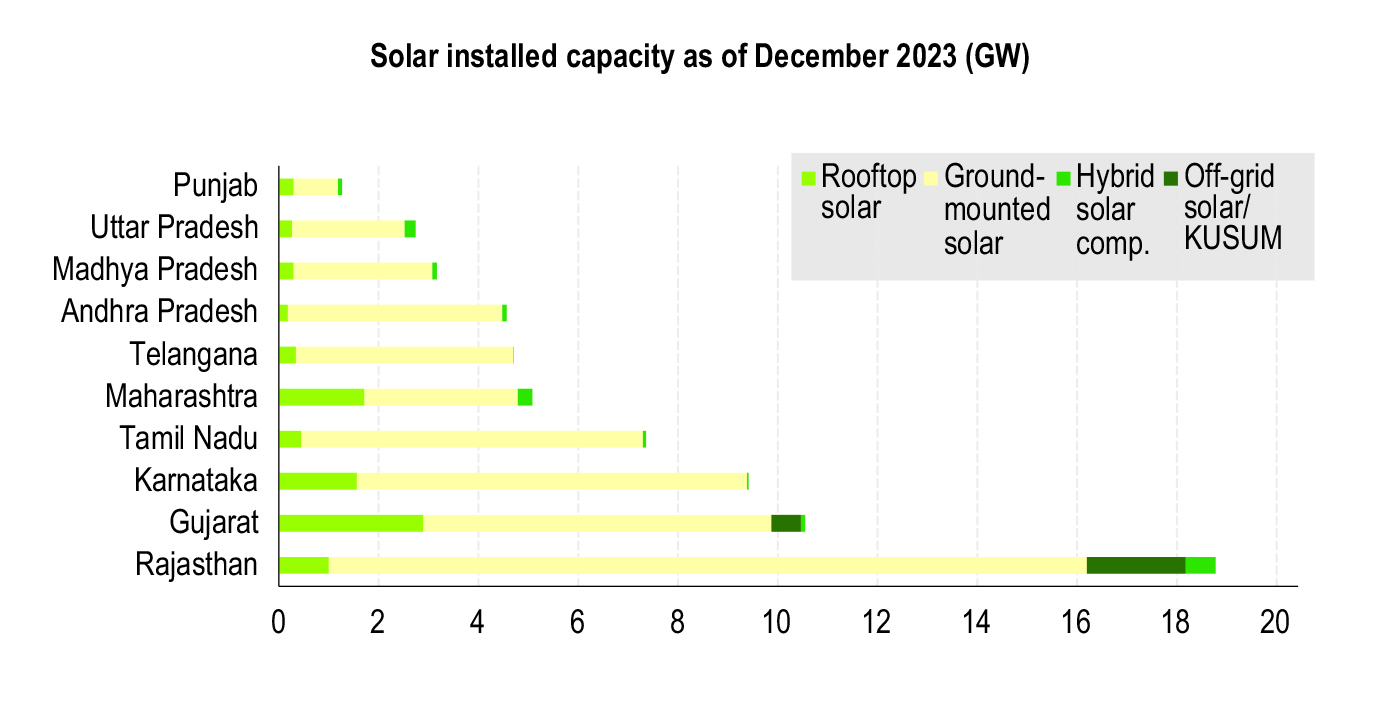
Rajasthan, which has the highest solar radiation in the country, has been harnessing the resource for a long time, with the current installed capacity standing at 18 GW. This is 25 per cent of the installed solar capacity of the country. While ground-mounted accounts for 80 per cent of this solar capacity, rooftop contributes only 5.4 per cent (Fig 1).
Potential of rooftop solar PV
The three state government-owned distribution companies of Rajasthan have a cumulative LT consumer base of over 13 million (excluding agricultural consumers). These LT connections consume more than 30 per cent of the state’s total energy. As per an estimate by the National Renewable Energy Laboratory, the global horizontal irradiance (GHI) in Rajasthan is in the 5-6.5 kWh per m2 per day range, one of the highest in the country. These factors point towards a huge market opportunity for domestic solar rooftop photovoltaic adoption in the state.
Despite its strong potential, Rajasthan has lagged behind in harnessing rooftop solar PV vis-à-vis other states such as Gujarat, Maharashtra and Karnataka. As per information shared during the Vibrant Gujarat Summit 2024, 500,000 homes (out of approximately 15 million LT connections) in Gujarat have adopted rooftop solar. Meanwhile, only 25,000 homes (out of approximately 13 million LT connections) in Rajasthan have opted for rooftop solar. So, there is huge potential to convert LT consumers to prosumers in Rajasthan.
Why rooftop solar is essential for Rajasthan
 State discoms are facing a deficit in peak power and have to rely on the short-term market to fulfil the gap; this leads to an increase in the overall power purchase cost for them. It also shoots up the financing cost and puts a burden on the subsidising categories of commercial and industrial (C&I) consumers. C&I consumers have to bear the brunt of additional cross-subsidisation, which could go up to as high as 47 per cent for some categories. Furthermore, the discoms are currently operating with distribution losses, which exceed the state regulatory norms. These issues, coupled with network reliability concerns, contribute to the overall operational costs of the discoms, resulting in financial strain and a necessity for tariff adjustments.
 In Rajasthan, the majority (75.15 per cent) of consumers are located in rural areas, posing distinctive challenges in the supply, consumption and revenue realisation of grid electricity supply. Unlike urban areas, where feeders are often loaded in small zones, rural regions require longer distribution feeders with lower consumption. This situation highlights the potential benefits of exploring rooftop PV solutions to address the specific needs of rural areas. Remarkably, the integration of mass-scale rooftop solar PV can reduce the overall power purchase cost requirement for a discom, while managing local demands and reducing T&D losses in
the system.
Further, the discoms are required to meet the overall target set by the central and state government in their policies and regulations, such as renewable purchase obligation (RPO) and energy storage obligation (ESO) compliance, net zero targets, resource adequacy planning, and the Rights of Consumer Rules, 2020 (and its amendments).
In October 2023, the Ministry of Power notified that the designated consumers under the Bureau of Energy Efficiency are mandated to fulfil the RPOs through various sources of renewable energy, including distributed renewable energy. Discoms are also one of the designated consumers under Perform, Achieve and Trade (PAT) Cycle II.
Bottlenecks in rooftop solar PV adoption
To foster the growth of rooftop solar PV in Rajasthan, it is important to address challenges such as the lack of awareness, infrastructure issues, and policy and regulatory challenges. In the recent past, Right to Information conducted a field survey for over 6,500 households (both rural and urban), and over 750 small- and medium-scale enterprises across Rajasthan in over nine districts. It was observed that, on average, 55 per cent of respondents were eager to adopt distributed energy technologies, solar rooftop in particular; however, they felt constrained due to the lack of sufficient knowledge and awareness of financing options.
The survey also delved into the issue of local distribution network strengthening, which is needed for the integration of distributed energy resources with grid infrastructure. According to the survey findings, while the majority of distribution transformers (DTs) are proficient in handling the current load, there is a need to upgrade nearly 80 per cent of the DTs to facilitate both the increase in average load requirements due to increasing appliance penetration as well as renewable energy adoption at the LT level. Moreover, 60-70 per cent of the current rooftop installations are concentrated in only four districts (Jaipur, Ajmer, Alwar and Bhilwara) out of the total 50 districts (Fig 2). This underscores the constrained uptake and incorporation of rooftop solar PV in the state and highlights the need to enhance consumer awareness.
There are some regulatory dilemmas concerning renewable energy loading on the DTs. The Grid Interactive DRE System – First Amendment 2023 relaxed the earlier limit of 50 per cent loading on DT to 80 per cent of the capacity. In contrary to the RERC order, the recent Rajasthan Renewable Energy Policy, 2023 refers to the earlier limit of solar rooftop capacity addition of up to 50 per cent of the DT capacity. Such differences can delay the approvals by the discoms or can create hurdles in increasing the uptake by customers and suppliers.
The way forward
Government and regulatory support
The state government can encourage discoms to utilise the maximum benefits from various central government schemes and create state-specific funds. On January 22, 2024, the prime minister launched the ambitious Pradhan Mantri Suryodaya Yojana with the objective of installing rooftop solar systems for 10 million homes. Rajasthan can aim to take advantage of this initiative.
There are also concerns over delayed financial assistance to domestic consumers, and this needs to be resolved in a timely manner. The Rajasthan government plans to develop solar cities, where solar rooftops will play an enabling role in increasing the state’s renewable energy footprint.
Loading on the DT capacity can be increased to 80 per cent or more, based on technical feasibility at a particular site. Regulators can introduce attractive features in the tariff for adopting solar energy utilisation for EV charging during the daytime and its energy settlement, which can reduce the network congestion by charging, and locally generated power can be consumed on the same premises (such as industries, hospitals, commercial complexes and educational institutes). The regulators can also enable battery storage systems with rooftop solar PV (BSS-RTPV) for behind-the-meter and front-of-the-meter energy storage, by offsetting the high capex of BSs from the energy settlements. These systems can help increase network reliability and reduce fluctuations in the grid, making the energy cost viable for industrial and commercial consumers by reducing CSS, AS and other surcharges such as wheeling charges and demand charges.
Awareness and customer resolutions
The Rajasthan government can increase the rooftop solar awareness using innovative promotion ideas such as AI-powered chatbots, offline awareness campaigns, social media infographics and advertisements in the media. The awareness programme should include not only customers but also discom officers and field staff, who need to engage with customers for supporting rooftop solar installations.
 Operational efficiencies for discoms
Discoms can focus more on achieving operational efficiencies, as well as robust power and infrastructure planning, through the strategic adoption of rooftop solar. They should take maximum benefits of various government schemes (such as the RDSS and UDAY) for infrastructure and operational improvements. Any loss prevention or improved planning is beneficial to discoms, customers and governments. The discoms can encourage rooftop solar adoption such that it can fulfil the RPO and ESO requirements while adhering to the Rights of Consumer Rules, 2020, reducing expensive procurements from the short-term power market.
Technical upgrade and demand aggregation
Tenders with old specifications need to be upgraded to improved technologies; this could result in increased efficiency, higher quality output, better controllability and reliability, and a better payback. Demand aggregation activities could help integrate a large quantity of solar rooftop power plants into the grid at attractive prices and improved quality standards.
Quality control
The RREC as well as the discoms can undertake periodic, random sampling for assessing rooftop solar quality and performance through third-party inspection. This method has been adopted by Gujarat, which increased awareness about the importance of quality of rooftop solar PV among consumers and vendors. This move is expected to help identify and penalise vendors having substandard quality of products and services.
Rooftop solar PV vendors can be also assessed through independent EPC ratings such as the Vendor Rating Programme (VRP) developed by the United States Agency for International Development and the Confederation of Indian Industry. Such ratings evaluate rooftop vendors on multipoint quality checks required for ideal rooftop installations.
Stakeholder participation and capacity development
The government should create more enabling policies and entrepreneurship workshops for promoting rooftop solar installations. To support the market, financial institutes can increase soft finance for the solar rooftop vendors/customers. On their part, vendors can bring market development activities, increasing competition in quality and spreading awareness.
The state government can plan more capacity development programmes (such as design, installation, O&M, and performance assessment) for various stakeholders (consumers, vendors, discoms, financial institutes, key government departments, etc.) to remove the barriers and speed up the uptake of rooftop solar PV in Rajasthan.