

 India’s micro, small and medium enterprises (MSMEs) account for nearly one-third of its GDP and almost half of its exports, making them central to the country’s industrial growth, as per the Economic Survey 2025-26. As global supply chains increasingly prioritise low-carbon manufacturing and sustainable sourcing, MSMEs are coming under pressure to reduce their environmental footprint. At the same time, rising electricity tariffs, increasing competitiveness in manufacturing and evolving sustainability requirements have strengthened the business case for solar power, energy efficiency and other green technology investments. However, access to affordable finance remains one of the biggest barriers to wider adoption.
Over the past few years, the green finance ecosystem for MSMEs has evolved significantly. Government-backed interest subvention schemes, concessional lending programmes, multilateral lines of credit and specialised financing platforms have expanded financing options for clean energy investments. Meanwhile, falling solar costs, technology innovation and greater familiarity among lenders have made renewable energy projects considerably more bankable. However, policy uncertainty across states, varying regulatory frameworks, inconsistent implementation and limited awareness among smaller enterprises continue to influence investment decisions.
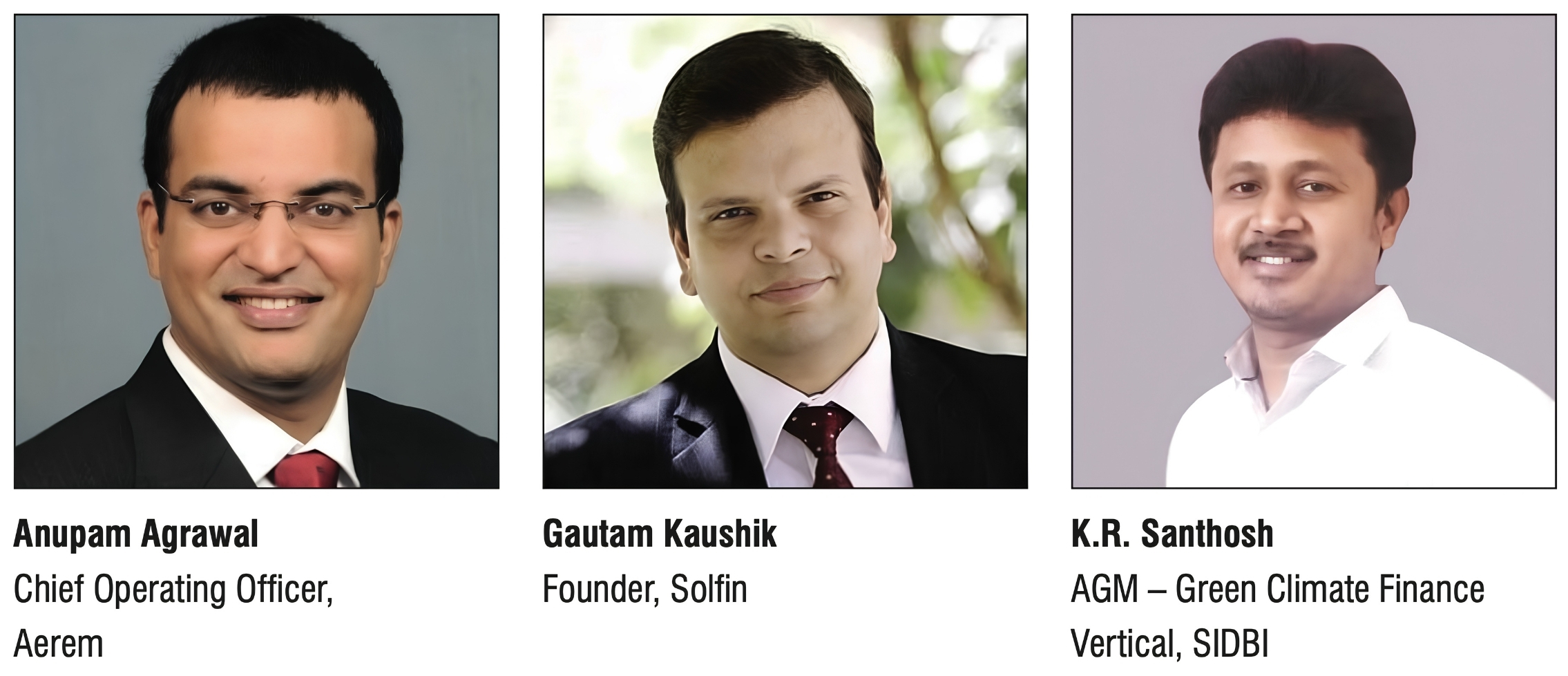
Against this backdrop, Renewable Watch organised a webinar on “Green Finance for MSMEs” on July 31, 2026. This article presents key insights from the panel discussion among Anupam Agrawal, Chief Operating Officer, Aerem; Gautam Kaushik, Founder, Solfin; and Santhosh K.R., Assistant General Manager – Green Climate Finance Vertical, Small Industries Development Bank of India.
 Building a supportive green finance ecosystem
Government support has played an important role in reducing financing barriers for MSMEs seeking to adopt renewable energy and other sustainable technologies. While clean energy investments often require significant upfront capital, a combination of interest subvention schemes, capital subsidies and concessional lending programmes has gradually improved project viability and encouraged financial institutions to participate more actively in the segment.
According to Santhosh K.R., the increasing emphasis on low-carbon manufacturing in global supply chains has made green investments less of an environmental responsibility and more of a business necessity for MSMEs. Buyers, particularly large industries and international customers, are increasingly expecting suppliers to adopt renewable energy, improve energy efficiency and integrate sustainable manufacturing practices into their operations. This transition, however, requires both policy support and access to affordable finance.
Hence, to facilitate greater adoption of green technologies among MSMEs, the Ministry of Micro, Small and Medium Enterprises introduced the MSE Green Investment and Financing for Transformation (MSE GIFT) scheme. The scheme provides a 2 per cent interest subvention for investments of up to Rs 20 million across nearly 890 approved green technologies, including rooftop solar, energy efficiency solutions and effluent treatment systems. The scheme has already supported more than 6,500 MSMEs, with approximately Rs 49 billion deployed. The scheme concluded on March 31, 2026. Other important initiatives include the Scheme for Promotion and Investment in Circular Economy (MSE-SPICE), which promotes circular economy investments through capital subsidies of up to 25 per cent, subject to a ceiling of Rs 1.25 million; and the Ministry of Power’s Assistance in Deploying Energy Efficient Technologies in Industries & Establishments (ADEETIE) scheme, which offers interest subvention of 5 per cent for micro and small enterprises and 3 per cent for medium enterprises while also reimbursing the cost of detailed energy audits and supporting monitoring and verification activities across 60 industrial sectors.
State governments have also emerged as important enablers. States such as Gujarat, Tamil Nadu, Rajasthan, Punjab, Haryana and Karnataka have introduced green investment incentives, including interest subventions and capital subsidies. These incentives, coupled with improving grid infrastructure and greater lender confidence in proven technologies, have contributed to increasing investments in rooftop solar and energy efficiency projects.
Financing models evolve alongside MSME demand
As policy support has expanded, specialised lenders and fintech platforms have emerged as an important link between government initiatives and on-ground implementation. While conventional lenders have traditionally focused on collateral-heavy lending, newer financing models are increasingly addressing the unique requirements of distributed renewable projects by simplifying loan processes, reducing turnaround times and developing financing products tailored specifically for rooftop solar installations.
Financing has gradually shifted from being a supporting element to becoming a primary driver of solar adoption among MSMEs. According to Agrawal, the conversation with prospective customers has evolved significantly over the past few years. Rather than questioning whether solar is technically viable, most MSMEs are now interested in the expected monthly savings and the financing options available to them.
Kaushik observed a similar trend. He shared that within the MSME segment, financing ranges from relatively small rooftop installations of 10-12 kW requiring loans of Rs 500,000-Rs 600,000 to megawatt-scale projects. Besides conventional term loans, financiers are increasingly offering financial lease structures, allowing enterprises to service repayments through savings generated from lower electricity bills rather than making large upfront capital investments.
Government incentives, while beneficial, are no longer the sole drivers of solar adoption. A large proportion of MSMEs continue to invest in rooftop solar even without access to subsidy programmes. Rising industrial electricity tariffs have significantly improved project economics, making financing speed, convenience and certainty increasingly important differentiators.
Policy and implementation challenges
Despite the steady evolution of the green finance ecosystem, the panellists agreed that scaling clean energy adoption among MSMEs will require addressing several policy, regulatory and implementation challenges that continue to influence investment decisions. Interestingly, the discussion suggested that access to finance is no longer the principal constraint in many cases. Instead, uncertainties around policy implementation, variations across states and inconsistencies in project execution are emerging as key considerations for both lenders and borrowers.
One of the recurring themes throughout the discussion was the need for greater policy stability. According to both Kaushik and Agrawal, financing institutions can structure products around almost any regulatory framework, provided the rules remain consistent over the project life. Frequent changes in regulations relating to domestic content requirement, net metering, banking provisions and time-of-day tariffs create uncertainty regarding future project economics. This, in turn, impacts lenders’ ability to accurately assess long-term cash flows and determine appropriate financing tenors. Variations in state-level implementation further compound the challenge. While states such as Rajasthan and Gujarat have established relatively stable regulatory environments and faster net metering approvals, other states continue to face challenges such as longer approval timelines, policy uncertainty and uneven project execution, resulting in delayed investments and, in some instances, project cancellations.
Moreover, since there is no standard qualification framework for EPC contractors, installation quality varies significantly across markets. According to Agrawal, financiers increasingly undertake detailed technical due diligence before approving loans, assessing factors such as system sizing, rooftop suitability, equipment selection, plant layout and overall engineering quality. In several instances, projects have been found to be oversized relative to the available rooftop area, potentially affecting long-term performance and repayment capacity. Consequently, lenders now evaluate not only the financial strength of the borrower but also the technical capability, track record and execution quality of EPC contractors. Financing platforms undertake several technical checks before sanctioning a project to ensure that projected electricity generation and savings are realised over the asset’s life.
From the institutional lending perspective, Santhosh K.R. noted that green investments continue to pose distinct financing challenges, particularly for newer technologies. Besides evaluating borrowers, lenders must assess compliance with evolving technical requirements such as the Approved List of Models and Manufacturers regulations, equipment certifications and technology risks. Dedicated de-risking mechanisms, including partial risk-sharing facilities and thematic credit guarantee programmes specifically designed for green investments, should also be the focus areas going forward.
The way forward
MSMEs have reached an important stage of maturity. Financing products are expanding, lender confidence has improved and policy support has become more structured than it was a decade ago. For most MSMEs, the primary question is no longer whether solar is financially viable but how quickly projects can be implemented.
Going forward, maintaining a stable and predictable policy environment will be critical. Consistency in regulations, timely net metering approvals, stronger coordination across states, and continued expansion of concessional financing mechanisms will remain essential for sustaining investor confidence. At the same time, continued awareness generation among MSMEs, improved quality standards for project execution and the expansion of risk-sharing mechanisms for emerging technologies can help broaden adoption beyond rooftop solar to segments such as battery energy storage, energy efficiency and compressed biogas.
