By Aastha Sharma
India’s transmission sector is currently marked by substantial infrastructure expansion and the adoption of cutting-edge technologies, positioning the country’s electricity grid as one of the largest synchronous grids globally. The sector has played a key role in supporting India’s growing energy demand while facilitating the integration of renewable energy sources. These advancements are pivotal as India works towards achieving its ambitious climate goals and modernising its energy infrastructure for future needs.
Renewable Watch takes a look at the key trends and developments shaping the power transmission segment…
Segment size and growth
As of August 2024, the total length of transmission lines at the 220 kV level and above stood at 488,423 ckt km, comprising 55,202 ckt km at the 765 kV level, 204,787 ckt km at the 400 kV level and 209,059 ckt km at the 230/220 kV level. At the high voltage direct current (HVDC) level, line length stood at 9,655 ckt km at the ±800 kV level, 9,432 ckt km at the ±500 kV level and 288 ckt km at the ± 320 kV level.
The total transmission line capacity addition during 2023-24 was 14,203 ckt km. In 2024-25, as of August 2024, the segment added 2,879 ckt km of line length. Further, the country’s total interregional capacity stood at 118,740 MW, as of August 2024.
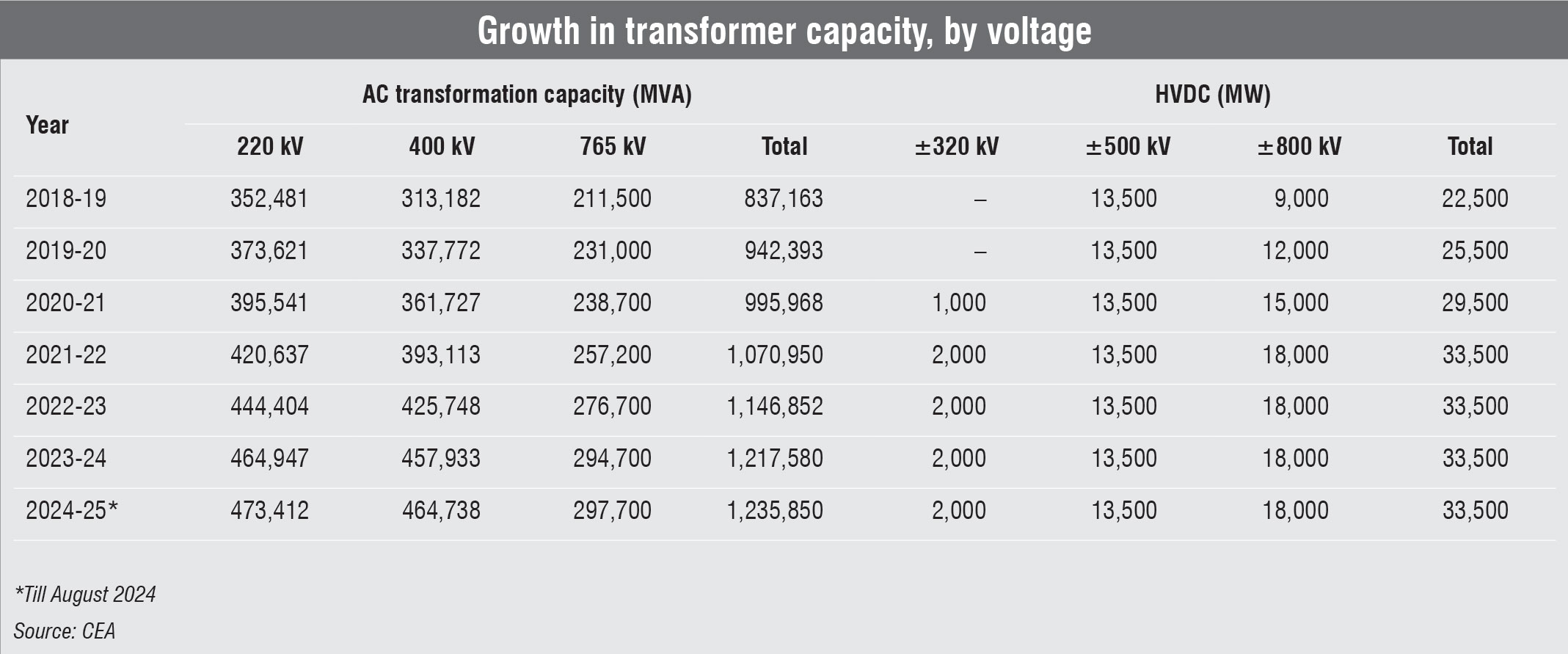
The total transformation capacity stood at 1,269,350 MVA as of August 2024, comprising 297,700 MVA at the 765 kV level, 464,738 MVA at the 400 kV level and 473,412 MVA at the 230/220 kV level. The HVDC capacity stood at 18,000 MVA at the ±800 kV level, 13,500 MVA at the ±500 kV level and 2,000 MVA at the
±320 kV level.
The total transformation capacity addition during 2023-24 was 70,728 MVA. During 2024-25, the total added transformation capacity stood at 18,270 MVA in August 2024.
Policy and regulatory developments
Deviation settlement mechanism, 2024: In August 2024, the Central Electricity Regulatory Commission (CERC) notified the CERC (Deviation Settlement Mechanism and Related Matters) Regulations, 2024. These regulations seek to ensure, through a commercial mechanism, that grid users do not deviate from their schedule of drawal and injection of electricity in the interests of the security and stability of the grid. As per the notification, for secure and stable operation of the grid, every grid-connected regional entity shall adhere to its schedule as per the grid code and shall endeavour not to deviate from it. Deviation shall generally be managed through the deployment of ancillary services, and computation, charges and related matters in respect of such deviation shall be dealt with as per the provisions of these regulations. Further, the charges for deviation by way of injection of infirm power shall be zero if infirm power is scheduled after the trial run as specified in the grid code; and the charges for deviation over the scheduled infirm power shall be as applicable for a general seller or wind-solar seller, as the case may be.
Guidelines for compensating RoW issues: In June 2024, the Ministry of Power (MoP) issued new guidelines for compensating right of way (RoW) issues related to transmission lines. These guidelines aim to expedite construction and ensure timely completion by effectively addressing RoW issues, particularly in urban areas. The updated guidelines, which replace previous ones, specify compensation for damages related to RoW under the Electricity Act. The compensation shall be payable only for transmission lines supported by a tower base at a 66 kV voltage level or above, and not for sub-transmission and distribution lines below 66 kV.
Procedure, Terms and Conditions for Grant of Transmission Licence and Other Related Matters Regulations, 2024: In May 2024, the CERC notified the CERC (Procedure, Terms and Conditions for Grant of Transmission Licence and Other related matters) Regulations, 2024. As per the regulations, no person shall be eligible for grant of licence for interstate transmission of electricity unless selected through the process under the competitive bidding guidelines issued under Section 63 of the Act, or selected by the central government or its authorised agency to implement a project under the regulated tariff mechanism. Further, the transmission licence shall, unless revoked earlier, continue to be in force for a period of 25 years from the date of issue. The transmission licence for transmission assets whose tariff is determined by the commission under Section 62 of the Act, shall, on completion of 25 years from the date of issue of licence, stand automatically renewed for another period of 25 years at a time, unless revoked earlier.
Electricity (Amendment) Rules, 2024: The MoP notified the Electricity (Amendment) Rules, 2024, in January 2024 with two primary aims: promoting the development of dedicated transmission lines and facilitating open access to the electricity grid. The rules now allow consumers with specified energy loads and energy storage systems to establish, operate and maintain dedicated transmission lines themselves, without the requirement of a licence. The rule covers companies/entities with loads over 25 MW and 10 MW on the interstate and intra-state transmission networks respectively. The new Rule 21 exempts these entities from obtaining a licence, provided they comply with
relevant regulations, technical standards and guidelines.
Draft National Electricity Plan (Volume II): One of the key policy developments last year was the release of the draft National Electricity Plan (Volume II) for transmission by the Central Electricity Authority (CEA). The tentative transmission line and capacity addition as per the draft NEP is estimated at 105,000 ckt km and 595,000 MVA, respectively, during 2027-32. The plan outlines a substantial investment of Rs 4.75 trillion by 2027 for the development of transmission infrastructure, including lines, substations and reactive compensation at the 220 kV and above voltage levels. This includes 170 transmission schemes with a total estimated cost exceeding Rs 3.13 trillion for interstate transmission systems (ISTS), and around Rs 1.61 trillion for intra-state systems.
TBCB update
As of August 2024, 113 ISTS projects have been bid out to public and private players since 2009 under the tariff-based competitive bidding (TBCB) mechanism. Of these, 48 have been secured by Power Grid Corporation of India Limited (Powergrid) and 65 have been won by private players. Of the private sector projects won so far, 34 have been commissioned and the remaining 31 are under construction. Of Powergrid’s projects, 20 have been commissioned and 28 are under construction. Key private players in the transmission segment include Sterlite Power, Adani Energy Solutions Limited, IndiGrid, ReNew Transmission Ventures and Apraava Energy.
Recently, Apraava Energy was awarded an ISTS project in Rajasthan through the TBCB process by REC Power Development and Consultancy Limited (RECPDCL). The project entails the construction of approximately 200 km of 400 kV and 765 kV transmission lines.
In September 2024, RECPDCL transferred the special purpose vehicle (SPV), Tumkur-II REZ Power Transmission Limited, to G R Infraprojects Limited. The SPV is focused on the establishment of a 400/220 kV, 4×500 MVA pooling station near Tumkur, Karnataka, with 27.2 km of 400 kV lines and associated works.
In the same month, Powergrid emerged as the successful bidder under TBCB for two ISTS aimed at facilitating the evacuation of power from renewable energy zones in Khavda, Gujarat (Phase IV, 7 GW: Part B) and Rajasthan (Phase IV, Part 2, 5.5 GW). Additionally, Powergrid has won the bid for the augmentation of transformation capacity at the Jam Khambhaliya PS (GIS) on a build-own- operate and transfer basis.
Earlier, in April 2024, RECPDCL handed over two project-specific SPVs. Kallam Transco Limited was handed over to a consortium comprising IndiGrid 2 Limited and IndiGrid 1 Limited. Meanwhile, Jalpura Khurja Power Transmission Limited was handed over to Tata Power Company Limited.
 Renewable energy integration
The grid has undergone a major transformation, with non-fossil fuel capacity now making up around 44 per cent of the total installed capacity.
The CEA’s “Transmission System for Integration of over 500 GW Renewable Energy Capacity by 2030” report suggests that 50,890 ckt km of ISTS transmission lines and 433,575 MVA of substation capacity will be needed to integrate additional wind and solar capacities by 2030. The planned additional transmission systems include 8,120 ckt km of HVDC transmission corridors (+800 kV and +350 kV), 25,960 ckt km of 765 kV AC lines, 15,758 ckt km of 400 kV lines and 1,052 ckt km of 220 kV lines. This requires an estimated investment of Rs 2,442 billion. The transmission plan also includes a transmission system required for the evacuation of 10 GW of offshore wind located in Gujarat and Tamil Nadu.
Under the green energy corridors (GEC) scheme, Phase I of the ISTS was completed in 2020, enabling the evacuation of 6 GW of renewable energy. Intra-state transmission systems (InSTS) are under implementation in eight renewable-rich states – Andhra Pradesh, Gujarat, Himachal Pradesh, Karnataka, Madhya Pradesh, Maharashtra, Rajasthan and Tamil Nadu – connecting 18.72 GW of renewable energy to the grid. While most of the projects are nearing completion, some states have been granted extensions until 2024-25 due to delays in land acquisition and clearances.
The InSTS GEC-II scheme, with a total target of 10,750 ckt km of intra-state transmission lines and 27,500 MVA of substations, was approved by the CCEA in January 2022 with a total cost outlay of Rs 120.31 billion. The transmission schemes will be implemented by the state transmission utilities (STUs) of seven states, namely, Gujarat, Himachal Pradesh, Karnataka, Kerala, Rajasthan, Tamil Nadu and Uttar Pradesh, for the evacuation of approximately 20 GW of renewable energy. Currently, the STUs are preparing the packages and are in the process of issuing tenders for implementing the projects. The scheduled commissioning deadline for the projects under this scheme is March 2026.
Emerging trends
Transmission utilities are increasingly turning to predictive maintenance strategies, utilising data analytics to assess equipment health and make informed, proactive decisions. Technological advancements such as drones equipped with thermos visual scanning, high resolution video and corona cameras are being adopted for real-time monitoring of transmission lines, substations and reactors. These tools enable utilities to quickly and efficiently detect vulnerabilities in the grid, offering a more effective, cost-efficient and faster alternative to traditional ground-based line patrolling. Aerial surveillance and remote inspection technologies are now being used to develop intelligent digital twins integrated with artificial intelligence (AI) to create accurate digital replicas of transmission lines and towers for optimised maintenance and record-keeping.
Powergrid has implemented digital applications for routine patrolling and assessment of networks (through PG DARPAN), facilitating real-time monitoring for patrol efficiency, geographical mapping, automated reporting, defect cataloguing, rectification tracking and resource planning. “Asset Management through AI in Transmission” is another initiative, which utilises image processing to identify over 30 types of defects with over 95 per cent accuracy.
Outlook
As per a recent announcement by the union minister of power, the new National Electricity Plan for central and state transmission systems, targeting a peak demand of 438 GW by 2032, has been finalised.
The transmission network is set to expand from 485,000 ckt km in 2024 to 648,000 ckt km by 2032, with the transformation capacity increasing from 1,251 GVA to 2,342 GVA. Additionally, nine new HVDC lines (33.25 GW) will supplement the existing 33.5 GW, while interregional transfer capacity will rise from 119 GW to 168 GW. The plan, covering networks of 220 kV and above, is estimated to cost Rs 9,150 billion. It will support the growing electricity demand, renewable energy integration and green hydrogen projects.
India’s power transmission sector faces several challenges, including right of way and land acquisition, resulting in project delays and cost increases. Acquiring land for transmission corridors is a complex and time-intensive process, frequently met with resistance from local communities and environmental concerns. Global supply chain issues, particularly for high-tech components, underscore the need for local manufacturing. The power transmission sector also faces a shortage of skilled workers for specialised tasks such as tower erection and maintenance. Advanced technologies, including artificial intelligence, drones and predictive maintenance, have the potential to address these challenges by improving operational efficiency and reducing downtime. To build a robust and resilient transmission infrastructure, India must focus on building human capital, strengthening supply chains and revising regulations.