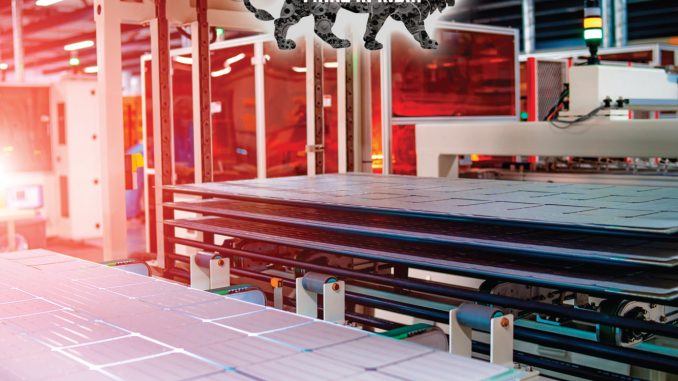
To promote domestic manufacturing and reduce India’s dependence on imports, the government has taken a number of policy initiatives in the renewable energy sector. Specific focus has been on domestic manufacturing of solar components, battery energy storage systems and electrolysers. Renewable Watch provides an overview of the status of domestic manufacturing in this space…
Solar component manufacturing
The Indian solar module manufacturing industry reached an annual installed capacity of 60 GW, as per the All India Solar Manufacturers Association (AISMA). This marks a significant increase in the capacity over the past few years, from less than 10 GW of low wattage polysilicon modules in financial year 2020-21, to the current 60 GW of high wattage and technologically advanced mono perc, TOPCon and HJT modules.
In 2023, Indian solar manufacturers have exported 3,900 MW of solar modules, with the potential to expand to 30 GW per annum, earning $7 billion-8 billion in foreign exchange and assisting in reducing the reliance on fossil fuel imports.
Measures taken by the Ministry of New and Renewable Energy have significantly bolstered the Indian solar manufacturing sector. The production-linked incentive (PLI) scheme has ensured that the country will add an additional 40 GW of module manufacturing capacity by the end of financial year 2024-25. This addition also strategically prioritises backward integration, ensuring a reliable supply chain for domestic solar installation, pegged upwards of 30 GW per annum.
There are over 100 solar module manufacturers in the country. The current installed capacity of select 27 module manufactures is 60 GW, as of November 2023, as per the AISMA. Apart from these, in the current financial year, Reliance and Tata are expected to add 9 GW module manufacturing capacity, while other players are expected to add 3 GW, which will make the country’s module manufacturing capacity 72 GW by the end of the current financial year.
In another key development during the past year, AmpIn Energy Transition formed a joint venture (JV) with Jupiter International Limited for a solar manufacturing business in India. As a part of this JV, a manufacturing facility will be established with the objective of producing up to 1,300 MW of solar cells and modules. Also, the Jakson Group signed an agreement with Jinchen Corp, a China-based turnkey supplier of solar module manufacturing equipment and technology, to further expand its solar PV manufacturing capacities in India up to 3 GW annually.
Meanwhile, Gautam Solar announced plans to increase its annual solar module production capacity to 2 GW. The company aims to complete this expansion by the end of 2024, with an investment commitment of approximately Rs 1.5 billion.
In addition, the Emmvee Group started the second-phase expansion plan of its 1.5 GW solar cell line and 1.75 GW module manufacturing facility in Dabaspet, Bengaluru. The cell and module facilities are scheduled to commence operation from early 2024 and June 2023 respectively. The project is a part of an expansion plan of the total 1.5 GW solar cell line and 3 GW module manufacturing capacity.
The private sector involvement that the segment has been witnessing recently is majorly due to incentives provided under the PLI scheme. The initial capital outlay of the PLI scheme was Rs 45 billion, which was later increased to Rs 240 billion. The initial capital outlay was too low to manufacture the quantum of capacity needed to meet the demand. This would have also led to lower profit margins for manufacturers and lower R&D investments. The first tender under this scheme received an impressive response and around 54.8 GW of capacity was bid. However, only about 8.7 GW was sanctioned. When the outlay of the scheme increased, the stakeholders debated whether a second tender should be floated or only waitlisted bidders under the first tender should be accommodated. Ultimately, Tranche II was floated, under which the government allocated a total capacity of 39,600 MW of domestic solar PV module manufacturing capacity to 11 companies, with a total outlay of Rs 140.07 billion.
Manufacturing capacity totalling 7,400 MW is expected to become operational by October 2024, 16,800 MW capacity by April 2025 and the remaining 15,400 MW capacity by April 2026. The second tranche is expected to bring in an investment of Rs 930.41 billion. It will also generate a total of 101,487 jobs, with 35,010 getting direct employment and 66,477 being indirectly employed. Considering the two PLI tranches together, the total domestic solar PV module manufacturing capacity allocated under the scheme is 48,337 MW, with a cumulative support of more than Rs 185 billion by the government.
Apart from the PLI scheme, basic customs duty (BCD), Approved List of Models and Manufacturers (ALMM), domestic content requirement (DCR) scheme, preference to “Make in India” in public procurement for the use of domestically manufactured solar PV modules and domestically manufactured solar inverters, and discontinuation of customs duty concessions have been some other policy initiatives to boost domestic manufacturing of solar components.
BESS manufacturing
In May 2021, the Indian government had approved the PLI scheme on the National Programme on Advanced Chemistry Cell [ACC] Battery Storage for achieving a manufacturing capacity of 50 GWh of ACC and 5 GWh of “niche” ACC, with an outlay of Rs 181 billion. The first round of ACC PLI bidding was concluded in March 2022 and three companies were allocated a total capacity of 30 GWh, and the programme agreement with selected companies was signed in July 2022. These companies were Reliance New Energy Limited, Ola Electric Mobility Private Limited and Rajesh Exports Limited. Under the ACC PLI programme, the manufacturing facility was to be established within a period of two years. The incentives were to be disbursed thereafter, over a period of five years, on the sale of batteries manufactured in India. In July 2023, for the remaining 20 GWh, the Ministry of Heavy Industries announced the rebidding of PLI ACC manufacturing.
In addition to the capacities allocated by the Ministry of Heavy Industries under the PLI scheme, private players were expected to set up a battery manufacturing capacity of approximately 95 GWh. For instance, in July 2023, Amara Raja Batteries Limited laid the foundation stone for a lithium cell and battery pack facility, with capacities of 16 GWh and 5 GWh, respectively, in Mahabubnagar district of Telangana. In April 2023, Su-Kam Power Systems Limited entered into an agreement with the Himachal Pradesh government to establish a sustainable energy storage park in the state. The company intends to manufacture e-mobility and solar energy products on 50 acres of land. Reportedly, the company will manufacture EV batteries and chargers for both two- and four-wheelers and solar panels, expanding its solar product range.
Electrolyser manufacturing
Making sure that India does not miss the bus of having significant domestic manufacturing space for electrolysers, incentives for the same had been planned from the initial days of policymaking. With a budget of Rs 197.44 billion till 2029-30, the Indian government had earlier approved the National Green Hydrogen Mission. Of this, Rs 174.9 billion was earmarked for the Strategic Interventions for Green Hydrogen Transition (SIGHT) programme. Two financial incentive mechanisms were proposed under the programme, for domestic manufacturing of electrolysers (Component I) and for the production of green hydrogen (Component II). During the past year, the Ministry of New and Renewable Energy notified the scheme guidelines for the implementation of both components.
Component I (electrolyser manufacturing) has a budget of Rs 44.4 billion. Under this, incentives will be provided in terms of Rs per kW. In the first year, the base incentive will be Rs 4,440 per kW, which will be annually reduced till it reaches Rs 1,480 per kW in the fifth year. The incentives will be provided for five years from the date of commencement of manufacturing. Just like the PLI scheme for solar components, this scheme aims to incentivise manufacturing of efficient and high quality electrolysers in India. The incentive will be calculated on the basis of their specific energy consumption. Another key guideline is that in order to be eligible for incentives, bidders will have to show a minimum local value addition for each year for different technologies. Furthermore, there will be a separate bucket for indigenously developed stack technology. The scheme will be implemented by the Solar Energy Corporation of India through a transparent selection process.
Apart from the policy impetus from the government, industry stakeholders have also taken proactive steps in this space. During the past year, Larsen & Toubro (L&T) signed an agreement to manufacture electrolysers with McPhy Energy, a France-based electrolyser technology and manufacturing specialist. L&T intends to build a gigatonne-scale manufacturing facility for electrolysers based on McPhy technology in India to meet the domestic demand as well as that from other selected geographies. Bharat Heavy Electricals Limited too announced its venture in the green hydrogen manufacturing segment. The company has announced plans to hire a business consultant to help it capitalise on possible prospects in electrolyser production and the green hydrogen value chain.
In addition, GreenH Electrolysis, a JV between the India-based GR Group and Spain-based H2B2 Electrolysis Technologies announced plans to set up its first, 1 GW, PEM electrolyser manufacturing plant in India. The company has already acquired a 97,000 square foot facility in the Reliance MET Industrial Park, Jhajjar district, Haryana. H2B2 Electrolysis Technologies is in charge of providing the technology for the plant. The initial capacity of the plant will be 100 MW and GreenH Electrolysis intends to grow it up to 500 MW in two years. Furthermore, it is planning to increase the capacity to 1 GW of capacity in Phase II.
Conclusion
While it is praiseworthy to see the Indian government act proactively to increase the domestic manufacturing capability, concerns over excessive barriers have often been raised.
To avoid imports and to protect and facilitate domestic manufacturers, several tariff (safeguard duties, now basic customs duties [BCDs]) and non-tariff barriers (ALMM) have been placed. While the intention of the government to promote domestic manufacturing and avoid imports may seem justified and noble, several issues with such barriers have been flagged.
With respect to BCDs, a key issue is that the existing domestic capacity, of solar modules and of several components used to produce them including wafers, glass and cells, is limited. Therefore, several domestic manufacturers of modules have to still import these components and at present have to pay high duties on cells. This trend has the risk of increasing the cost of domestically produced solar modules, further making it even more uncompetitive vis-à-vis imports.
The elephant in the room is in fact the ALMM. With the government approving a limited list of components that can only be used – the ALMM policy is reminiscent of the licence raj that existed before India’s 1991 economic reforms. While proponents of the ALMM may cite the need for promoting domestic manufacturers and maintaining quality, both these objectives can be achieved through different policy tools and routes (such as complying with quality assurance standards/certificates) that avoid putting excessive restrictions on industry stakeholders. After regular demands from industry stakeholders, the ALMM requirement has only been temporarily exempted for projects to be commissioned by March 31, 2024.
Excessive restrictions in the country’s solar segment reminds one of a sarcastic open letter (candlemakers’ petition) that the French economist Frédéric Bastiat wrote to the French parliament. In this letter, he underscored the need for avoiding protectionism in a country’s trade policy. Writing on behalf of domestic candlemakers in 1845, he wrote about the perils faced by them due to unfair competition of a foreign rival – the sun. The latter’s light being not only better in quality but also comparatively cheaper and thereby attracting more customers. Therefore, in his petition, Bastiat requested the French government to pass a law ordering the closing of all windows, skylights, shutters, curtains, blinds, holes and cracks through which sunlight may enter houses.
Meanwhile, the BESS and electrolyser manufacturing space seems to be comparatively more free from government shackles even though it is receiving generous financial support from the government. Several challenges still remain in the manufacturing landscape of these two segments.
According to the International Energy Agency (IEA), the global electrolyser capacity in 2023 is 21.4 GW per year. In 2030, it is expected to reach 61.3 GW per year. The current electrolyser manufacturing capacity in India is 1.5 GW per year and is expected to grow to just 2.5 GW per year by 2030, according to the IEA. However, according to Renewable Watch Research, over 10 GW of electrolyser manufacturing capacity is at various stages of development. But even this manufacturing capacity is insufficient to meet the domestic green hydrogen targets. Therefore, going forward, dependence on imports to meet the domestic de-mand may become an issue. In the BESS manufacturing space, the dependence on imported raw material is going to pose a key challenge.
As the solar, BESS and electrolyser manufacturing segments get to enjoy the government’s support, the wind segment too wishes to not fall behind. At the Windergy 2023 conference, senior industry stakeholders discussed how wind turbines do not need a PLI scheme as domestic the manufacturing base is already strong. However, PLI has been sought for specific products that are used in these turbines for which there is dependence on imports. Going forward, it will be interesting to see if the government pays heed to these suggestions next year.
By Sarthak Takyar