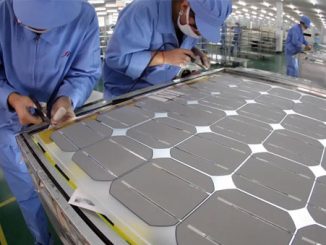
The global solar PV market has witnessed many upheavals over the past few months – supply chain constraints due to pandemic-led lockdowns, shortage of key components leading to fluctuations in global PV prices, trade wars and changing policy regimes in many key markets. Meanwhile, PV technology is evolving rapidly with more and more efficient products being rolled out. Solar cell and module manufacturers have had to navigate this challenging political and economic climate, and also constantly innovate and update their production lines to stay ahead in the race. Incorporated a decade and a half back in China, JinkoSolar is today one of the leading solar PV manufacturers worldwide. The company is making its operations secure for the future through vertically integrated supply chains across a mix of regions. In a recent interview with Renewable Watch, Daniel Liu, Head of South and Central Asia, JinkoSolar, shared his views on the key issues in the segment, the company’s progress and its plans for the future…
What has been JinkoSolar’s progress since its inception?
JinkoSolar was established in 2006 in Shangrao, China. In 2007 and 2008, it launched its own factories for ingot and wafer manufacturing. By 2009, the company operationalised the first fully automated PV module NPC production line in China. The company then went on to get listed on the New York Stock Exchange in 2010 and became a leading profitable PV manufacturer worldwide by 2011, with an integrated supply chain to ensure healthy business operation. In 2012, JinkoSolar also became the world’s first company to pass the Potential Induced Degradation (PID) free test under 85 ℃/85 per cent RH. By the end of 2021, the company’s vertically integrated production capacity is expected to reach approximately 30 GW for monocrystalline wafers, 24 GW for cells and 33 GW for modules.
How is JinkoSolar currently placed in the global PV market?
With more than 25,000 employees, 12 global factories, and a marketing network covering 35 countries, JinkoSolar provides solar products, solutions and technical services to utility, commercial and industrial and residential customers in more than 160 countries. The company has been successful in building an evenly distribued industry map in the international market. China, the US, Vietnam, Japan, Germany, Australia, Brazil, Korea, India and the Netherlands are the top 10 global markets for us at present. JinkoSolar has bagged 16 module power and efficiency records in the past three years and has touched the 25.25 per cent mark in terms of battery efficiency. Recently, the company’s N-type monocrystalline module achieved a record conversion efficiency of 23.01 per cent. These latest achievements were delivered in a short span of time from intelligent production lines, which make our plants operate at a mass production efficiency of over 24 per cent.
What are the various business verticals that you are operating in?
Having started its business from the upstream side of the solar value chain, JinkoSolar now produces wafers and cells as well. We are committed to expanding the boundaries of our PV knowledge through research and development, and actively catalysing the commercialisation of cutting-edge solar technology. Our introduction of various solar technologies in the past financial year is evidence of our dedication to innovation. Ever since our establishment, we have continuously worked with upstream players and other stakeholders including independent power producers, banks/investors, engineering, production and construction (EPC) companies, non-banking financial companies, etc. to understand their broad perspectives on the solar market. We have always placed ourselves at the centre of the energy value chain to pave the way for clean and green energy for the world and reduce the carbon footprint.
How did the company deal with the pandemic? What is your perspective on the long-term impact of Covid on global solar supply chains?
We worked closely with existing suppliers while diversifying the supply base to mitigate the supply risk. The teams evaluated different scenarios and devised strategies for different demand environments to create contingency plans. Owing to Jinko’s multiple production locations, operations and delivery did not get disrupted. We took every step to make employees stay at home without affecting their safety or productivity, and ensured the well-being of all on-site staff through elaborate safety measures. We optimised work shifts to ensue social distancing between workers, invested in protective gear for supply chain workers, and enabled communication via apps to manage time, availability and safety. The pandemic has forced supply chain optics to shift from efficiency to resilience, from centralised to more localised sources, and from monopoly to diversified sources and sites. The relationship with suppliers and customers is changing and evolving – from straightforward deals to strategic partnerships, primarily to manage the demand and supply volatility.
What are the key global technology trends in solar PV? Which technology is the company currently focusing on?
From building integrated PV, storage, solar-powered green hydrogen, to digitalisation of energy use and the new TOPCON technology – there is a lot of room to play and that is what we are currently focusing on.
How has the fluctuation in the demand and supply of glass and modules impacted pricing? What is your outlook on global solar PV prices?
Due to the strong demand for solar modules globally, the current supply of almost all raw material (not just glass) is short. The bottleneck occurs along the whole supply chain – EVA, backsheet, silver and the most problematic, polysilicon. The impact will last longer and will be wider than we expected previously. The prices will continue to rise in the coming months until the capacities of these critical raw materials catch up. The electricity curtailment and emission control steps implemented in China have also had an impact on operations and capacity availability for polysilicon and other key materials. This will have a short term but significant impact on pricing.
What are your expectations from the Indian government and regulators?
In recent years, the Indian government has formulated several favourable policies for the solar segment. While we see a major trend of Indian policymakers trying to attract investment through long-term and clear policy initiatives, they must release more sector-friendly policies supporting energy banking, net metering, scheduling and forecasting regulations, etc. Moreover, we expect certain futuristic initiatives from the Indian government such as special production-linked incentives that enable long-term foreign investments and business incentives. Such measures will help attract the top global players to the Indian market for solar technology tra-nsfer and promote expansion of local manufacturing. In addition, we would appreciate greater clarity on the timelines and specifics around basic custom duties (BCDs) and the approved list of module manufacturers (ALMMs) as these aspects affect us directly. Overall, a focused transition from the expansion of project development to promotion of local manufacturing is quite evident. We feel that although this would encourage investment in the manufacturing sector, it might ultimately deter the country from achieving the long-term renewable energy targets set by the government.
What are the opportunities and challenges in India’s solar sector?
The Indian solar market is slated to grow at approximately 20-25 GW per annum from 2023 onwards. This massive demand for solar products will ensure room for every kind of player – be it domestic or foreign. Thus, to capitalise on the potential that the Indian solar market is offering, we foresee that all the stakeholders will expand their capacity and execution speed during 2023-30. Further, several new start-ups are expected to grow alongside the more established and bigger players in this space. However, as a manufacturer, we are facing some challenges with respect to BCDs and the slow pace of ALMM implementation. Nevertheless, with aggressive growth projections, renewable energy targets and central- and state-level tenders and policies, we remain quite optimistic about the immense opportunity that the Indian market offers. We also feel confident that we will see a steady growth in this market in the near future.
What are JinkoSolar’s future plans and goals?
We aim to change the way we generate and use electricity, optimise energy portfolio, and take responsibility for enabling a sustainable future by delivering the cleanest, most efficient and economic solar energy solutions. We are also committed to promoting the wide application of solar PV generation worldwide, thereby promoting comprehensive replacement of conventional energy sources with solar energy and building a sustainable green world.
Going forward, JinkoSolar will cooperate with ecological partners, including institutes and research organisations, electric power design companies, key product suppliers, system integrators, omni channel distributors and EPCs to provide carbon-neutral consulting, designing and deployment for all industries and corporate clients. We will continue to optimise methods that help reach carbon neutrality and empower other organisations and industries to achieve the same.