By Labanya Prakash Jena, Director, Climate and Sustainability Initiative, and Visiting Senior Fellow, London School of Economics and Political Science; and Prasad Ashok Thakur, CIMO Scholar
Much before the current global energy flow volatility, India had committed at COP26 to deploy 500 GW of non-fossil-fuel-based energy capacity by 2030. In line with this objective, the integration of variable renewable energy, including wind and solar, into the power grid has been a defining and essential characteristic of our national grid. However, this energy transition depends on the services provided by energy storage systems, which help achieve and maintain grid stability and ensure round-the-clock despatchable firm power. To meet the dual goals of energy sovereignty and energy transition, the strategic development and deployment of pumped storage projects (PSPs) need to be incentivised to complement battery energy storage systems (BESSs).
Construction innovations for PSPs
At present, fossil fuels provide both baseload and peak-load support. As the country adopts clean, firm and despatchable energy sources, PSPs have emerged as a technically proven, economical and indigenous solution for providing six to eight hours of long-duration energy storage.
Leveraging innovations in construction technologies, closed-loop artificial PSPs can be designed as modular, scalable systems to meet local requirements, even in areas where geographical landforms may not be ideal. In fact, by using sustainable materials to manufacture factory-made panels, erection frames, foundations, pipelines, etc., closed-loop artificial PSPs can be erected without disturbing the natural flora, fauna and landforms. Further, a modular approach can ensure quick, convenient, cost-effective project completion and operations. A classic example is the erection of large water storage tanks for drinking water supply alongside dense habitation and other flora and fauna. This demonstrates how design innovations and skilled execution can be combined to create reliable water management solutions. A battery of such storage tanks, supported by tall factory-made scaffolding structures (like tall phone tower networks), can create the water head required to store potential energy, which can then be released in a controlled manner to generate electricity. Further, the creation of enabling infrastructure to support PSPs (roads, power, data networks, etc.) benefits local communities as well.
Demand-supply dynamics: Global and local PSP storage
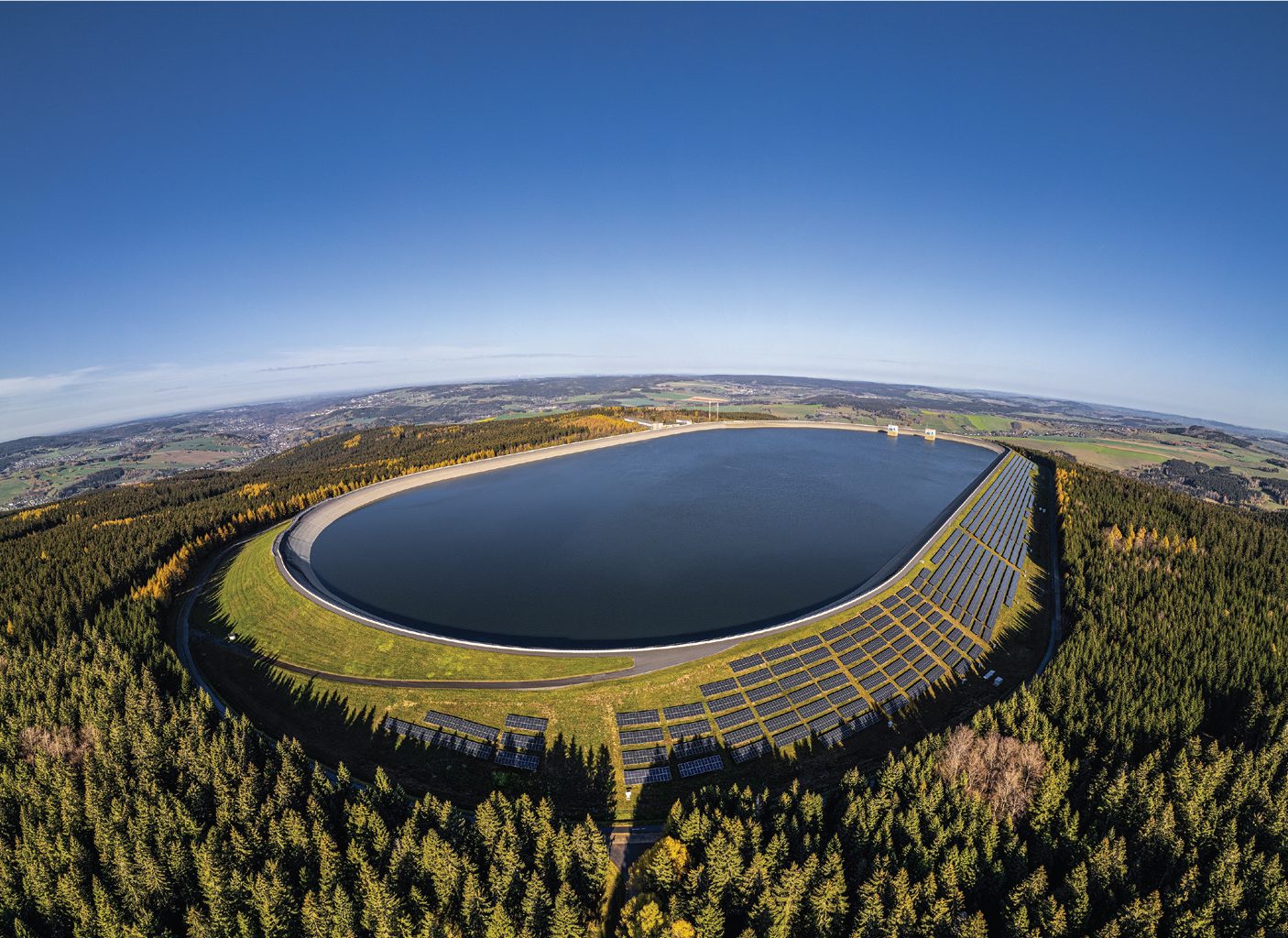 With nearly 190 GW/9,000 GWh of operational capacity, PSPs account for more than 95 per cent of the installed energy storage capacity globally, highlighting their undisputed effectiveness as large-scale energy storage solutions. China, the US and Japan are the leading nations in terms of installed capacity. China has set a target to install an additional 60 GW of PSP projects by 2030. Similarly, in the US, 36 GW of capacity is at various stages of planning and implementation.
In India, the Central Electricity Authority (CEA) aims to achieve over 100 GW of pumped storage capacity by 2036. This entails adding over 9 GW of capacity per annum from today till 2036. On the supply side, as of September 2025, India’s identified pumped storage potential stands at 206 GW, of which 6.4 GW is commissioned, 12.3 GW is under construction and 69 GW is under planning.
PSP techno-commercial advantage
PSPs offer high operational flexibility through frequent start-stop operations and fast ramping capabilities. In addition, smart water management systems, powered by artificial intelligence/machine learning, can be integrated into PSPs to make them more efficient and agile. In India, the capital cost of a PSP is estimated at Rs 10 million per MWh (Rs 60 million per MW) with a six-hour cycle. Such a project is expected to have a designed life of at least 40 years (with an actual life of up to 70 years). If the viability gap funding of Rs 2 million per MWh is provided, the levellised cost of storage is expected to be competitive at about Rs 35.5 million per kWh as compared to Rs 38.5 million per kWh for BESSs.
Current schemes enabling infrastructure for PSPs, including site preparation and non-plant structures, provide Rs 10 million per MW support for hydro and PSPs up to 200 MW. For projects above 200 MW, the support is Rs 2 billion plus Rs 7.5 million per MW above the initial 200 MW.
PSPs can also be supported through targeted tax credits under relevant official provisions. Additional financial incentives should be introduced to monetise essential grid services, such as supply flexibility, black-start capability, reactive power support, frequency regulation and other ancillary services. Since agriculture, irrigation and electricity are subjects under the state list or the concurrent list of the Constitution of India, state-level public sector enterprises should be invited to become direct stakeholders in PSPs through equity or low-interest loans. Revenue models such as “cap-and-floor” arrangements or contracts for difference can be explored.
Future steps
The government, at the central/state and local levels, along with the CEA, can promote the deployment of PSPs by making them more viable and faster to develop. The first steps can be to acquire the right of use with minimal disturbance, provide fair compensation to the owners of relevant land parcels, and involve them as partners in the development of PSPs.
Further, PSPs can be exempted from the free power sale obligation and allowed to participate in the high-price segment of the day-ahead market. Recently, the Ministry of Power has extended a 100 per cent waiver of interstate transmission system charges to PSPs whose construction work is awarded on or before June 30, 2028, for a period of 25 years from the date of commissioning. This provision can be extended to December 31, 2030, to align with the achievement of 500 GW of non-fossil-fuel-based installed capacity.
For designated consumers, the Bureau of Energy Efficiency, in consultation with the Government of India, has notified the minimum share of electricity consumption from renewable energy sources. These consumers are typically captive users, electricity distribution licensees and open access consumers. This fulfilment of the renewable consumption obligation must be encouraged by using clean power stored in PSPs.
On the transmission front, planning must align with the modular approach of PSPs. Thus, PSP and transmission developers must work in synchrony. As per the CEA, transmission plans for about 36 GW of conventional PSPs have been included in the National Electricity Plan (Transmission). However, based on feedback received from modular PSP developers, transmission plans can be further fine-tuned by approaching Central Transmission Utility of India Limited and state transmission utilities. This will also help align budgetary support for enabling infrastructure, particularly transmission connectivity from the generation switchyard to the pooling point, required for the deployment of modular PSPs.
Leveraging India’s extensive coastline, seawater reverse osmosis powered by intermittent clean energy can provide desalinated water for artificial closed-loop PSPs. Such offstream/closed-loop, fully indigenous, modular and digitally smart PSPs are an environmentally sustainable solution for India’s long-duration clean energy storage challenge. They have a very low carbon footprint throughout their operational life cycle. Hence, such PSPs should be considered under the “White Category” for environmental clearances. A national-level land digital database may be created with a GIS-based repository to channel potential PSP developers and investors towards suitable locations.
Furthermore, the declining cost of renewable energy can be leveraged by storing surplus generation in PSPs, thereby assisting discoms and other consumers. Strategically, PSPs can significantly reduce India’s dependence on critical mineral imports for the manufacturing of lithium-based battery technologies used in BESS solutions. Together with innovative modularised construction technologies and strategic transmission connectivity, PSPs can transform India’s decarbonisation journey.