 India’s oil and gas public sector companies play a critical role in the country’s energy transition. Bharat Petroleum Corporation Limited (BPCL) is one such company and accounts for around 14 per cent of India’s refining capacity (35.3 million metric tonnes per annum [mmtpa]) across its Mumbai, Kochi and Bina refineries. It plans to expand this to 45 mmtpa, and has also set up a new refinery in Andhra Pradesh.
Its marketing network includes more than 23,500 fuel stations and over 6,200 liquefied petroleum gas distributors. The company is investing in renewable energy solutions to diversify its portfolio and meet India’s decarbonisation goals, moving from being a traditional fuel supplier to a more diversified and technology-driven energy company.
Green hydrogen
Green hydrogen is central to BPCL’s long-term decarbonisation strategy, especially for its refinery operations. The company has commissioned a 5 MW electrolyser at its Bina refinery. This is the first green hydrogen plant at a public sector refinery in India. The hydrogen produced is used within the refinery, reducing dependence on fossil-based hydrogen. The company is also working on biomass-based hydrogen projects at Kochi and Bina.
Its efforts are not limited to refining, but extend across hard-to-abate sectors such as transport, aviation and port infrastructure. A notable initiative is its partnership with Cochin International Airport Limited and the Bhabha Atomic Research Centre. This project aims to set up a green hydrogen production and dispensing facility at Kochi airport. It uses an indigenously developed alkaline electrolyser. In the future, it could support hydrogen-powered ground vehicles and possibly aviation applications.
In addition, it has formed a joint venture (JV) with Sembcorp Green Hydrogen India, a subsidiary of Sembcorp Industries, to focus on renewable energy, green hydrogen and green ammonia projects, along with port decarbonisation. The JV has recently secured a contract to supply 10 kilotonnes per annum of green hydrogen to Numaligarh Refinery Limited.
These initiatives highlight BPCL’s growing emphasis on collaboration with private sector players to scale up green hydrogen deployment and build an integrated ecosystem.
By partnering with global energy companies and leveraging domestic technology institutions, the company is adopting a multi-stakeholder approach to accelerate innovation and reduce costs.
Compressed biogas
While green hydrogen is a long-term bet, compressed biogas (CBG) is emerging as a near-term solution. BPCL has already established a footprint in this space with 10 operational CBG plants currently running through partner networks, with supply accessible at over 100 stations across the country.
The company is now accelerating its buildout. Twenty six additional plants are in the pipeline, expected to come online within the next two to three years. To scale further, BPCL has formed a JV with GPS Renewables to develop production facilities across multiple states, leveraging organic biomass waste as feedstock.
A recent milestone came in February 2026 with the inauguration of BPCL’s CBG plant in Kochi. The facility processes 150 tonnes of source-segregated biodegradable municipal solid waste daily, yielding 5.6 tonnes of CBG and 28 tonnes of organic manure, effectively turning urban waste into dual-value output.
Looking ahead, BPCL’s ambition is considerably larger. In collaboration with state agencies, the company is targeting a network of around 200 CBG plants with an aggregate production capacity of 1.3 million metric tonnes per year.
Biofuels, CCUS and clean mobility
BPCL has been an active participant in India’s ethanol blending programme. In FY 2024-25, it achieved a blending rate of over 16 per cent. According to BPCL’s Sustainability Report 2024-25, the company planned to increase this share to over 19 per cent in FY 2025-26, with a further rise to around 20 per cent soon thereafter.
It also plans to reach 5 per cent biodiesel blending by 2030. To support this, BPCL has set up an integrated ethanol plant in Bargarh, Odisha. This facility can produce ethanol from both grains and agricultural waste, helping reduce dependence on food-based feedstocks.
In the carbon capture, utilisation and storage (CCUS) space, the company is working on in-house technologies, including simulated moving bed systems and aqua-based capture methods. It has identified a potential to capture over 4 mmtpa of carbon dioxide from its refineries. However, these solutions are still at the development stage.
In clean mobility, BPCL has installed more than 3,400 electric vehicle charging stations across its network. It is targeting 7,000 stations and 200 highway corridors with fast charging. It is working with vehicle manufacturers such as Ola, Ather and Hero to expand this ecosystem.
Solar and wind
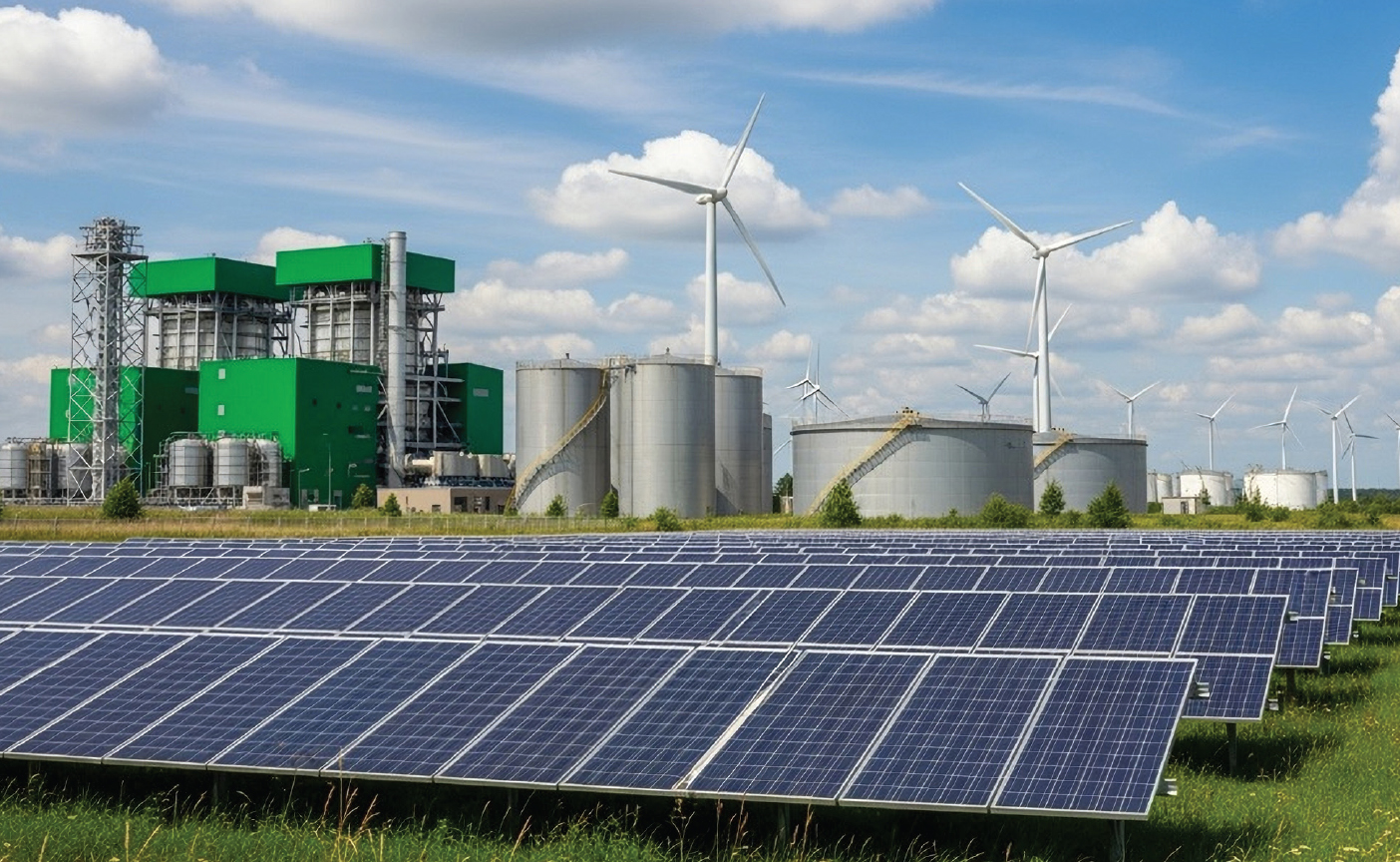
BPCL is focusing on both utility-scale projects to meet refinery demand and solar deployment across its large retail network. As of FY 2024-25, BPCL’s installed renewable capacity stands at about 155 MW. This includes around 143 MW of solar and close to 12 MW of wind. This is still small in comparison to the company’s overall energy needs; thus, several more projects are in progress.
Recently, in February 2026, it inaugurated a 71 MW solar project in Prayagraj. BPCL has also won its first utility-scale solar bid of 150 MW through an NTPC tender. This capacity is expected to come up in Rajasthan and will support green hydrogen production at its refineries.
On the retail side, the progress is more visible. By March 2025, more than 12,000 fuel stations had been equipped with solar systems. Over 7,500 outlets also have solar lighting. Renewable electricity generation across operations reached around 59 GWh in FY 2024-25, meeting about 4.8 per cent of total electricity consumption.
BPCL has also piloted a net zero retail outlet concept. This combines solar panels, a vertical axis wind turbine and battery storage. The idea is to create fuel stations that can meet their own energy needs with minimal emissions. While the scale is small, it shows a willingness to explore new ideas.
In the wind energy space, BPCL has awarded contracts for setting up 100 MW wind farm projects in Maharashtra and Madhya Pradesh. These will primarily supply power to its Mumbai and Bina refineries. The current wind capacity of about 12 MW is expected to increase significantly once these projects are commissioned.
Future outlook
 BPCL’s energy transition strategy covers a wide range of technologies. Its investment commitments and partnerships show the intent, but there are clear gaps between targets and actual progress. The company had set a target of 2 GW of renewable capacity by 2025.
By the end of FY 2024-25, it had achieved only about 155 MW. Similarly, in green hydrogen, most projects are still at an early stage. The current projects are important, but they are far from the scale required to significantly reduce refinery emissions. Carbon capture initiatives are also at an early stage, with no large-scale deployment yet.
Going forward, BPCL has a target of 10 GW of renewable capacity by 2035. To achieve this, it will need to add close to 900 MW every year. The current pace of capacity addition is much lower.
Under its Project Aspire road map and its net zero target for Scope 1 and Scope 2 emissions by 2040, BPCL has committed about Rs 1 trillion to green and low-carbon technologies. The key question now is not intent, but execution. The coming years will show whether BPCL can turn its plans into large-scale outcomes or not.
In this context, global oil and gas majors have rapidly scaled up their renewable portfolios by acquiring operational assets and development pipelines, enabling faster capacity addition compared to greenfield buildouts. In India, companies such as Reliance Industries and Adani Green Energy have also expanded their renewable footprint through a mix of organic growth and strategic acquisitions.
For BPCL, adopting a similar inorganic growth strategy could help bridge the gap between ambition and execution, allowing it to quickly scale up, tap ready project pipelines and strengthen its position in the clean energy market.