

By Mohammed Ali Siddiqi
 The annual financial statement or the union budget reflects the government’s policy intent and ambition. According to budget estimates for 2026-27, the government has projected total receipts of Rs 53.5 trillion and plans to incur a cumulative expenditure of Rs 53.47 trillion. Even as the revenue expenditure is set to dominate the spending mix, the debt to GDP ratio is expected to ease from 56.1 per cent last year to 55.6 per cent in 2026-27. Within this fiscal space, the renewables sector continues to demand a higher share as the Ministry of New and Renewable Energy (MNRE) aims to translate its targets into priorities to drive clean energy adoption.
What is new in 2026-27?
A defining feature of the Union Budget 2026-27 is that several fresh interventions have been launched. The most explicit of these being a proposed outlay of Rs 200 billion over the next five years for carbon capture, utilisation and storage (CCUS) readiness across five industrial sectors including power, steel, cement, refineries and chemicals. This addition is significant as it lands at a moment when trade-linked decarbonisation pressures are becoming more intense. The European Union’s (EU’s) Carbon Border Adjustment Mechanism has moved from its reporting-only transition phase into its definitive regime from January 1, 2026 with coverage spanning cement, iron and steel, aluminium, fertilisers, electricity and hydrogen. India’s exposure is concentrated in emission-intensive materials, with estimates reporting that iron and steel account for the bulk of India’s CBAM-relevant exports to the EU. A related policy addition is the proposal to support Odisha, Kerala, Andhra Pradesh and Tamil Nadu in establishing dedicated rare earth corridors to promote mining, processing research and manufacturing. The budget has also proposed restructuring of the Power Finance Corporation and the Rural Electrification Corporation, to achieve scale and improve efficiency in public sector non-bank finance companies that anchor power sector lending.
Money allocation: MNRE’s shift to distributed solar
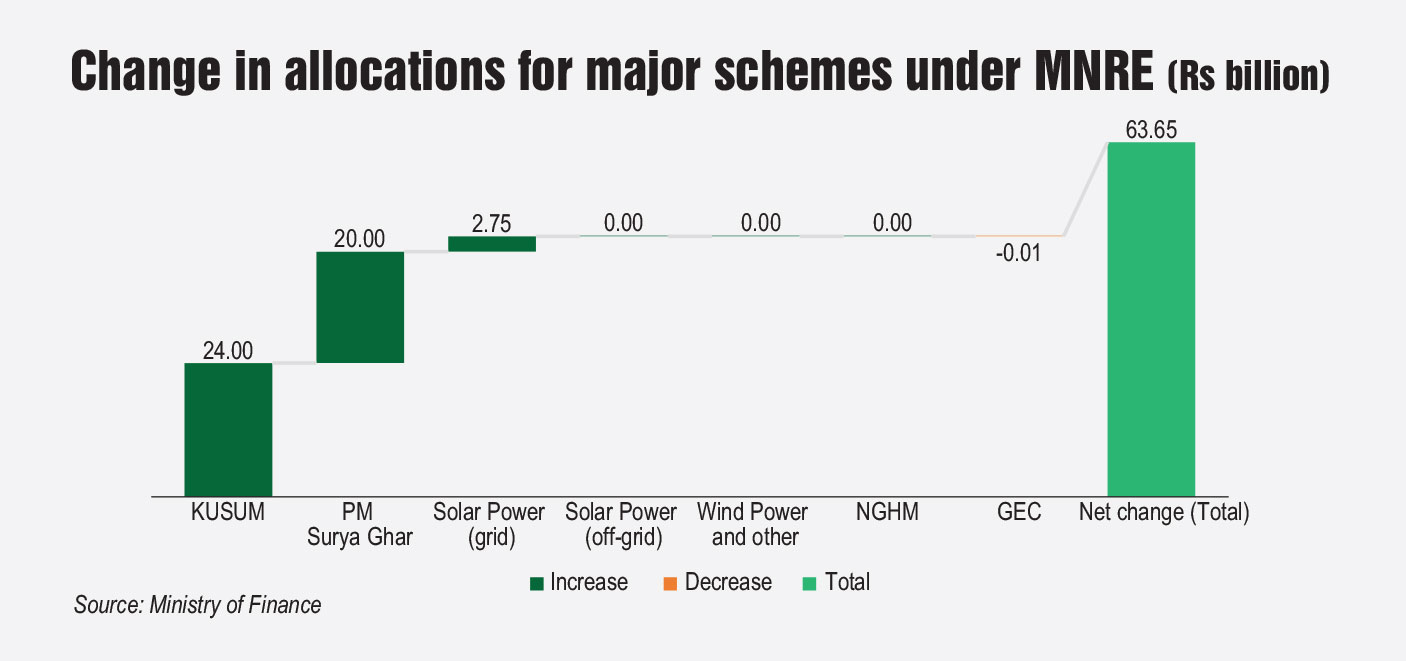 The MNRE has been allocated Rs 329.14 billion in the budget for FY2026–27, which is a 30.09 per cent increase, over the revised estimates in 2025–26, from Rs 253.01 billion. Despite several years of decreasing allocations, solar power (off-grid) has been kept unchanged, which effectively confirms that stand-alone off-grid support under this head has been phased down and will likely be either consolidated as part of another scheme or shifted away from direct budgetary support for decentralised off-grid deployment. In contrast, solar power (grid) allocation has been raised to Rs 17.75 billion from Rs 10 billion, an increase of 77.5 per cent. However, it is important to note that despite the sharp year-on-year jump, the allocation remains far below the levels seen earlier. The PM-KUSUM scheme has been retained at Rs 50 billion, unchanged from the revised level in the previous year’s estimates. The largest beneficiary of MNRE allocations, PM Surya Ghar Muft Bijli Yojana (PM-SGMBY) has witnessed an increase to Rs 220 billion from Rs 170 billion, a rise of Rs 50 billion or 29.41 per cent. Overall, the distribution of allocations signals a sharper alignment towards distributed solar delivery, with PM-SGMBY alone accounting for 66.84 per cent of the MNRE’s outlay and the single largest share among listed heads, followed by PM-KUSUM adding another 15.19 per cent. Taking into account that the combined share of the two flagship consumer and agriculture programmes is about 82.03 per cent, it would be fair to say that the policy direction has shifted course towards scalable rooftop and decentralised adoption even as grid integration, wind support and Green Hydrogen Mission plans remain comparatively constrained.
In parallel, the Ministry of Power (MoP) has also been strengthening its distribution reform through the Reform Linked Distribution Scheme, which alone forms 60.01 per cent of the MoP’s total allocation. It is likely that in the coming years there will be greater synergies between the MoP and the MNRE, as India continues to expand large-scale rooftop solar under the PM-SGMBY and agricultural solarisation under PM KUSUM. This shift is driven by changes in the operational and commercial profile of distribution utilities by increasing two-way flows of renewables and making billing, energy accounting and settlement systems more complex and time-sensitive. The simultaneous scale-up of storage viability gap funding strengthens this linkage further, since storage provides flexibility that can support higher solar penetration and reduce peak stress, which ultimately improves the system’s ability to absorb the distributed build-out that the MNRE intends to develop.
From estimates to actual expenditure: What spending patterns reveal
 Even though allocations increase each year, budget execution trends across MNRE schemes have a completely different story to tell. Over the years, the MNRE’s total outlay moved from a budget estimate of Rs 102.22 billion and an actual expenditure of Rs 79.28 billion in 2023-24 (utilisation rate of 77.57 per cent) to a far tighter outcome in 2024-25 with a budget estimate of Rs 191 billion and an actual expenditure of Rs 186.26 billion, translating into 97.52 per cent utilisation. Within this improvement, distributed solar lines showed the most pronounced overshoots, with PM-SGMBY recording an actual utilisation of Rs 78.17 billion against a budget estimate of Rs 62.5 billion, while PM-KUSUM rose to Rs 25.6 billion versus a budget estimate of Rs 14.96 billion, which indicates a faster-than-anticipated disbursement and a catch-up in implementation.
What the budget does not solve
A clear gap in the Union Budget 2026-27’s clean energy narrative is that it continues to lean on headline manufacturing intent and customs and excise relief, without addressing the binding constraints that lie at the heart of domestic supply and system integration. For example, a recent analysis by Bloomberg on solar manufacturing highlighted that India’s module capacity has expanded sharply since 2020 and capacity utilisation has fallen to around 40 per cent. Further capacity creation on its own risks deepening the glut as long as demand and export competitiveness do not improve. In addition, the budget’s duty measures such as basic customs duty relief on capital goods for lithium-ion cell manufacturing for battery energy storage systems and the exemption on sodium antimonate used in solar glass are positive directions for lowering input and capital costs; however, they do not directly solve issues related to market access.
A key data figure that needs more deliberations is that the production-linked incentive scheme for advanced chemistry cell battery storage saw an actual spending of only Rs 122.8 million against a budget estimate of Rs 1.55 billion in 2024-25, which is just 7.88 per cent utilisation. Besides, the revised estimate for 2025-26 remained low at Rs 133.1 million before the budget for 2026-27 finally raised the provision to Rs 860.1 million.
Conclusion
The Union Budget 2026-27 broadly reinforces The Economic Survey’s diagnosis that India’s renewable energy system has to now balance two parallel transitions, in the form of rapid renewable capacity expansion and building flexibility for reliable integration. The survey also frames critical minerals as the political economy constraint of the energy transition, which has been supported by the budget’s duty relief for critical mineral processing capital goods. However, recent market developments such as collapsing treatment and refining charges for copper serve as a reminder that industrial self-reliance and competitiveness will not be delivered by incentives alone, but also by supply side factors.
Overall, the budget for FY2026-27 advances the right broad power architecture, accelerating distributed renewable adoption, while scaling distribution reforms and providing support to emerging technologies such as CCUS. The decisive test will be to see whether these allocations can convert into measurable outcomes.
