Over the past 15 years, several landmark renewable energy projects have shaped the sector’s growth trajectory. These projects have set new benchmarks in terms of technology, project design and tariffs, while also addressing key challenges in the sector. Renewable Watch identifies 15 such projects from the past 15 years that warrant special recognition…
 Solar project at Cochin International Airport Cochin International Airport
Cochin International Airport Limited (CIAL) is the world’s first airport to operate completely on solar power. CIAL commissioned a 12 MWp ground-mounted solar plant in August 2015, adding to earlier solar installations that began with a 100 kWp rooftop pilot in 2013 and a 1.1 MWp plant, which was the first MW-scale solar installation in Kerala. The 12 MWp ground-mounted plant comprised roughly 46,150 panels across about 45 acres and was designed to generate around 48,000 units of electricity daily, sufficient to meet the requirements of the airport.
 Waste-to-Energy (WtE) plant at Ghazipur
The WtE plant at Ghazipur, Delhi has been operational since 2016. It was developed by IL&FS Environmental Infrastructure and Services Limited as a public-private partnership project for the East Delhi Municipal Corporation. The plant processes 1,300 tonnes of waste per day, and the project generates 12 MW of power from seven-stage pre-processed refuse-derived fuel of high quality, with plans to scale the capacity to 2,000 tonnes of waste per day and up to 25 MW of power under a new request for proposal tendered by the Municipal Corporation of Delhi in July 2025. Apart from BSES Yamuna Power Limited, 2 MW of power from this project was supplied to the Delhi Metro Rail Corporation to fulfil the operational needs of its Pink line.
 Wind-solar hybrid project at Raichur
The country’s first large-scale solar-wind hybrid project was commissioned by Hero Future Energies in April 2018, a month before the government released the policy guidelines for these projects. The project was built by engineering, procurement and construction (EPC) contractor Siemens Gamesa at Kavithal in Raichur district, Karnataka, by adding a 28.8 MW solar project to an existing 50 MW wind farm.
 Sembcorp wind farm at Chandragiri
Sembcorp Energy India Limited commissioned its 250 MW SECI 1 wind power project in Chandagiri, Tamil Nadu, in October 2018. This was the first commissioning of any project awarded under Solar Energy Corporation of India’s (SECI) first tranche of interstate transmission system-connected wind power auctions in April 2017. Completed six months ahead of schedule, the project consists of 119 Suzlon turbines with a capacity of 2.1 MW each.
 Bhadla Solar Park
With a total capacity of 2,245 MW, the Bhadla Solar Park is considered one of the largest solar parks in the world and is spread across 5,700 hectares. The solar park has been developed in four phases, with construction starting in 2015 and the entire park becoming fully operational in March 2020. Solar power tariffs hit Rs 2.44 per unit in May 2017 (a historic low at that time), in an auction for 500 MW of capacity under Phase III of the Bhadla solar park.
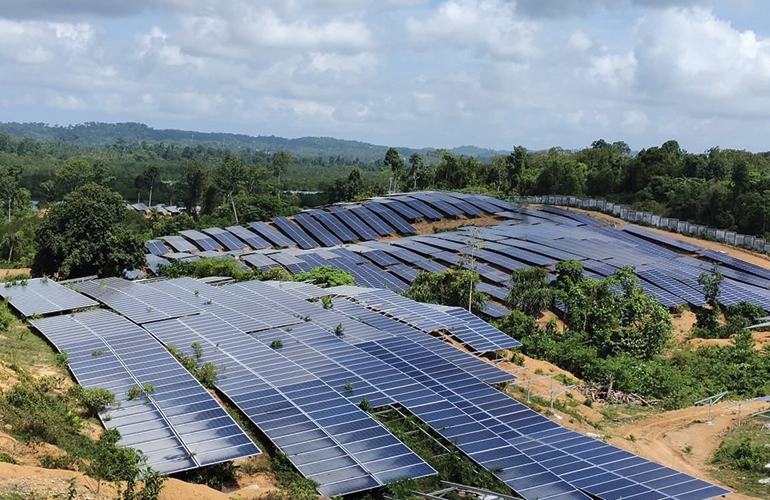 NLC’s solar-plus-BESS project in Andaman
NLC India Limited integrated a 20 MW solar project with an 8 MWh battery energy storage system (BESS) at Dollgunj and Attampahad in the Andaman & Nicobar Islands. Commissioned in June 2020, it was one of the country’s earliest utility tenders to combine solar and storage. Larsen & Toubro reportedly carried out the EPC works for the project.
 Khavda Renewable Energy Park
The Gujarat Hybrid Renewable Energy Park, also called the Khavda Renewable Energy Park, is under construction in Kutch, Gujarat, and is being planned as one of the world’s largest hybrid renewable energy parks. Spread across 800 square km, this renewable energy park is still under construction with a target capacity of 37 GW. Both public and private sector companies, such as NTPC Renewable Energy Limited, Gujarat Industries Power Company Limited, Gujarat Power Corporation Limited, Adani Green Energy Limited, SECI, and Sarjan Realities Private Limited, are developing projects in the renewable energy park.
 OIL’s pure green hydrogen plant
Oil India Limited (OIL) commissioned a 99.999 per cent pure green hydrogen pilot plant in April 2022 at its pump station in Jorhat, Assam. Completed in three months, the plant has a capacity of 10 kg per day, with plans to scale it up to 30 kg per day. It is powered by an existing 500 kW solar plant using a 100 kW anion exchange membrane (AEM) electrolyser array. The plant was reportedly the first AEM electrolyser-based green hydrogen demonstration in India.
 IOCL’s 2G ethanol plant
Indian Oil Corporation Limited’s (IOCL) second-generation (2G) ethanol plant located at its Panipat refinery in Haryana was inaugurated in August 2022. The project was built at an estimated cost of Rs 9 billion. It is one of the first projects in the country that generates ethanol using rice straw, reportedly processing around 200,000 tonnes of straw to produce about 30 million litres of ethanol annually. Furthermore, the zero liquid discharge project is expected to reduce open stubble burning and offset around 300,000 tonnes of carbon emissions annually.
 Rajnandgaon solar-plus-BESS project
SECI’s 152.325 MW solar project coupled with a 40 MW/120 MWh BESS near Rajnandgaon in Chhattisgarh is among India’s largest grid-connected solar-plus-storage projects. The project has a despatchable capacity of 100 MWac/155.02 MWpdc and supplies power to Chhattisgarh State Power Distribution Company Limited (CSPDCL) through a power purchase agreement. It was financed by the World Bank and built on 451 acres of repurposed land across nine villages in Dongargarh and Dongargaon in Rajnandgaon district through a tripartite land-use permission agreement among the Energy Department of the Government of Chhattisgarh, CSPDCL and SECI.
 Biomass cofiring at NTPC Tanda plant
NTPC Limited’s demonstration of 20 percent torrefied biomass cofiring at Unit 4 of the Tanda thermal plant in March 2024 is a key achievement. It is reportedly the highest cofiring percentage achieved in biomass cofiring at a thermal plant. By demonstrating higher-share co-firing with torrefied pellets without major boiler modifications, the initiative provides a pathway to decarbonise existing coal assets and mitigate air pollution caused by stubble burning.
 Omkareshwar Floating Solar Park
Located in Khandwa district, Madhya Pradesh, the Omkareshwar Floating Solar Park is reportedly the largest floating solar project in India and one of the largest such projects in the world. This Rewa Ultra Mega Solar Limited’s 600 MW project is being developed by SJVN Green Energy Limited, NHDC Limited, and AMPIN Energy Transition, with 278 MW of capacity having already been commissioned as of January 2025. The project addresses the issue of land constraints while improving panel performance through the cooling effect of water, reducing water evaporation and contributing to water resource management in the region.
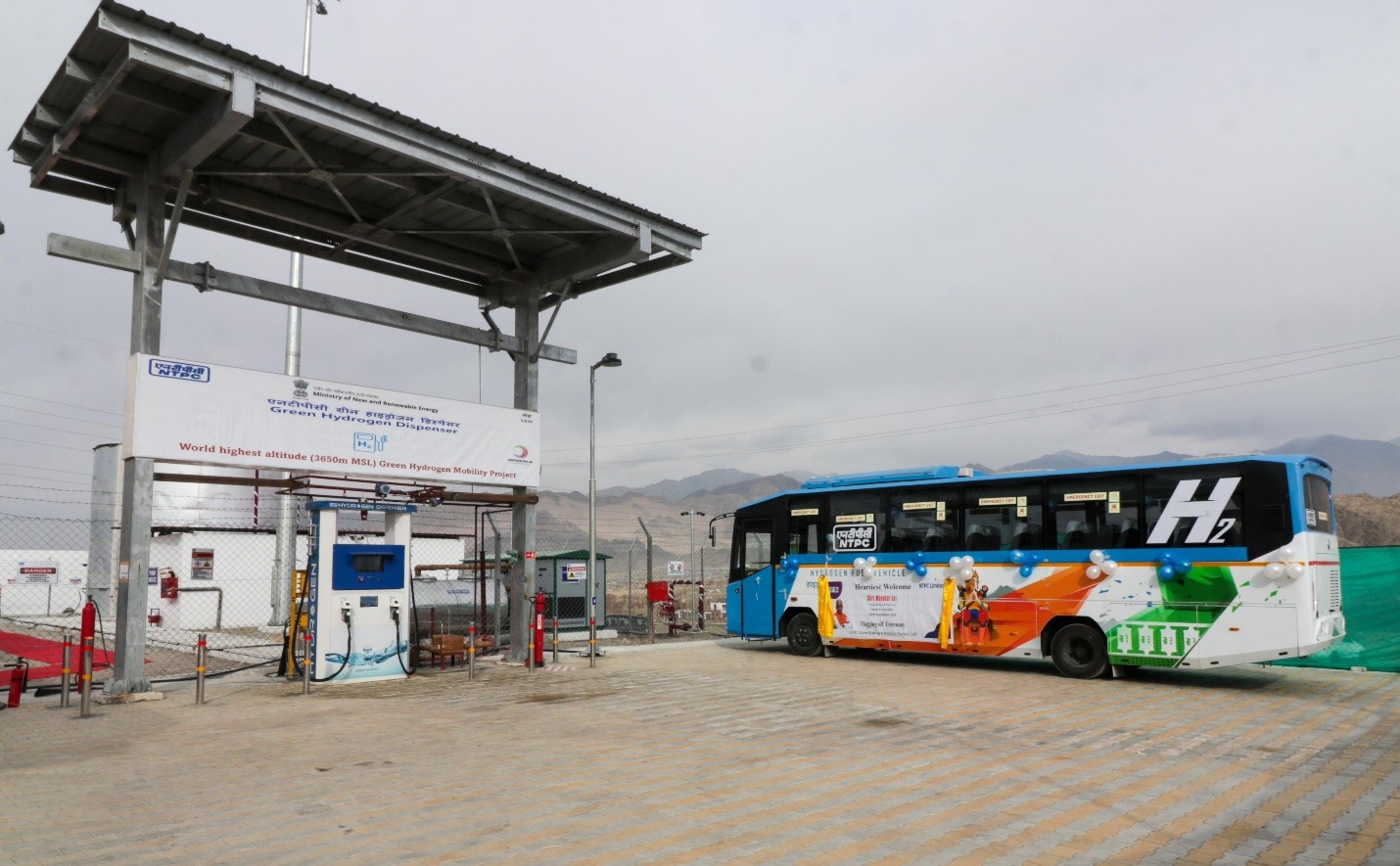 NTPC Green Hydrogen Mobility Project
NTPC Limited’s Green Hydrogen Mobility Project at Leh, inaugurated in November 2024, is the first commercial deployment of hydrogen-powered buses in India. The project comprises an in-situ 1.7 MW solar plant, a green hydrogen refuelling station with a capacity of 80 kg per day, and a fleet of five intra-city hydrogen fuel-cell buses to be operated by Sindhu Infrastructure Development Corporation Limited. Each bus can travel about 300 km on a single hydrogen filling of 25 kg.
 Pinnapuram Integrated Renewable Energy Project
The Pinnapuram Integrated Renewable Energy Project in Kurnool district, Andhra Pradesh, is one of the world’s first and largest integrated renewable-plus-storage complexes combining utility-scale solar, wind and a standalone hydro pumped storage project (PSP). Developed by the Greenko Group, it has 4,000 MW of solar capacity, 1,000 MW of wind capacity and 1,680 MW of pumped storage capacity; of which the 1,500 MWac solar component and the 1,680 MW pumped storage component have been commissioned, as of June 2025. The $4.2 billion project will help offset 3.3 million tonnes of carbon emissions annually, and support the green steel, green aluminium and green hydrogen production industries.
 Kilokari BESS
The Kilokari BESS at the Kilokari BSES Rajdhani Power Limited (BPRL) substation in New Delhi is the largest utility-scale standalone commercial BESS project in the country. The project, commissioned in March 2025, has a capacity of 20 MW/40 MWh and utilises lithium iron phosphate technology. It was developed by IndiGrid in collaboration with AmphereHour Energy and BPRL, and was completed in 20 months. It has been financed by the Global Energy Alliance for People and Planet through concessional finance covering 70 per cent of the project cost. This resulted in reducing the levellised annual tariff to Rs 5.76 million per MW, reportedly among the lowest recorded for such BESS projects in India.
The past 15 years have been marked by the rapid scale-up of utility-scale solar and wind parks, coupled with the commissioning of a diverse portfolio of renewable projects. These include floating solar, PSPs, grid-scale BESS, green hydrogen pilots, second-generation biorefineries and round-the-clock renewable projects. In the coming years, the sector’s progress will be shaped by how effectively it scales existing technologies and ventures into new territories such as offshore wind, geothermal, carbon capture, utilisation and storage, and ocean energy projects.