By Sakshi Bansal and Nidhi Dua
Gujarat has established itself as one of India’s renewable energy powerhouses, combining an abundant resource base with strong policy intent and private sector participation. According to the Central Electricity Authority (CEA), as of June 2025, the total installed power capacity in Gujarat stood at 61,601.9 MW, with thermal power contributing 24,244.49. MW, or 39.3 per cent of the total power mix. As per the Ministry of New and Renewable Energy (MNRE), as of June 2025, Gujarat’s total installed renewable energy capacity had reached 37,494.5 MW, second only to its neighbouring state, Rajasthan, which recorded a capacity of 37,818.81 MW. The renewable energy capacity comprised approximately 13,816.68 MW of wind power, 21,451.33 MW of solar power, 1,990 MW of large-hydro power, and smaller capacities of biomass (129.85 MW) and small-hydro power (106.64 MW). In total, it accounts for approximately 16 per cent of India’s renewable energy portfolio.
The state’s solar capacity is further segmented into 14,771.11 MW of ground-mounted solar, 5,636.1 MW of rooftop solar, 871.1 MW of hybrid capacity, 173.01 MW of off-grid/Pradhan Mantri Kisan Urja Suraksha Evam Utthaan Mahabhiyan (PM-KUSUM) components. The biopower segments comprise 65.3 MW of biomass power/bagasse cogeneration, 12 MW of non-bagasse biomass cogeneration, 7.5 MW of waste-to-energy (WtE) and 28.13 MW of off-grid WtE components.
Renewable Watch takes a look at recent developments across renewable energy segments, the renewable energy manufacturing sector and the future outlook for Gujarat…
Solar surge
The state holds the second-largest solar power capacity in the country, second only to Rajasthan (31,967.69 MW). Furthermore, it is among the only three states that have an active presence in all four verticals (ground-mounted, rooftop solar, hybrid, PM-KUSUM) of the solar segment.
The uptake of the PM Surya Ghar: Muft Bijli Yojana in Gujarat has been exceptional. According to the website of the scheme, Gujarat has received 505,018 applications, with 395,265 installations completed, resulting in an impressive conversion rate of approximately 78 per cent. Notably, it has achieved the highest number of installations in the country to date. The total installed capacity stands at 1,501.5 MW. Moreover, the state has received substantial financial support under the scheme, with subsidies worth Rs 29.55 billion disbursed so far. This strong performance makes Gujarat a leading player in residential rooftop solar installations under the scheme.
Simultaneously, it has demonstrated strong implementation under the PM-KUSUM scheme, particularly Components B and C. Under Component B, which involves the installation of standalone solar pumps, 18,212 pumps have been sanctioned, with 11,813 installed as of June 30, 2025. Meanwhile, under Component C, focused on feeder-level solarisation, as many as 725,000 pumps have been sanctioned, and 183,728 have already been installed.
It has also placed significant emphasis on large-scale solar parks. While several solar parks have been commissioned and sanctioned in the state, currently an additional 700 MW capacity of solar parks is under construction at the Dholera solar park, according to the CEA’s quarterly report on under-construction renewable energy Projects (June 2025). The anticipated date of completion for the project is March 31, 2027.
The state has laid equal focus on the micro and macro aspects of solar energy. At the micro level, initiatives such as household rooftop solar adoption have empowered individual consumers to reduce their electricity bills, enhance energy independence, and contribute directly to the green transition. At the same time, large-scale solar projects at the macro level are enabling bulk power generation, catering to the needs of industries, utilities and other large consumers. All in all, the state has put strong emphasis on the holistic development of the solar energy segment.
Harnessing wind
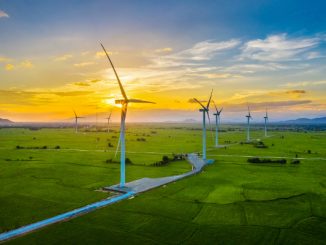
The state, with the highest installed wind power capacity in the country, continues to maintain its leadership position in India’s wind energy segment. Due to its strategic geographical location – a long coastline and favourable wind speeds – it makes for an ideal location for both onshore and offshore wind energy development.
In the onshore wind space, GUVNL auctioned 250 MW capacity of wind power projects (Phase IX) in January 2025. KPI Green Energy, Juniper Green Energy, JGRJ Four Renewable (Jakson Green), and Inox Neo Energies (Inox Clean Energy) won the auction to set up 250 MW of grid-connected wind power projects with a greenshoe option of 250 MW in Gujarat. KPI Green Energy won 100 MW at a tariff of Rs 3.64 per unit. Juniper Green Energy and JGRJ Four Renewable won 50 MW each at a tariff of Rs 3.65 per kWh and Rs 3.66 per kWh respectively. Further, Inox Neo Energies won 50 MW out of the quoted capacity of 100 MW at a tariff of Rs 3.66 per kWh under the bucket-filling method.
Earlier, in September 2024, Solar Energy Corporation of India Limited (SECI) launched a tender for the development of a 500 MW offshore wind project off the coast of Gujarat. The successful bidder will enter into a power purchase agreement with SECI for a period of 25 years. The renewable energy procured by SECI will be sold to GUVNL. This achievement is remarkable for both the state and the country as it marks the first offshore wind auction, paving the way for future development.
The recent auctions and upcoming projects signal the state’s growing focus on harnessing its wind resources. Gujarat’s last dedicated Wind Energy Policy, active from 2016 to March 2022, played a key role in driving wind power growth. However, the current market scenario commands a fresh relook at the policy, which has not been revised for over three years. Currently, wind energy is covered under the broader Renewable Energy Policy, which includes solar and hybrid projects. While this inclusive approach supports overall renewable development, a dedicated wind energy policy will serve as a guiding light for the wind segment’s sustained growth.
Gujarat’s BESS and PSP ambitions
The state is blessed with a high wind and solar energy potential. However, due to the intermittent nature of renewables, energy storage is vital to manage any grid issues. In light of this, Gujarat is actively investing in battery energy storage systems (BESSs) and pumped storage projects (PSPs).
In December 2024, GUVNL’s Phase IV 500 MW/1,000 MWh BESS storage auction was concluded. In the auction, H.G. Infra Engineering secured 500 MWh at Rs 225,985 per MW per month, Kintech Synergy won 200 MWh at Rs 225,985 per MW per month, Bhilwara Energy (LNJ Bhilwara Group) won 200 MWh at Rs 225,993 per MW per month and Advait Infratech won 100 MWh at Rs 226,000 per MW per month. Moreover, in April 2025, GUVNL’s 500 MW/1,000 MWh standalone BESS tender concluded with Solarworld Energy Solutions winning 400 MWh at Rs 280,000 per MW per month and H.G. Infra Engineering securing 600 MWh at Rs 285,600 per MW per month. Moreover, in July 2025, GUVNL announced a 2 GW/4 GWh (Phase 7) standalone BESS tender under the new VGF scheme. In the same month, the International Finance Corporation and IndiGrid partnered to develop a 180 MW/360 MWh standalone BESS project in Gujarat.
In addition to BESS, Gujarat is exploring its vast potential for PSPs. The state has a PSP potential of 10,180 MW for a total of 13 projects. This includes two on-river and 11 off-river projects with 1,440 MW and 8,740 MW potential respectively. A total of seven off-river PSPs are under survey and investigation in Gujarat. Two PSPs – Kadana (240 MW) and Sardar Sarovar (1,200 MW) – have been constructed but are not working in pumping mode.
Green hydrogen
The state possesses strategic advantages – a growing market for hydrogen, a high renewable energy potential and abundant water resources. To develop the state’s green hydrogen ecosystem, the state government has issued policies and taken initiatives. A notable government initiative is the inclusion of green hydrogen as a thrust area under the Aatmanirbhar Gujarat Scheme for assistance to large industries and thrust sectors (Industries and Mines Department, 2022).
During the Vibrant Gujarat Global Summit 2024, the state further solidified its commitment by announcing a special land policy dedicating 0.2 million hectares of wasteland in Kutch and Banaskantha for green hydrogen production. In fact, the state provides financial support of Rs 518.71 billion for green hydrogen projects.
These policy-level initiatives are already translating into concrete investments and projects. In June 2024, the Essar Group announced a Rs 300 billion investment plan to develop a green hydrogen plant in Jamnagar, targeting 1 GW of hydrogen capacity and 1 million tonnes per annum of green molecules over the next four years. GH2 India entered into an MoU with Gujarat Power Corporation Limited in July 2024, aimed at accelerating green hydrogen production across the state through collaborative efforts. Adding to the momentum, Adani New Industries Limited (ANIL) commissioned India’s first off-grid 5 MW green hydrogen pilot project in Kutch in June 2025. This pilot project serves as a precursor to ANIL’s green hydrogen hub under development in Mundra, Gujarat.
Compressed biogas
Gujarat’s abundant organic resource offers a significant yet largely untapped opportunity to produce around 4,000 tonnes of compressed biogas (CBG) per day (according to a government press release dated January 16, 2025). This positions the state as a potential leader in bioenergy and green fuel production.
Gujarat currently has 24 CBG projects in the pipeline, trailing only behind Uttar Pradesh and Maharashtra, according to the GOBARdhan portal. The state also ranks second in operational capacity, with 20 CBG plants currently functional, and an additional 43 projects yet to begin construction. This surge in activity can be attributed to Gujarat’s supportive state-level bioenergy policies, which have fostered a favourable environment for investment and implementation.
Going forward, the state aims to set up over 20 additional CBG plants and install more than 30,000 individual biogas units, with a combined estimated investment exceeding Rs 10 billion.
GEC update
Gujarat is among the few states to be included in both Phase I and Phase II of the intra-state transmission system (InSTS) green energy corridor (GEC) scheme. This highlights its strategic importance in India’s renewable energy road map.
Under GEC Phase I, the state had set a target to construct 1,908 ckm of transmission lines. As of February 28, 2025, the state had completed 1,636 ckm, demonstrating steady progress. In terms of substation capacity, it successfully achieved the target of 7,980 MVA. The central grant allocated to Gujarat for this phase was Rs 5.62 billion, of which 75.27 per cent has already been disbursed, reflecting both strong implementation and financial traction.
However, progress under GEC Phase II has been tardy. Out of 27 total packages, 19 have been tendered. Out these 19, 18 were awarded as of February 28, 2025. The revised infrastructure targets under this phase include 2,570 ckm of transmission lines and 7,460 MVA of substation capacity. Despite administrative progress, no physical milestones have been achieved yet. Similarly, the Rs 12 billion central grant earmarked for Phase II remains unutilised as of the reporting date.
Solar manufacturing
The state’s conducive business environment, supported by policy clarity, streamlined regulatory processes, and robust infrastructure, has positioned it as a leading investment destination in the country. A key strategic advantage is Gujarat’s proximity to major ports, which has historically played a pivotal role in its industrial growth. Access to ports facilitates easy import of raw materials, efficient export of finished goods, and reduces overall logistics costs and time. This, coupled with its well-developed manufacturing ecosystem, has enabled the rapid launch and scaling of major industrial projects.
Recent developments in the state’s solar manufacturing sector:
- In July 2025, H&H Aluminium inaugurated its aluminium solar frame manufacturing plant. Having a manufacturing capacity of 24,000 metric tonnes per annum, the plant is located in Rajkot, Gujarat.
- In March 2025, Goldi Solar launched an artificial intelligence-powered solar module manufacturing line at its newly built facility in Kosamba, Surat, Gujarat. The facility has been designed for a planned production capacity of 14 GW.
- In January 2025, Waaree Energies Limited commenced trial production at its 5.4 GW solar cell manufacturing facility in Chikhli, Gujarat.
Outlook
As per NITI Aayog, Gujarat boasts an impressive renewable energy potential, with 36 GW of solar power, and 142.6 GW of wind power at 120 metres and 180.8 GW at 150 metres. Additionally, the NIWE has estimated India’s offshore wind potential at 71 GW, with 36 GW identified in coastal zones near Gujarat. The state also stands out in the green hydrogen space, with a production potential of 2.18 million tonnes per annum by 2030, as highlighted in the CEEW’s April 2025 report on “Assessing Financial Support Through Policies in India”.
Despite Gujarat’s impressive strides in renewable energy development, it faces several challenges that could impede future growth if left unaddressed. One of the foremost issues is land acquisition, particularly in ecologically sensitive regions such as Kutch. Furthermore, transmission infrastructure development, while progressing, must keep pace with the increasing addition of renewable energy capacity, especially in remote zones. Going forward, bottlenecks in evacuation and the high cost of grid integration may hinder offshore wind project development. In the onshore wind segment, the underperformance of older turbines at high-wind-potential sites is a key concern. This makes repowering necessary; however, it has not gained traction across the country.
According to the CEA’s quarterly report on under-construction renewable energy projects released in June 2025, Gujarat has a pipeline of around 136.84 GW of solar, wind and solar-wind hybrid projects. Managing this vast pipeline will become increasingly challenging if these structural issues are not ironed out. Without adequate investments in transmission infrastructure and BESS, the state may struggle to integrate variable renewable energy efficiently. This could lead to grid instability, curtailment of generation and underutilisation of valuable renewable energy assets, in turn, slowing down the pace of energy transition and deterring investor confidence.
Emerging segments such as energy storage and green hydrogen require clarity on long-term procurement mechanisms, financing models, and VGF structures. Addressing these cross-cutting challenges through streamlined policies, faster clearances, and stronger stakeholder coordination will be crucial for Gujarat to sustain its clean energy leadership.
Net, net, the state’s diversified approach – spanning distributed solar, solar parks, onshore and offshore wind, compressed biogas, hydropower and PSPs, green hydrogen, battery storage, and transmission infrastructure – sets a strong precedent for integrated renewable energy development. As India accelerates towards its renewable energy goals, Gujarat is well poised to remain at the forefront, powering not just itself, but also contributing significantly to the nation’s sustainable future.