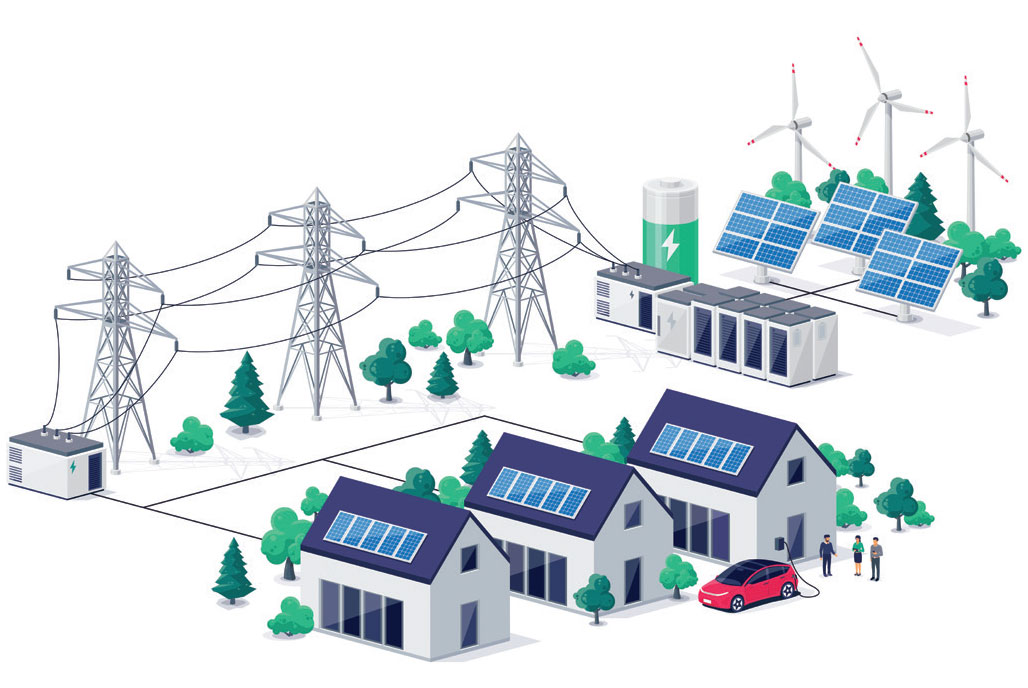
As India moves toward its ambitious target of 500 GW of non-fossil fuel-based capacity by 2030, the transmission, generation and distribution segments of the power value chain must evolve in a coordinated manner. The success of India’s renewable energy transition depends on how effectively these components are integrated. Recent developments across these three areas highlight both opportunities and challenges. This article presents key insights from a panel discussion among Ashok Pal, Chief Operating Officer, Central Transmission Utility of India Limited (CTUIL); H. N. Shah, General Manager, Gujarat Urja Vikas Nigam Limited; and Naveen Nagpal, Vice-President, BSES Rajdhani Power Limited, at Renewable Watch’s 18th Edition of Solar Power in India conference and explores the interlinked challenges and opportunities across the value chain as India advances its renewable energy ambitions…
Scaling transmission infrastructure to enable India’s renewable energy surge
Transmission is a key enabler of India’s energy transition. The transmission network is being rapidly scaled to keep pace with renewable energy growth. The planned connection of over 230 GW of renewable energy to the interstate transmission system and 110 GW to intra-state networks signals a strong institutional commitment to infrastructure readiness. CTUIL has already received more than 335 GW worth of open access applications, surpassing projected targets and indicating a healthy project pipeline.
However, challenges are emerging. A key issue is the concentration of generation in select states, particularly Rajasthan and Gujarat, which together account for more than 200 GW of proposed renewable capacity. This regional imbalance is pushing transmission planners to design long-distance evacuation corridors, including high-voltage direct current (HVDC) lines. With limited vendors and long lead times for HVDC technology, the pressure on planners is intensifying. Another area of concern is the underutilisation narrative surrounding renewable transmission assets, often due to the variable nature of solar and wind power. With renewable capacity utilisation factors ranging from 20-25 per cent, transmission lines may appear underused, but in reality, they are fulfilling their mandate by ensuring connectivity and grid stability. To further improve asset utilisation and match generation with load profiles, the adoption of battery energy storage systems (BESSs) is being planned, with estimates suggesting 60 GW of BESS capacity will be needed by 2030.
Scaling renewable generation through hybrid projects and storage integration: Case of Gujarat
India’s renewable generation landscape is characterised by rapid scaling and diversification of projects from standalone to hybrid projects. This shift can be seen in Gujarat, which has over 35 GW of installed renewable capacity, with 30 GW of tied-up renewable energy projects in the pipeline. The state’s approach demonstrates comprehensive planning with resource adequacy assessments extending to 2034-35 and systematic capacity additions of approximately 6.7 GW annually. Large-scale solar parks in the state have demonstrated their ambition to achieve economies of scale. However, this rapid expansion of standalone solar projects introduces complex challenges related to grid integration, resource adequacy planning and the need for complementary storage solutions.
Storage technology emerges as a critical enabler for renewable generation, to balance the intermittent nature of solar and wind power. Gujarat is making progress in setting up storage projects, securing standalone BESS through competitive bidding tenders. Current storage procurement activities focus primarily on two-hour duration systems, though the state recognises the growing need for long-duration energy storage solutions to address seasonal variations and extended periods of low renewable generation. Gujarat’s strategy includes both standalone storage projects and planned hybrid solar-plus-storage systems. The integration of storage with renewable generation is evolving from standalone systems to hybrid configurations that can provide both energy and ancillary services to the grid.
Going forward, Gujarat will focus on diverse project configurations, such as the Khavda renewable energy park, which will focus on both solar and wind installations. This approach addresses the fundamental challenge of renewable intermittency while providing grid operators with reliable capacity that can be used during peak demand periods.
The state’s distributed renewable energy initiatives, including bilateral purchase mechanisms for projects below 5 MW for solar and 10 MW for wind, demonstrate innovative procurement strategies that accommodate both large-scale developers and smaller market participants. On the policy side, Gujarat is taking steps to resolve key implementation barriers, including land availability and transmission connectivity. New mechanisms under development include a land pooling portal, a revised connectivity approval process in alignment with national norms, and the expansion of the Akshay Urja Setu portal to enable seamless coordination among multiple state agencies.
Transforming the distribution network through decentralised renewables, storage and consumer-centric innovations
The distribution segment is undergoing a parallel transformation as it navigates the complexities of accommodating distributed renewable energy while maintaining grid stability and service quality. Urban centres face unique challenges in meeting distributed renewable energy targets due to limited rooftop space relative to high energy consumption patterns. This constraint has necessitated innovative policy interventions, including enhanced capital subsidies up to Rs 10,000 per kW and generation-based incentives that provide consumers with Rs 3 per unit for five years post installation. Virtual net metering and group net metering arrangements have emerged as critical solutions, enabling consumers without adequate rooftop space to participate in solar energy programmes through community-based installations.
The evolution of distribution networks to handle bidirectional power flows presents both opportunities and challenges, particularly in agricultural and peri-urban areas where ground-mounted solar projects encounter weak network infrastructure. These installations often create over voltage issues and reverse power flows that exceed the capacity of networks originally designed solely for local load supply. The concept of green energy corridors is, therefore, extending beyond transmission networks to distribution systems, requiring dedicated evacuation infrastructure to efficiently handle distributed generation without compromising grid stability.
Storage integration at the distribution level represents a paradigm shift from traditional grid operations to dynamic energy management systems. An emerging trend is the adoption of utility-scale, distribution-level BESS installations as core grid infrastructure. A case in point is the recently launched Kilokari BESS project, a 20 MW/40 MWh installation at the Kilokari substation that became India’s first regulated, standalone distribution-level battery storage system. Commissioned in March 2025 and officially unveiled in May 2025, this project demonstrates how storage can function as core grid infrastructure rather than auxiliary equipment. The system provides multiple grid services, including voltage regulation, reactive power support, backup for 11 kV bus operations, and energy arbitrage during peak periods, while its data acquisition systems generate real-time operational insights that inform future deployments.
Behind-the-meter storage solutions are simultaneously being promoted to align consumer generation patterns with actual demand profiles, particularly addressing the mismatch between daytime solar generation and evening peak consumption. The regulatory approval of storage systems under opex models has created new pathways for discoms to deploy storage assets while managing capital constraints. These installations provide utilities with sophisticated tools for managing renewable intermittency, peak demand and power quality issues while supporting the integration of electric vehicle (EV) charging infrastructure and distributed solar initiatives.
Data acquisition systems embedded in projects are providing realtime operational insights, informing future deployments, especially in support of EV charging and distributed solar initiatives. The success demonstrates that urban utilities can deploy modular BESS to manage night loads, reverse flows and rooftop solar intermittency while easing network congestion.
Additionally, peer-to-peer energy trading is being piloted to enable prosumers to sell surplus energy to other consumers. Blockchain-based platforms are being developed to integrate with discom billing systems, laying the groundwork for more consumer-centric, flexible market mechanisms.
Conclusion
Going forward, the successful integration of India’s renewable energy expansion requires coordination between the transmission, distribution and generation segments, each facing distinct yet interconnected challenges. The transmission sector must rapidly scale infrastructure to handle concentrated renewable generation from resource-rich states, while overcoming supply chain constraints in critical technologies like HVDC systems. Generation companies and developers must embrace storage integration as a fundamental component of renewable projects, moving beyond simple capacity addition to creating dispatchable clean energy resources. Discoms must transform their networks to accommodate bidirectional power flows while maintaining service quality and enabling innovative business models for distributed energy resources.
Insights from across the transmission, generation and distribution segments reveal the depth of planning and effort under way to support India’s renewable energy goals. Yet, the transition is not without systemic challenges. Disproportionate generation siting, limited storage readiness, intermittency and network constraints require holistic planning and cross-sectoral coordination. The next phase of India’s energy transformation will hinge on deep integration between these three pillars, with battery storage and digital visibility acting as critical enablers.