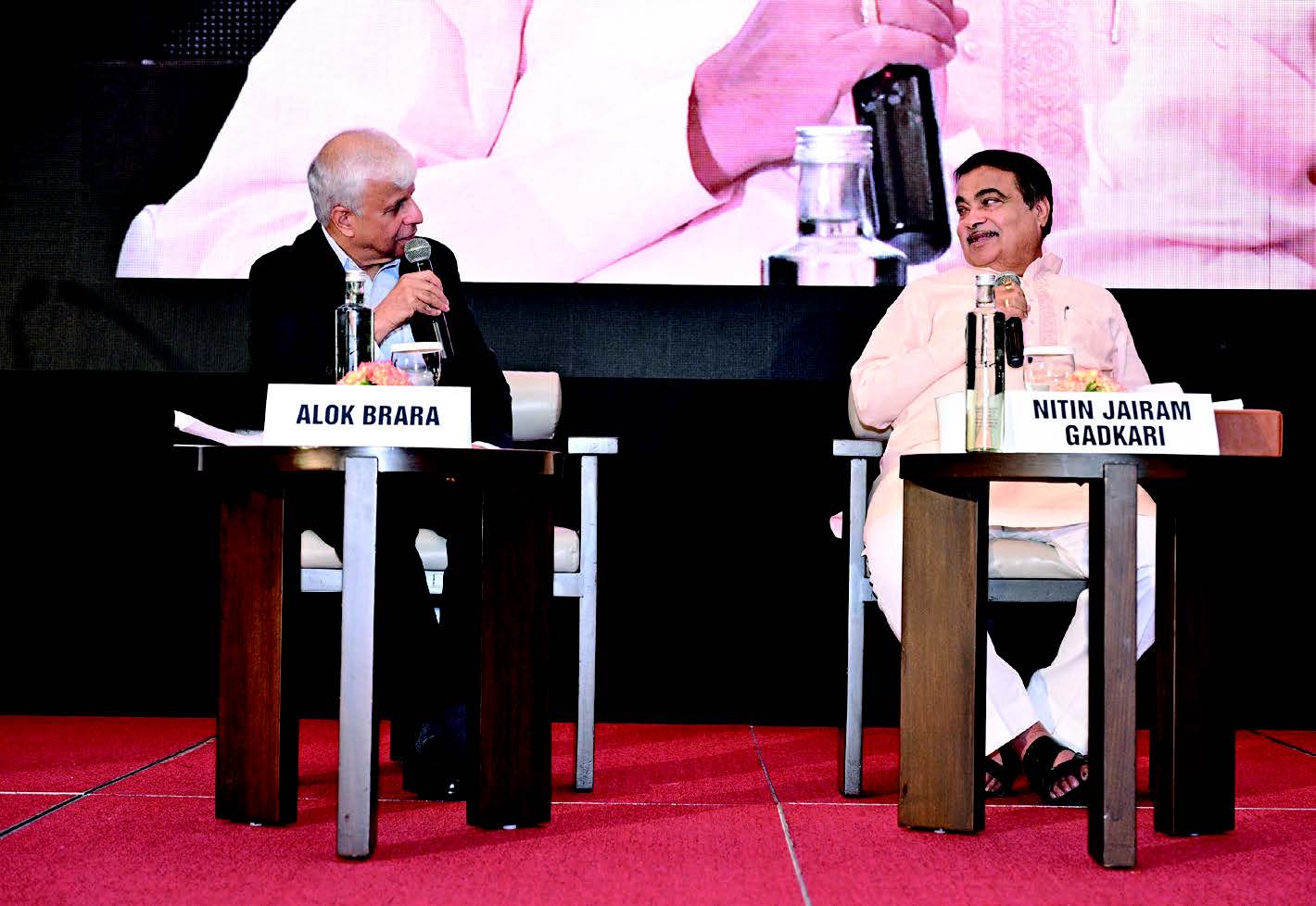
In an interaction with Alok Brara, Publisher, Renewable Watch, at the India Infrastructure Forum 2025, Nitin Jairam Gadkari, Union Minister of Road Transport and Highways, talked about the uptake of alternative fuels such as ethanol and compressed biogas (CBG), as well as clean mobility, including electric vehicles (EVs) and hydrogen fuel cells. He also highlighted the role of sustainability practices in infrastructure development and his vision for the future. Edited excerpts…
What is the role of infrastructure development in India’s economic growth?
Politics is an instrument of socio-economic change, and infrastructure development assists in this endeavour. To achieve a $5 trillion economy and realise the vision of Atmanirbhar Bharat, the development of robust infrastructure in the power, transport, water and communication sectors is key. Without this, we cannot attract capital investment; develop industry, trade, business and agricultural growth; and create employment. Thus, infrastructure development is key to India’s economic growth.
What is your view on promoting sustainability in infrastructure development?
We must maintain a delicate balance between ethics, economy, ecology and the environment. Fossil fuels continue to be utilised extensively, but we must now decisively transition to alternative fuels and biofuels. India has already implemented 20 per cent ethanol blending in petrol. Furthermore, ethanol can be used produce isobutanol, which can then be used in construction equipment. This solution offers significant cost advantages.
The overall policy framework must prioritise import substitution, cost effectiveness, pollution reduction and indigenous production capabilities. Compressed natural gas (CNG) for construction equipment, flex engines compatible with ethanol, hydrogen power and electric alternatives must be implemented while actively discouraging diesel use.
Bio-bitumen is now being efficiently derived from rice straw. The lignin byproduct from this process is blended with petroleum bitumen. A successful pilot on the Nagpur-Jabalpur national highway has demonstrated the viability of this innovation. This project incorporated 10 per cent of bio-bitumen.
Other sustainable innovations include the implementation of bamboo crash barriers. Going forward, adopting a green approach to developmental initiatives will be paramount for long-term sustainability.
You have also been promoting clean mobility. What is your view on EVs, hydrogen fuel cells and biofuels?
Promoting alternative fuels and biofuels in the transport sector is a key focus area of the government. I came to this event in an Innova HyCross, which is fully run on ethanol and is equipped with a flex-fuel engine. The average cost of fuel for this car is around Rs 25 per litre. The car has a battery pack that allows it to run in EV mode as well. I also have a hydrogen-powered car, underscoring the importance of promoting hydrogen fuel cells, given India’s significant import dependence on fossil fuel, which costs us around Rs 22 lakh crores.
My dream is to see farmers diversify their business activities beyond traditional agriculture into the energy and power sectors. Today, we are producing ethanol from various sources, such as corn, bamboo, rice straw, molasses, sugar and food grains. This is financially helpful for the farmers. I am also confident about the future of EVs, given the falling cost of lithium-ion batteries, which has fallen from $150 per kWh to less than $115 per kWh. Going forward, it is expected to come down further to $100 per kWh, helping achieve cost parity between petrol, diesel and electric cars.
My dream is to see farmers diversify their business activities beyond traditional agriculture into the energy and power sectors.
If we compare fuel costs, for EVs, they are only 10 per cent of fossil fuel-based cars – and there is no pollution. Flex-fuel engine cars are also entering the market. Electric buses are gaining popularity across cities, and electric trucks are now being launched as well. To support this transition, EV charging infrastructure is expanding, both within cities and along highways. Notably, we are developing 670 roadside amenities along highways, each equipped with EV charging facilities.
I am also confident about the future of EVs, given the falling cost of lithium-ion batteries
For construction equipment, I am actively promoting the use of isobutanol, which is produced from bioethanol. This fuel can replace diesel. Experiments are currently under way at the Automotive Research Association of India, and after receiving its report, we can start adopting this technology.
Apart from isobutanol, construction equipment can also run on hydrogen and CNG, while electric equipment is also gaining traction. These alternative technologies have the potential to become cost-effective, help in import substitution, can be produced indigenously and significantly reduce environmental pollution.
Further, work is under way to develop advanced mass rapid transit systems powered by electricity. A notable initiative is the introduction of flash-charging buses, designed to handle a passenger capacity of 135 individuals. These air-conditioned buses will feature amenities like televisions. These electric buses will be economically viable, with ticket prices approximately 30 per cent below those of diesel-powered buses.
Overall, apart from promoting clean fuels, there is a need to adopt innovative technological solutions to address traffic congestion to reduce air pollution. Initiatives are under way for the development of underground tunnel networks to alleviate surface traffic, the interconnection of transportation nodes via ropeway systems, and the establishment of flash-charging electric bus networks.
Apart from promoting clean fuels, there is a need to adopt innovative technological solutions to address traffic congestion to reduce air pollution.
The CBG sector is also close to your heart. Are you satisfied with the developments in this space?
CBG is an economically viable industry. Punjab and Haryana produce a significant amount of agricultural waste, which is unfortunately burnt. Seven tonnes of rice straw can produce 1 tonne of bio-CNG, with lignin as the byproduct. As discussed earlier, we successfully constructed 1 km of road on the Nagpur-Jabalpur highway, blending 10 per cent of lignin into the petroleum bitumen.
Diesel tractors and buses can also be replaced with CNG-based vehicles. Some months ago, I got the opportunity to launch Bajaj’s CNG motorcycle. I learnt that a petrol motorcycle costs Rs 2.40 per km, whereas a CNG motorcycle costs just Re 1 per km.
Going forward, our focus must be on reducing imports and increasing exports. At present, India is an importer of energy, but within five to six years, we should aim to become an exporter of energy. That is my dream, and I am actively working towards achieving it.
We successfully constructed 1 km of road on the Nagpur-Jabalpur highway, blending 10 per cent of lignin into the petroleum bitumen.
Which infrastructure project are you most satisfied about?
Since the very beginning, I carried with me a vision that originated from my childhood experiences with cycle rickshaws. I had long contemplated how we might improve this challenging situation.
The successful implementation of mechanised e-rickshaws stands as one of my most significant accomplishments, delivering tangible humanitarian benefits to 15 million citizens.
From a humanitarian perspective, the traditional system – where an impoverished individual physically pulled passengers – represented an unfortunate societal arrangement. Upon taking office, I convened technology specialists and technical experts to develop special laws for mechanised e-rickshaws. Previously, approximately 150 million individuals derived their livelihood from rickshaw-pulling. Fast forward to today, they operate e-rickshaws. This represents a revolutionary social change.
The successful implementation of mechanised e-rickshaws stands as one of my most significant accomplishments, delivering tangible humanitarian benefits to 15 million citizens. This outcome provides immense personal satisfaction, knowing we have improved working conditions for so many individuals.