

New transmission lines are crucial for India’s renewable energy expansion. One of the flagship projects driving transmission grid expansion is the green energy corridor (GEC) project.
Structured under two phases, GECs have played a key role at the intra-state level, integrating wind and solar power into India’s grid. Highlighting the progress under this initiative, the Economic Survey 2024-25 states that almost 9,136 ckt km of transmission lines and 21,413 MVA of substations have been built under GEC-I, while GEC-II is extending into seven more states. Due to their importance in the sector, GEC projects have received a significant fund allocation of Rs 6 billion under the Union Budget 2025-26.
The GEC initiative is set to enter its next phase, with a third phase in the works now. The power ministry has reportedly set March 31, 2025 as the deadline for states to submit proposals for intra-state transmission projects under the scheme.
A look at how these green energy superhighways are shaping up…
Overview and progress so far
Back in 2012, a study report by Power Grid Corporation of India Limited (Powergrid) identified gaps in power evacuation and transmission infrastructure in the vicinity of potential renewable energy sites and highlighted the need for a dedicated transmission infrastructure for large-scale solar and wind power plants. Based on the report, states submitted their transmission plans to the Central Electricity Authority (CEA) for appraisal. Implementation work subsequently started in 2015.
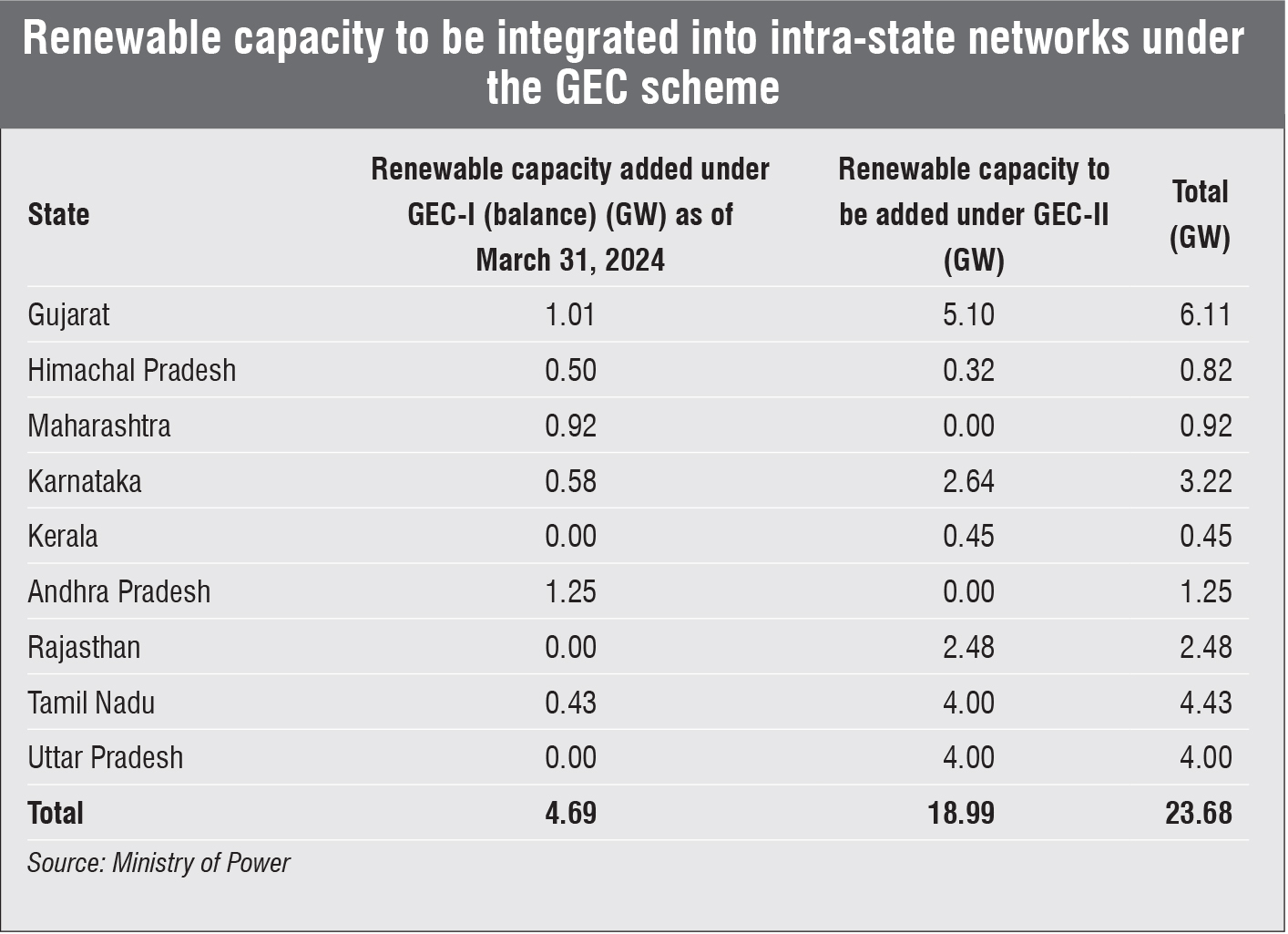
GEC-I aims to evacuate 24 GW of power across eight states – Andhra Pradesh, Gujarat, Himachal Pradesh, Karnataka, Madhya Pradesh, Maharashtra, Rajasthan and Tamil Nadu. Overall, this phase entails setting up 9,767 ckt km of transmission lines and 22,689 MVA of substations. So far, Phase I projects have been completed in the states of Madhya Pradesh, Rajasthan, Tamil Nadu and Karnataka. The remaining four states have requested further extension owing to right-of-way constraints and the Great Indian Bustard issue. Almost 9,136 ckt km of transmission lines and 21,413 MVA of substations have been built so far. Projects are being implemented with a central grant of 40 per cent of the project cost or award cost, whichever is lower.

Network expansion under Phase II for the evacuation of around 20 GW of renewable energy is now under way across seven states. These are Gujarat, Himachal Pradesh, Karnataka, Kerala, Rajasthan, Tamil Nadu and Uttar Pradesh. Under GEC-II, the target is to add 7,574 ckt km of transmission lines and 29,737 MVA of substation capacity.
For the intra-state portion of the GEC Phase II scheme, the total estimated cost is Rs 120.31 billion, with a central financial assistance (CFA) of 33 per cent of the project cost, that is, Rs 39.7 billion. Some states had requested a revision of transmission schemes under GEC-II, which was approved by the Ministry of New and Renewable Energy (MNRE). However, the CFA was limited, as approved by the Cabinet Committee on Economic Affairs for that particular state.
State transmission utilities are currently in the process of tendering projects under the scheme, which is scheduled for completion by 2025-26. States are preparing the packages and issuing tenders for implementing the transmission schemes.
Other mega green energy evacuation projects under planning
Apart from the various ongoing intra-state projects, an important project sanctioned in 2024 under GEC-II was the establishment of an interstate transmission system (ISTS) to support a 13 GW renewable energy project in Ladakh. Being implemented by Powergrid, the project entails the construction of approximately 713 km of transmission lines, covering 1,268 ckt km, and the installation of two 5 GW high voltage direct current (HVDC) terminals in Ladakh (Pang) and Kaital (Haryana). The infrastructure will facilitate the transmission of electricity generated from the 13 GW renewable energy project, along with a 12 GWh battery energy storage system, in Ladakh.
The cost of Phase II projects is about Rs 207.73 billion, and the CFA will cover 40 per cent of the project cost amounting to Rs 83.09 billion. Powergrid will finance the remaining project costs through debt and equity. The project is scheduled for completion by 2029-30.
In a recent update from the MNRE, it was reported that as of December 2024, 300 acres of land had been acquired at Pang for the project. The HVDC tender has been published, with awards expected by March 2025. The LiDAR survey for the transmission lines has also been initiated.
Meanwhile, projects for power evacuation from bulk consumers such as green hydrogen and ammonia plants of about 20 GW and others of about 18 GW are in the works. As per the Interim ISTS Rolling Plan 2029-30 by Central Transmission Utility of India Limited, almost 19,500 MW of ISTS schemes for various green hydrogen and ammonia plants are planned by financial year 2030. Of these, five ISTS schemes, costing Rs 156.29 billion, will support green hydrogen projects in Gujarat, Tamil Nadu and Andhra Pradesh. Gujarat will benefit the most with 13,500 MW, while Andhra Pradesh and Tamil Nadu will receive 3,000 MW each. Three ISTS schemes (8,200 MW) for Gujarat and Tamil Nadu have been approved under tariff-based competitive bidding.
In addition, mega transmission schemes are being planned for offshore wind transmission projects. Around 10 GW of offshore wind energy evacuation has been envisaged – 5 GW in Gujarat and 5 GW in Tamil Nadu.
Challenges
The transmission infrastructure expansion is expected to require a significant capex in the next few years. As per the National Electricity Plan for Transmission released by the CEA, the development of transmission networks during 2027-32 is expected to entail a massive investment of almost Rs 4.9 trillion (at the 220 kV and above voltage level), of which the intra-state portion is estimated at Rs 993 billion.
Various approaches are being explored to attract institutional investment to tap into the financial potential of intra-state projects. In a notable initiative in December 2024, the CEA collaborated with the National Investment and Infrastructure Fund, PGInvIT and PFC Consulting Limited to organise a workshop with leading transmission industry players, financial institutions, legal experts and representatives from state transcos to discuss asset monetisation for the state transmission sector. Since states have a significant potential to monetise brownfield transmission assets, various strategies were discussed for mobilising the much-needed funds for new infrastructure investment. Two models for investment were discussed in the workshop, the InvIT model and the acquire-operate-maintain-transfer (AOMT) model. In 2022, the CEA, in consultation with a few states and NITI Aayog, prepared the guiding principles for monetising transmission assets through the AOMT model. The AOMT model was recommended as a clear and practical approach that the states could adapt to their specific needs and conditions.
Meanwhile, to fast-track the completion of their green energy projects, the states have approached regulatory commissions to increase the threshold limits for investment. According to recent reports, Rajasthan Rajya Vidyut Prasaran Nigam Limited has proposed raising the threshold limit for intra-state transmission projects under the regulated tariff mechanism to Rs 20 billion, from the previous limit of Rs 2.5 billion for GEC projects in Rajasthan. This proposal is currently under review by the Rajasthan Electricity Regulatory Commission.
Outlook
Matching renewable energy capacity and transmission infrastructure has been an ongoing effort as India steadily ramps up installations to meet its 500 GW target by 2030. This month, India’s solar capacity reached the 100 GW milestone. As per CRISIL estimates, the country is expected to add 175-180 GW of solar capacity between 2025 and 2030.
Bulk transmission capacity will be crucial for integrating this upcoming generating capacity. As per the National Electricity Plan (NEP), around 297 GW of renewable capacity is planned to be evacuated by the states by 2032. Of this, more than 160 GW of renewable energy capacity is proposed to be integrated in Rajasthan (particularly in four districts – Jaisalmer, Jodhpur, Barmer and Bikaner), and Gujarat (mainly in the Khavda region).
GECs are also expected to facilitate cross-border interconnection projects. During a recent ministerial visit to India, Singapore announced that it is actively exploring the possibility of setting up a renewable energy corridor between the two countries. India currently has interconnections with its neighbouring countries, including Bhutan, Nepal, Bangladesh and Myanmar. The proposed corridor is expected to be in line with the One Sun, One World, One Grid initiative.
In sum, these GECs are among the most ambitious grid infrastructure projects globally. Given the scale of India’s renewable energy capacity additions, supporting investments and facilitating timely execution of transmission infrastructure will play a key role in ensuring energy supply security.
By Reya Ramdev

