It is crucial to expand electric vehicle (EV) charging networks to ensure the successful uptake of EVs in India. According to McKinsey research, the country is on the brink of an EV transition, with 70 per cent of Tier I Indian car buyers expressing a willingness to consider an EV for their next purchase, which is significantly higher than the global average of 52 per cent. Furthermore, the survey highlights that most Indian consumers are drawn to EVs because of factors such as environmental benefits, lower long-term ownership costs and reduced engine noise.
Industry forecasts indicate that the total number of EVs on Indian roads is estimated to reach 22 million by 2030. This will largely be driven by the electric two-wheeler market, which is expected to grow at an annual rate of 46 per cent from 2023 to 2030.
Consequently, the future of EV charging market is also likely to witness a significant expansion. In terms of charging infrastructure, slow chargers dominate the landscape, representing 89 per cent of the total stations, while fast chargers constitute 7 per cent, and battery swapping stations make up 4 per cent.
Policy ecosystem
Approximately 26 states in India have designated state nodal agencies to oversee the implementation of EV charging infrastructure, ensuring streamlined development. Additionally, 21 states have announced distinct electricity tariffs for EV charging, promoting affordability and accessibility, while 16 states have introduced dedicated EV policies to foster the adoption of green mobility solutions. Correspondingly, the number of public EV charging points is expected to grow substantially, reaching approximately 1.7-3.1 million by 2030.
Hence, India is making significant strides in building a future with fast-charging infrastructure to support its growing EV ecosystem. The Ministry of Heavy Industries is promoting the use of EVs through the PM Electric Drive Revolution in Innovative Vehicle Enhancement scheme. This scheme aims to boost EV adoption, set up charging infrastructure and support the growth of the EV manufacturing ecosystem in the country. It has been allocated a budget of Rs 10.9 billion for two years, with Rs 20 billion specifically for setting up EV public charging stations (EVPCS).
Importantly, the Ministry of Power has issued the Guidelines for Installation and Operation of Electric Vehicle Charging Infrastructure-2024 to standardise and streamline the installation and operation of EV charging infrastructure. These guidelines are designed to create a connectedand interoperable network for EV charging across the country.
These are welcome developments, as India faces a critical challenge in achieving the global benchmark of one EV charging station per 20 vehicles. India’s EV-to-public charger ratio stands at 135:1, significantly higher compared to countries such as China (6), the US (19) and the Netherlands (6), indicating a shortage of public chargers compared to the number of EVs. To address this, India needs to add 3,000 public chargers under a base case scenario, 6,500 under a realistic scenario, and 46,000 to meet global benchmarks. Despite progress, substantial efforts are still required to build a robust charging infrastructure that can meet the demands of the growing EV market.
Delhi’s initiatives
Delhi is actively working towards establishing a robust and widespread EV charging infrastructure to support the transition to electric mobility. The city currently has a total EV population of 285,000, comprising a significant share of two-wheelers at 33 per cent and three-wheeler passenger vehicles at 49 per cent. Other segments include three-wheeler cargo vehicles, four-wheelers and electric buses.
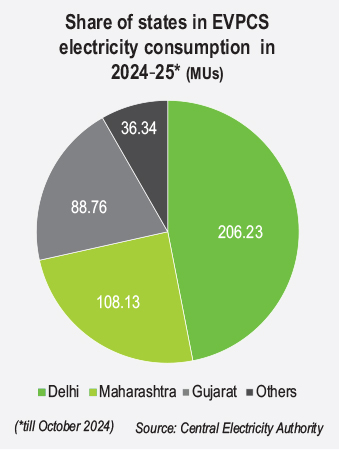
To accommodate this growing EV population, Delhi has developed over 5,000 charging and swapping stations, with the distribution skewed towards slow chargers, which account for 50 per cent of the total. Private chargers make up 36 per cent, while fast chargers and battery swapping stations represent 8 per cent and 6 per cent, respectively. As the chart suggests, Delhi is the largest state in terms of total EVPCS electricity consumption, as of October 2024.
Delhi discom BSES Yamuna Power Limited (BYPL) has been working on several initiatives to promote EV charging. In a first, it has set up a smart managed charging station, jointly funded by Nordic Innovation and BYPL. As the first of its kind in the country, this innovative initiative is designed to optimally balance the requirements of charging point operators (CPOs) and utilities, ensuring efficient energy management and improved grid integration. The station employs EV-managed charging technology, which allows it to dynamically adjust and lower the output of EV chargers based on grid conditions and demand. This feature ensures a sustainable and efficient charging process while avoiding grid overload. Additionally, the station is equipped with a user-friendly mobile application that allows customers to pre-book, book and pay for charging sessions in advance. This seamless digital integration enhances user convenience, catering to varied charging needs while promoting widespread EV adoption in India.
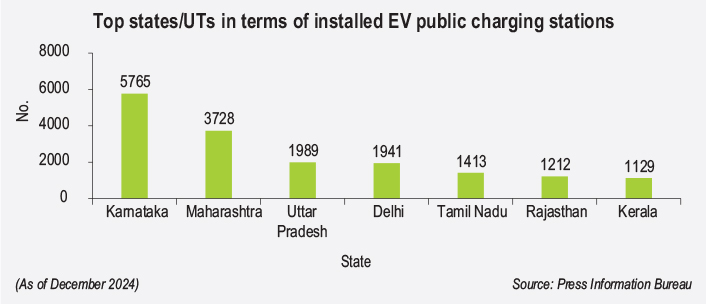
Furthermore, to utilise power swapping from grid support, BYPL has set up battery swapping stations. These stations provide a “battery-as-a-service” model, allowing EV users to replace discharged batteries with fully charged ones, ensuring minimal downtime. The swapping process is facilitated through dedicated stations where users can deposit their depleted batteries and retrieve fully charged ones, streamlining the charging experience. The initiative, as showcased by BYPL in Delhi, demonstrates a practical and efficient approach to addressing EV charging challenges.
There are also initiatives to promote green EV charging by installing rooftop solar panels at public EV charging sites in Hauz Khas Village, Delhi. This project is a collaborative effort involving the National Solar Energy Federation of India with support from the German government. The charging station incorporates PV-enabled battery storage, showcasing a state-of-the-art solution for sustainable energy utilisation. Designed as a green EV charging station, this facility is fully operational for public use. It also features a small battery system capable of providing demand response services, further enhancing grid efficiency and stability. This innovative project not only promotes renewable energy adoption in EV charging but also serves as a model for future green mobility solutions.
Another key initiative implemented by BYPL is its collaboration with the Municipal Corporation of Delhi and Terra Motors, to convert a closed waste dumping site (Dhalao) into a public EV charging station. This innovative initiative not only improves the aesthetics of the area but also raises awareness and motivates residents to adopt clean mobility solutions.
Evolving needs
The evolving needs for EV charging infrastructure emphasise the increased use of DC fast chargers, with a growing focus on ultra-fast charging stations that can charge vehicles to 80 per cent in just 15 minutes, as well as the exploration of advanced technologies such as wireless charging and solar-powered charging solutions. Pilot projects for wireless and solar-powered charging are under way in cities such as Delhi and Mumbai to reduce grid dependency. Renewed research and development efforts are also targeting battery swapping systems to enable better grid support. According to Bureau of Energy Efficiency guidelines, public charging infrastructure, predominantly fast chargers, must be available every 1×1 sq. km in urban areas and within 20 km on highways, necessitating careful planning in sync with discom network requirements due to grid loading implications. Thus, discoms play a critical role in this transition, serving as enablers of fast-charging infrastructure and potentially acting as CPOs to ensure rapid and widespread deployment.
To support the evolving needs of EV infrastructure, it is essential to address the growing load requirements stemming from the addition of 2 million charging points. This expansion is expected to add a significant load of 40,000-50,000 MW at the national level, requiring careful planning and resource allocation.
A key focus should be on enabling solar-powered EV charging stations to manage this increased load efficiently while reducing tailpipe emissions and promoting sustainable energy use. Additionally, time-of-day tariffs must be re-evaluated to encourage EV charging during non-peak hours or solar generation hours, effectively shifting demand and optimising grid utilisation.
To ensure seamless implementation, discoms and CPOs must invest in innovative solutions such as managed charging systems, vehicle-to-grid technology and solar-powered charging infrastructure. These measures will not only minimise capital expenditure but also foster a positive ecosystem that supports the scalability and sustainability of EV infrastructure nationwide.
Outlook
India’s journey toward a robust EV ecosystem faces several challenges, including the need to scale up EV charging infrastructure to meet global benchmarks, address grid strain from increased load and balance the EV-to-public charger ratio. Achieving this involves utilising underutilised spaces by contributing to sustainable development and promoting the adoption of EVs in urban settings. This will require ensuring affordability and the efficient utilisation of renewable energy for charging. Despite these challenges, the outlook is promising, primarily because of strong government policies, ambitious electrification targets and innovative initiatives like battery swapping, managed charging systems and solar-powered charging stations.
Based on a presentation by Brajesh Kumar, Chief Business Officer, BSES Yamuna Power at Power Line’s recent Power Distribution conference