

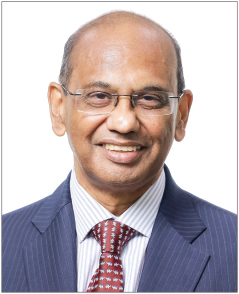
 International collaboration for the transfer of knowledge and technology, capacity building and access to finance is key to accelerating solar power development, especially in the Global South. With over 100 member countries, the International Solar Alliance (ISA) is at the helm of various programmes aimed at promoting the just and inclusive adoption of solar power. In an interview with Renewable Watch, Dr Ajay Mathur, Director General, ISA, discussed the key priorities for the ISA and its initiatives to promote private sector participation, ensure affordable access to finance and encourage gender equity in the solar power sector. Edited excerpts…
What are your recommendations on the policy side for the Indian renewable energy sector?
India has achieved significant success, especially earlier this year, with four auctions where the price of round-the-clock (RTC) renewable energy was equal to or less than the price of new fossil fuel-based electricity. However, challenges remain in scaling up, which requires land and transmission infrastructure.
The Gujarat government has created an area around Khavda to accommodate the development of 30 GW of solar, wind and storage projects. Similar sites have been set up in Rajasthan and Karnataka as well. More such parks need to be planned across India. This does not mean that all the land must be acquired; it can also be leased. The government can undertake large-scale leasing and then sublease the land to solar, wind or
storage developers.
We also need to build transmission infrastructure, as constructing the grid takes longer than developing solar projects. However, designating specific areas of land will facilitate better planning and ensure that transmission lines are ready. Enabling investment is vital because, although we have come to a point where RTC renewable electricity is cheaper than fossil fuel-based electricity, the upfront investment cost is double. One way to address this is by ensuring that funds are available for a shorter duration.
How is the ISA facilitating private sector participation in different member countries?
In most of the countries we work in, the majority of investment in electricity generation has been made by the government. However, this approach presents a significant number of challenges. The country must establish institutions that can figure out which projects should be undertaken and where they will be set up. It must develop mechanisms for project awarding, establish power purchase agreements and ensure payment guarantee. All of these things need to be in place. In the case of renewables, the cost of electricity is less than that of thermal power, but the initial investment is higher. In most of these countries, governments are unable to invest further or take additional loans to invest. Therefore, it becomes essential to create regulations that provide comfort of payment and encourage private sector investment.
However, changing regulations is just one aspect. Building capabilities through training programmes is the second, and implementing demonstration projects to show consumers that renewable energy can meet their needs is the third. These efforts will help attract private sector participation, and this is a key role of the ISA.
You talked about access to finance. What is being done to provide access to affordable finance?
When we examined global investment needs, they were estimated at about a trillion dollars per year, while the total investable capital exceeded this amount. Thus, there are enough funds in the world to invest in renewables. However, the investment in the renewable energy sector last year was about $700 million, and most of it went to the developed countries and China. Approximately 12-13 per cent of this investment came to India, Indonesia and Brazil, while all of Africa just got 3 per cent. This, to me, is the biggest financing problem.
The issue is that while funds are available, they often come with such high interest rates that they make renewable electricity very expensive. In fact, in our assessment, more than 95 per cent of solar loans were repaid in African countries. Therefore, there is a perceived risk problem. To address this, we have initiated the creation of a global solar facility, supported by a pool of funds from our donors. This serves as a guarantee for private sector players and helps make projects affordable.
What is your take on gender inclusivity in the clean energy transition? Does the ISA have any programmes to promote women’s participation in this transition?
Solar provides opportunities for women as workers or entrepreneurs in ways that did not exist with fossil-fuel-based electricity. In the latter, the majority of jobs were in the mining of fossil fuels or in the operation of power stations, and these roles were largely filled by men. With solar, even in the development of products, we see a much greater involvement of women. We are also witnessing a growing number of women entrepreneurs across the world. In our own SolarX programme, approximately one-third of the identified entrepreneurs are women.
One of the key activities that the ISA is focused on is addressing the challenges faced by solar development and exploring ways to enhance the role of women in this sector. This is the core objective of the Solar for She initiative. We are conducting surveys in some of our member countries to identify specific opportunities to enhance women’s participation. Our focus is on enhancing the role of women in activities that align with the development needs of the solar sector.
What is your view on developing local manufacturing and supply chains in ISA member countries?
A vast majority – more than 90 per cent – of solar cells, solar modules, solar cells, ingots and wafers come from China. While this has resulted in extremely cheap prices, it also creates challenges as this activity is concentrated in one country, impacting supply chains. To meet the Paris commitments, the demand for solar cells is projected to increase by at least three times, up to eight times, by 2030. This will further exacerbate the existing challenges in the supply chain.
From an economics perspective, manufacturing solar cells and converting them into solar modules make great sense. Solar modules are being manufactured in various user countries wherever there is enough demand. However, manufacturing solar cells is challenging because even with the best costs, competing with the scale that already exists in China is difficult. So, the only way this can occur is if countries that want to make solar cells provide incentives to the prospective manufacturers. The US is providing it through the Inflation Reduction Act of 2022 and India is providing it through the performance-linked incentive scheme. There are probably four or five geographies capable of providing these subsidies in adequate scale. Thus, we anticipate the expansion of solar manufacturing, particularly solar cells, in these four or five geographies. However, as far as converting solar cells into solar modules is concerned, this should happen across a greater number of countries.
There has been a lot of discussion on green hydrogen globally, but we are yet to see any on-ground, scalable kind of projects. What is your view on this?
We need a non-carbon-emitting source for the fuel sector. Whether it is addressing the hard-to-abate sectors or decarbonising the fuel sector, the only option available today is hydrogen. However, making hydrogen from natural gas costs $2 per kg of hydrogen, and producing it using green electricity increases the cost to $4.5 per kg. In regions with abundant solar energy, where the use of electrolysers can be maximised, we will soon see the lowest prices for green hydrogen. As production scales up, costs will fall, necessitating different markets. Thus, we are moving in the right direction, and we are seeing supply and demand match at a high price.
What are the three big priority areas for the ISA for the next year?
The first priority is integrating solar into our daily lives. Ultimately, it is about how solar power can improve the quality of life. The second priority is regulatory changes. While we have had successes in some countries, we need to ensure that we can provide the infrastructure, skilled personnel and support necessary to help other nations rewrite their regulations. The third priority is addressing the issue of the geographical spread of manufacturing. For instance, widespread manufacturing may not yet be feasible in most parts of Africa. However, these countries have two-wheeler manufacturers, which creates a demand for charging stations. This, in turn, creates a demand for solar panels for charging stations. The ISA should focus on these multiplier opportunities to catalyse growth in the sector.

