

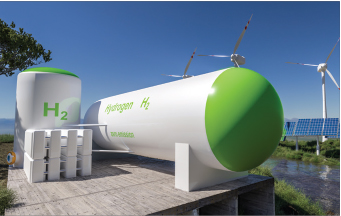
 India, as a major global producer of steel, ammonia and oil, is well positioned to be a significant market for green hydrogen, essential for reducing carbon emissions in traditionally fossil fuel-dependent industries. The country has emerged as a leader in low-cost renewable energy production, which is crucial for reducing the overall cost of green hydrogen production. This is supported by a high installed renewable energy capacity of approximately 200 GW (including large hydro).
Green hydrogen is expected to witness significant adoption across several key industries. In crude oil refining, hydrogen will continue to be used for desulphurisation and hydrocracking. The ammonia sector, primarily the fertiliser production segment, is anticipated to see increased demand. Methanol production is also set to grow, as it is vital for petrochemicals, plastics and other applications. Hydrogen is set to replace coking coal in steel production, while in the shipping sector, hydrogen will be used particularly in the form of ammonia or methanol. However, hydrogen’s use in aviation remains uncertain and is expected to be limited to shorter routes. It will be useful for long-distance transportation, methanol production, ammonia synthesis, steel manufacture, oil refining and energy storage.
Recognising the potential, the Indian government is promoting green hydrogen development by designating 10 states as hubs with focused infrastructure development. Initiatives such as the National Green Hydrogen Mission aim to accelerate its production and utilisation. Despite these efforts, financing remains a critical challenge. While renewable energy costs have decreased significantly, the cost of electrolysers remains high, making it essential to address these financial hurdles to scale up green hydrogen
initiatives effectively.
Reducing the cost of green hydrogen production
Currently, grey hydrogen, produced from coal and natural gas, is cheaper than green hydrogen. The cost competitiveness of green hydrogen depends on several critical factors, including the reduction of electrolyser capital costs, the cost of renewable energy procurement, the efficiency of electrolysers and the viability of storage or banking to enable a round-the-clock (RTC) supply from renewable energy sources. Currently, with a landed renewable energy tariff of Rs 3.50 per unit, including intra-state wheeling and transmission charges in the captive mode, the levellised cost of production (LCoP) for green hydrogen is estimated to range from $3.7 to $4.9 per kg. Projects that co-locate electrolysers and renewable energy capacity can reduce the LCoP by approximately $0.5 per kg, owing to savings on intra-state open access charges.
Energy cost is the primary driver of green hydrogen production expenses, accounting for nearly 60 per cent of the total cost. India, recognised as one of the lowest-cost regions for renewable energy globally, stands to benefit significantly from further reductions in renewable energy prices. As these prices continue to decline, the cost of producing green hydrogen will also decrease. Additionally, introducing a power banking mechanism could enable developers to store renewable energy during peak production times and utilise it when generation is low. This will provide a more consistent RTC supply, ultimately reducing energy costs associated with green hydrogen production. Incentives such as carbon credits and tax relief could also be instrumental in reducing production costs. Furthermore, government support in the form of tax relief, including waiving GST and customs duties on renewable energy generation equipment and storage components, will enhance the economic viability of green hydrogen production.
Improving the efficiency and economics of electrolysis, which currently accounts for around 25 per cent of the total cost, is also crucial. Significant cost reductions can be achieved by enhancing the efficiency of electrolysers, increasing their average stack life and size to enable more hydrogen production over time, and finding viable substitutes for expensive rare earth metals used in electrolyser construction. Enhancing energy efficiency to reduce energy consumption per unit of hydrogen produced, along with increasing the load range and reducing the start-up time of electrolysers, can further lower production costs and improve the overall performance.
Key players and their initiatives
India’s green hydrogen ecosystem is witnessing a surge of large-scale investments with various companies undertaking ambitious projects, each with distinct strategies and massive capex commitments.
- Reliance Industries Limited (RIL) has announced a Rs 750 billion investment over the next three years to build a green hydrogen ecosystem. This includes the establishment of an integrated green energy complex in Jamnagar, Gujarat, featuring a 2.5 GW electrolyser manufacturing facility. The company has secured 74,750 hectares on a 40-year lease for this project, aiming to start green hydrogen production by 2025 and lower the production cost to below $1 per kg by 2030. RIL is also partnering with Ashok Leyland and BharatBenz to explore hydrogen-powered trucking and plans to retail green hydrogen through Jio-bp outlets, which will expand from 1,500 to around 5,000.
- Adani New Industries Limited (ANIL) is another major player, planning a Rs 419 billion investment in the short term to develop green hydrogen facilities in Khavda and the Mundra special economic zones in Gujarat. The Khavda site is expected to produce 1 million metric tonnes (mmt) of green hydrogen annually by 2030, with production starting in 2027. Over the next decade, ANIL plans to invest Rs 4,192 billion to boost its capacity to 2.5-3 mmt per year. Adani Enterprises has also partnered with Kowa Holdings Asia Pte Limited to market and sell green hydrogen, green ammonia and related products in Hawaii, Japan and Taiwan.
- Indian Oil Corporation Limited (IOCL) has floated tenders for a green hydrogen plant at its Panipat refinery, with a capacity of 7,000 mt per annum. This project, expected to cost Rs 20 billion, is part of its broader strategy that includes joint ventures with Larsen & Toubro (L&T) and ReNew to scale up production across India. IOCL also plans to develop green hydrogen facilities in Kerala and Tamil Nadu as part of a Rs 540 billion initiative encompassing electric vehicle charging stations, hydrogen dispensing facilities and city gas distribution (CDG) pipeline infrastructure.
- NTPC Limited is investing Rs 1 trillion to establish a green hydrogen hub in Andhra Pradesh, to be completed in two phases: Phase I by 2026 and Phase II between 2026 and 2030. NTPC plans to fund this project through a strategic investor or an initial public offering. With the goal of reaching 60 GW of green energy capacity by 2032, NTPC has partnered with Ohmium International to supply proton exchange membrane (PEM) electrolysers for up to 400 MW of projects within its 5 GW green hydrogen and green ammonia target.
- GAIL (India) Limited is raising Rs 250 billion to enter the green hydrogen market, with plans to commission India’s largest PEM electrolyser-based green hydrogen plant at its Vijaipur complex in Madhya Pradesh, producing 4.3 tonnes per day (tpd). GAIL is also blending green hydrogen into the CGD network in Indore in collaboration with Hindustan Petroleum Corporation Limited (HPCL) through Avantika Gas Limited.
- ACME Cleantech Solutions has leased 220 hectares of land from the V. O. Chidambaranar Port Authority in Tamil Nadu to build a green hydrogen and green ammonia plant with a capacity of 3,000 tpd at an estimated cost of
Rs 520 billion. The company will also acquire 350 hectares of land in Odisha’s Gopalpur Industrial Park to set up another green hydrogen and ammonia facility at an investment of approximately Rs 270 billion. - L&T is investing Rs 320 billion into green hydrogen through a joint venture with IOCL and ReNew. L&T has partnered with France-based McPhy Energy for electrolyser manufacturing and has signed an agreement with Norway’s H2Carrier for floating green ammonia projects. L&T is already producing 45 kg of green hydrogen per day at its Hazira facility.
- Hindustan Petroleum Corporation Limited (HPCL) aims to establish a green hydrogen production capacity of 24,000 mt per year. It is working on a 370 tpa green hydrogen plant at its Vizag refinery, having invested Rs 110 million of the Rs 330 million budgeted for the project, which is expected to be commissioned this year.
- Bharat Petroleum Corporation Limited (BPCL) is building a 20 MW green hydrogen plant at its Bina refinery. it is also working with the Bhabha Atomic Research Centre to enhance alkaline electrolyser technology for green hydrogen production.
The way forward
India has the potential to become a leading source of green hydrogen and its derivatives, such as green steel and green ammonia, due to its low-cost renewable energy. However, large-scale deployment may be hindered by land availability issues, as solar and wind power require significant space. Despite these challenges, countries like Japan, South Korea and parts of Europe are interested in importing green hydrogen from India. Recently, India and Japan signed their first green ammonia export agreement.
The global demand for green hydrogen is expected to exceed 100 mmt by 2050, with India potentially exporting around 10 mmt annually. Despite challenges such as inadequate hydrogen transport infrastructure, existing ammonia production facilities offer a strong foundation for exports. Reducing capital and energy costs, along with mechanisms like carbon pricing, could further boost market development.
Domestic hydrogen demand in India is projected to increase from the current 6 mt to 25-28 mt by 2050, with its role in the green economy rising to 17-18 per cent. While electricity will remain the dominant energy vector, green hydrogen will provide an alternative when electrification is not feasible. Addressing high electrolyser costs and transportation challenges will be crucial for the sector’s growth, necessitating more sector-specific mandates and increased budgetary support.
Based on a presentation by Prashant Vasisht, Senior Vice-President and Co-Group Head, ICRA Limited at Renewable Watch’s Green Hydrogen in India conference
By Anusshka Duggal

