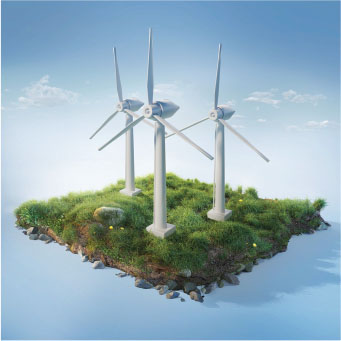
 Wind energy technology has experienced significant advancements over the years. Turbine capacities have transitioned from kW to MW, with notable improvements in efficiency. It continues to evolve, focusing on enhancing reliability, increasing capacity factors and reducing both fixed and variable costs. Contemporary wind turbines feature longer and lighter rotor blades, as well as taller towers and control systems designed to optimise performance.
In addition, advancements in drivetrains are being made to align with the overall growth of the wind turbine industry. Innovations include single-stage gearboxes, direct drive systems and permanent magnet generators. One of the key technology developments involves increasing tower heights to enhance capacity and power output per turbine. As land availability becomes more limited, particularly in a rapidly urbanising country like India, improving turbine efficiency to generate more energy per unit will reduce the number of turbines needed at a site. This can significantly lower transportation and installation costs, as well as reduce overall operation and maintenance costs over the project’s lifespan. Additionally, India is actively exploring the offshore wind sector, which could lead to the development of larger turbines with greater capacities (upwards of 10 MW), providing further opportunities to enhance drivetrain efficiency and increase tower heights for these larger turbines.
As these technology developments take place in the wind power sector, it is key to review the trends, especially the impact these advancements have on the performance of wind power plants. The US Department of Energy’s “Land-Based Wind Market Report: 2023 Edition” provides details on the technology trends for wind turbines and how it is impacting the performance of the turbines. An overview of the report…
Technology trends
The report states that over the years, turbine capacity, rotor diameter and hub height have significantly increased to enhance project efficiency and reduce costs. In 2022, the average rated capacity of newly installed wind turbines in the US reached 3.2 MW, marking a 7 per cent increase from 2021 and a 350 per cent rise since 1998-99. The average rotor diameter also increased to 131.6 metres, marking a 3 per cent increase from 2021 and a 173 per cent increase since 1998-99. Additionally, the average hub height rose to 98.1 metres, up 4 per cent in 2021 and 73 per cent since 1998-99.
While turbines initially designed for low wind speed sites still dominate the market, the trend towards lower specific power has reversed in recent years. The increase in rotor area has outpaced the growth in nameplate capacity, leading to a decline in average specific power from 393 watts per square metre (W/m²) in 1998-99 to 233 W/m² in 2022. However, specific power has slightly increased over the past three years. Turbines with low specific power, originally intended for low wind speed locations, are now widely deployed across various sites due to their attractive features.
Wind turbines installed in 2022 were situated in locations with an average long-term wind speed of 8.3 metres per second at a height of 100 metres above ground, the highest average wind speed at these sites since 2014. Despite this, data from the US Federal Aviation Administration (FAA) and industry reports suggest that future wind projects may be built in areas with lower average wind speeds. Therefore, increasing hub heights will help enable turbines to access higher wind speeds. Low-specific-power turbines continue to be widely used in various regions, including both low and high wind speed sites. Taller towers, particularly those exceeding 100 metres, are becoming more common, especially in the upper Midwest and north-eastern regions of the US. Going forward, planned wind projects are expected to feature even taller turbines. In 2022, the average tip height of newly installed turbines reached 164 metres, and FAA data indicates that future projects will see this increase, with proposed turbines having an average tip height of 195 metres.
Given the introduction of more efficient wind turbine technologies in the market, the industry considers repowering as an opportunity to increase power generation at sites that have high wind with low capacity wind turbines. In 2022, 13 wind projects underwent partial repowering, with most now featuring larger rotors and lower specific power ratings. The upgrades, primarily involving larger rotors, reduced specific power from 300 W/m² to 220 W/m². The main reasons for partial repowering include requalifying for the production tax credit, increasing energy output and extending project lifespans.
India has also witnessed a similar trend in the wind turbine technology space, with turbine size increasing owing to rotor diameters becoming larger and hub heights becoming taller. Although wind speeds in India are lower (5-6 metres per second) compared to those in Europe or the US, the wind turbines currently manufactured in the country are being designed to capture wind speeds beyond 100 metres in height. According to the August 2024 update from the Ministry of New and Renewable Energy on the Revised List of Models and Manufacturers of Wind Turbines (RLMM), newer models have both rotor diameters and hub heights going up to 160 metres. Further, the rated capacity of the turbine models listed in the RLMM ranges from as low as 225 kW to as high as 5.2 MW.
Further, as more and more high wind sites become exhausted, repowering will become critical to sustain the wind power growth in the country. Although there has been significant discussion on this subject, on-ground implementation is yet to take place.
Impact on performance of wind power plants
Technological developments in wind turbines are leading to improved performance in wind projects. The projects constructed between 2013 and 2021 in the US had an average capacity factor of 40 per cent, compared to 31 per cent for those built between 2004 and 2012, and 23 per cent for projects from 1998 to 2003. This has gradually increased the overall fleet-wide capacity factor to 36 per cent by 2022. Capacity factors vary by state and region, largely reflecting the strength of wind resources in those areas. Projects built between 2017 and 2021 had the highest average capacity factors in 2022 in the central states, with lower values near the coasts. This pattern aligns with the quality of wind resources in each region.
In addition, the design of turbines and the characteristics of the sites where they are deployed significantly influence performance. Over the past two decades, the reduction in specific power has been a key driver of increased capacity factors, although this has been partially offset by the trend of building projects at sites with lower average wind speeds. As a result, capacity factors for projects built in the past nine years have remained relatively stable, with some evidence of slight declines in post-2018 projects due to increasing specific power and a decline in site quality.
The increased generation presents its own challenges. A primary one is the curtailment of excess energy generated. For instance, in 2022, wind power curtailment across seven regions in the US averaged 5.3 per cent, up from a low of 2.1 per cent in 2016. The rate of curtailment has gradually increased over the past six years, with the highest curtailment rates observed in the Southwest Power Pool (9.2 per cent), Electric Reliability Council of Texas (4.7 per cent), Midcontinent Independent System Operator (4.4 per cent) and New York Independent System Operator (3.2 per cent) regions. The other regions had curtailment rates below 2 per cent.
The performance of older wind projects in the US declined in 2022, likely due to the degradation of capacity factors as the projects age. This decline in performance becomes more evident as projects exceed 10 years of operation, explaining why older projects, particularly those built between 1998 and 2003, underperformed compared to newer projects in 2022.
In the Indian context, while grid curtailment has improved over the years, climate change has impacted wind patterns drastically. As a result, revenues of older projects have been slightly impacted as actual wind energy generation has differed from initial estimations. Going forward, this trend is expected to become more prominent, and more advanced tools are now required to predict wind power generation more accurately. Further, the hybridisation of wind with solar power plants or even solar and storage set-ups is becoming significantly common, which is helping address the issue of resource intermittency. Utilities and commercial and industrial players are increasingly opting for hybrid solutions instead of standalone wind or solar power for greater energy security.
The way forward
Going forward, the increasing technological developments across the globe in the wind turbine space are expected to have cost implications. These developments lead to increased costs for wind turbines but result in increased power generation and revenue for developers, thereby reducing the levellised cost of energy and improving cost efficiency.
The future outlook for advanced wind turbine technologies looks promising, driven by ongoing innovations aimed at enhancing efficiency, reducing costs and increasing power output. Continuous increase in turbine size is expected. In addition, emerging technologies such as direct drive systems, which eliminate the need for gearboxes, and permanent magnet generators are set to play a significant role in increasing turbine reliability and efficiency. Additionally, the use of advanced materials such as carbon fibre composites in rotor blades is expected to make turbines lighter and more durable, further enhancing performance.
Offshore wind technology is also poised for significant growth, with larger and more powerful turbines being developed to harness the strong and consistent winds over the oceans. This will open up new opportunities for energy generation, particularly in regions where land availability is a constraint. Innovations in floating wind turbines are also expected in this space. Moreover, advancements in digital technology, including predictive maintenance and artificial intelligence-driven performance optimisation, will further improve the operational efficiency and lifespan of wind turbines.
All in all, technological developments in the wind power sector are expected to contribute to its growth, which is crucial for meeting global climate commitments.