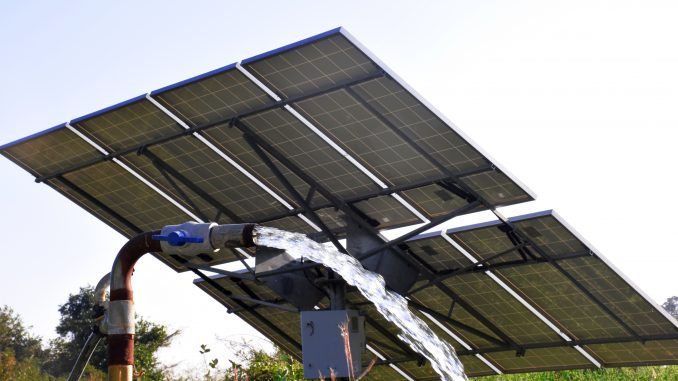
Solar-powered irrigation pumps represent a significant innovation in India’s agricultural and renewable energy sectors. The uptake of solar pumps is key as they offer various advantages to farmers. One, they offer substantial environmental benefits due to their low impact. Two, they require comparatively less maintenance compared to conventional pumps because they have fewer moving components, resulting in reduced operations and maintenance expenses. Three, they are incredibly versatile and can be used in off-grid or rural areas with limited or unstable power infrastructure. Four, solar pumps are scalable and can be sized to accommodate individual water needs. Five, farmers can generate a steady income stream by selling power to discoms at a predetermined tariff. They can also earn revenue by leasing their land to developers or discoms for the establishment of solar power plants. Six, there are no recurrent power or fuel costs because solar water pumps do not require fuel (diesel/kerosene) or electricity to operate.
Given these advantages, the Indian government developed a comprehensive policy framework to promote the adoption of solar pumps across the nation by introducing the Pradhan Mantri Kisan Urja Suraksha evam Utthan Mahabhiyan (PM-KUSUM) scheme in 2019. The scheme aims to address key challenges faced by farmers, such as escalating energy costs, unreliable electricity supply and over-reliance on fossil fuels. Through its implementation, the government aims to create a more sustainable agricultural sector for the future. According to the Ministry of New and Renewable Energy (MNRE), the total state-wise installed capacity of renewable power under PM-KUSUM was 3.18 GW as of May 31, 2024. Of this, Rajasthan led with a capacity of 704.75 MW, followed by Haryana with 695.89 MW and Maharashtra with 401.22 MW.
Recent policy changes
Recently, key amendments were made to the policy and regulatory framework of the PM-KUSUM scheme. In January 2024, the MNRE updated the guidelines for implementing the scheme. This recent update replaces the earlier memorandum from July 22, 2019, and incorporates all subsequent amendments.
Component A: This component aims to help farmers install 10,000 MW of decentralised ground-or stilt-mounted grid-connected solar power plants, or other renewable energy-based power plants, on their land. Renewable power generators (RPGs) will set up these plants, which will have capacities ranging from 500 kW to 2 MW, within a 5 km radius of substations to reduce transmission costs and losses. Farmers can either install these plants individually or partner with groups, cooperatives, panchayats or other organisations. The scheme also allows farmers to lease their land to discoms under mutually agreed-upon terms. Discoms will assess and communicate the renewable generation capacity that can be integrated into rural substations. The energy generated will contribute to fulfilling the renewable purchase obligation by discoms and will be procured at a pre-established levellised tariff. If there are excess capacity applications, a bidding process will be used. A model land lease agreement is included to facilitate transactions between farmers and discoms. The chosen RPG will be responsible for installing a dedicated 11 or 33 kV, 66/11 kV, or 110/11 kV line from the renewable energy plant to the substation, including the construction of a bay and necessary switchgear at the substation. The state implementing agency will collaborate with the state or union territory, discom and farmers to execute the scheme.
Component B: This component has a target of installing 1.4 million standalone solar agricultural pumps. It provides individual farmers with assistance to install standalone solar agricultural pumps or replace existing diesel pumps or irrigation systems in off-grid areas. Small and marginal farmers, especially in off-grid regions, will receive financial aid from both central and state governments, along with loans from banks. While pumps with capacities over 7.5 horsepower (HP) may be allowed, central financial assistance (CFA) will be limited to the subsidy applicable for a 7.5 HP pump. Farmers in the north-eastern region, hilly regions (such as Jammu & Kashmir, Ladakh, Uttarakhand and Himachal Pradesh) and islands such as the Andaman & Nicobar Islands and Lakshadweep, can avail of CFA for pumps up to 15 HP. However, the CFA for these larger pumps of will be limited to 10 per cent of the total installations. Implementing agencies for this component will include discoms, agricultural departments, minor irrigation departments or other designated state departments. Component B can be implemented with or without state share, and the guidelines outline the structure of CFA, enabling farmers to request solar pumps with the central subsidy through a national portal.
Component C: This component has a target of solarising 3.5 million grid-connected agricultural pumps to provide reliable daytime solar energy. It includes both individual pump solarisation (IPS) and feeder-level solarisation (FLS). IPS allows farmers to use excess solar power and sell it to discoms, increasing income and promoting water-saving practices. FLS involves integrating solar power into agricultural feeders for efficient solar energy use. Generating companies, discoms or other designated state departments will serve as the implementing agencies. The guidelines specify the distribution of CFA based on benchmark or tender costs and recommend using GPS surveys for precise calculations of feeder load and distribution loss.
Financial incentives
In Component A, discoms are eligible for a performance-based incentive at Re 0.40 per unit purchased or Rs 660,000 per MW of capacity installed, whichever is lesser, for a period of five years from the commercial operation date. Under Components B and C, the eligible CFA includes 30 per cent of the benchmark cost or tender cost, whichever is lower, of a particular category/type of the standalone solar pump. The state government will provide a subsidy of at least 30 per cent and the remaining 40 per cent will be provided by the farmer. In the north-eastern states, Sikkim, Himachal Pradesh, Jammu & Kashmir, Uttarakhand, Lakshadweep, and the Andaman & Nicobar Islands, CFA of 50 per cent of the benchmark or tender cost, whichever is lower, of a particular type of standalone solar pump, will be provided. The state government will give a subsidy of at least 30 per cent and the remaining (up to 20 per cent) will be given by the farmer. Overall, the ambitious goal is to incorporate 34,800 MW of solar capacity by March 2026, supported by CFA of Rs 344.22 billion.
Challenges and the way forward
While the programme has ambitious targets, the actual implementation is progressing at a slower pace. It can be observed from the table that there is a significant gap between sanctioned/installed capacities across all components. Component B (standalone pumps) shows the highest installation rate compared to sanctioned ones. Component C, especially FLS, has a very low installation rate compared to sanctioned numbers. Various factors, such as funding, logistics and technical challenges, contribute to this gap between sanctioned and installed capacities.

There are several reasons for the limited uptake of solar pumps compared to the set targets. The primary challenge is the significant upfront costs involved in installing solar power plants and solar pumps, which act as barriers to adoption despite the availability of subsidies. In addition, the predetermined tariff for the sale of power to discoms is also considered low, which has disincentivised uptake. Some of the other challenges are as follows. One, both central and state governments have implemented policies to accelerate the deployment of distributed energy resources in India. However, these policies are frequently revised, leading to considerable ambiguity among stakeholders due to differing interpretations and implications. Two, many farmers are still unaware of the benefits or technical details of solar energy solutions and lack the skills needed to operate and maintain solar pumps and power plants. Three, securing financing for these installations is difficult, as farmers often do not have the necessary documentation or collateral to obtain loans. Four, regular maintenance is crucial for the efficient operation of solar pumps, but accessing maintenance services and spare parts in remote rural areas is limited. Five, the low capacity utilisation factor of solar pumps poses another challenge for farmers who depend on these systems for irrigation and electricity.
Despite the challenges, the PM-KUSUM scheme holds immense potential to transform India’s agricultural landscape through sustainable solar energy solutions. However, to fully realise this potential, a multifaceted approach is essential. Firstly, addressing existing challenges and ensuring equitable access will be key to maximising the technology’s potential. Secondly, through financial support, spreading of awareness, improving maintenance services and optimising policies, the scheme can overcome current challenges and accelerate adoption. Thirdly, fostering public-private partnerships, involving local communities and leveraging expertise from different sectors will be vital for its uptake.
Furthermore, embracing technological innovations and continuously monitoring and evaluating the scheme’s progress is key. As the scheme evolves, its success could serve as a model for other developing nations facing similar agricultural and energy challenges.