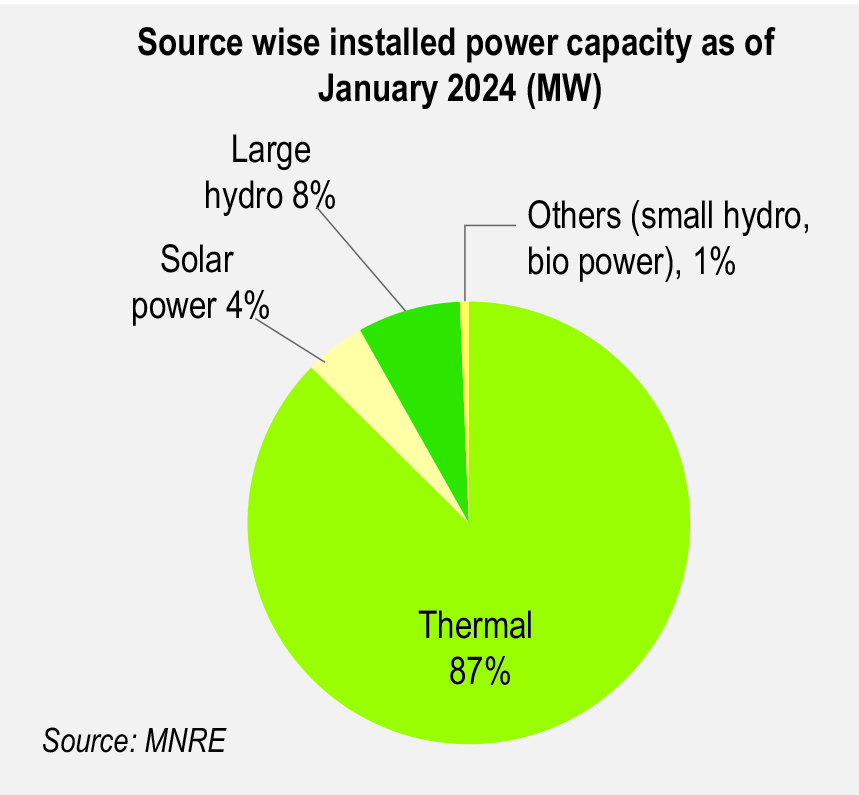
Jharkhand, known for its coal reserves, has one of the lowest installed renewable energy capacities in India. According to the Central Electricity Authority, as of January 2024, the state’s total power capacity reached 2,773.53 MW. Of this, renewable energy accounted for just 332.87 MW (including 191 MW of hydro capacity). The remaining 2,440.66 MW consisted of thermal power. According to the Ministry of New and Renewable Energy (MNRE), as of January 2024, the total renewable capacity, excluding large hydro, comprises 123.72 MW of solar power, 14.1 MW of biopower (non-bagasse biomass cogeneration) and 4.05 MW of small-hydro power. The state’s total solar capacity of 123.72 MW comprises ground-mounted solar (21 MW), rooftop solar (53.19 MW), and off-grid solar (49.53 MW). There is no wind power capacity in the state.
However, the state is making efforts to tap its renewable energy potential and increase uptake. Thus, several regulatory developments have taken place in Jharkhand’s renewable energy space, encompassing group and virtual net metering for rooftop solar plants and green energy open access. An overview of these regulations and key industry developments in the state’s renewable energy sector…
Recent regulatory developments
Regulations for group net metering and virtual net metering, 2024: The Jharkhand State Electricity Regulatory Commission (JSERC) recently introduced guidelines for group net metering and virtual net metering within the state. These regulations are anticipated to contribute to the objectives laid out in the Jharkhand State Solar Policy, 2022. The JSERC (Group Net Metering and Virtual Net Metering) Regulations, 2024, will come into effect upon their publication in the Jharkhand state government gazette.
As per the regulation, the group and virtual net metering frameworks are applicable to all eligible consumers, except those with outstanding arrears with the distribution licensee. Land allocation will be based on the JSERC (Electricity Supply Code) Regulations, 2015. The distribution licensee is required to conduct a technical assessment of the renewable energy system’s impact on the distribution system within seven days of application submission. Feasibility approval will be granted on a first come, first served basis. According to the regulations, connection agreements must finalise project installation within six months, with possible extensions granted by the discoms on a case-by-case basis. Renewable energy meters must be installed at generation points for remote reading, following the JSERC regulations. In group net metering, excess energy is reconciled against other service connections, with surplus credits refunded at a sanctioned rate.
In virtual net metering, participating connections receive credits based on specified procurement ratios, with excess units rolled over and reimbursement provisions in place. Discom officials have the authority to conduct regular inspections of renewable energy systems to ensure compliance and system integrity. Exemptions from certain charges and facilitation of renewable purchase obligations and certificate mechanisms are provided for qualifying generators.
Terms and conditions for green energy open access, 2024: The JSERC has also introduced new regulations to encourage the generation of electricity from renewable sources in January 2024. The JSERC (Terms and Conditions for Green Energy Open Access) Regulations, 2024, outline the measures for grid connection and the sale of green energy. As per the regulation, individuals identified as green energy open access consumers (GEOA) are eligible to participate if their contract demand or sanctioned load is 100 kW and above. This includes both single connections and multiple connections aggregating 100 kW or more within the same electricity division of a distribution licensee. Captive consumers, exempt from load limits, are also covered under these regulations. GEOA consumers receive their electricity supply from renewable energy sources, whether from a licensee, the government, or any other entity involved in supplying electricity to the public. The tariff for green energy is determined by the commission, which comprises the average pooled power purchase cost of renewable energy, cross-subsidy surcharges, and service charges covering the distribution licensee’s prudent cost. Consumers have the option to voluntarily procure more renewable energy than their obligation, with steps ranging from 25 per cent to 100 per cent.
Regulations for captive power verification, 2024: The JSERC has also issued the Verification of Captive Generating Plants and Captive Consumers Regulations, 2024. The regulations aim to specify a methodology to verify the status of captive generating projects and captive consumers when consumers import power from their respective captive generators located either within the state or outside, as well as the consequences of their not meeting the conditions.
Every year, the commission will check if the captive power projects and their consumers meet the criteria set in these rules by assessing the data provided by the projects and consumers. By May 15 of every year, captive power projects and their consumers are required to give the commission a sworn statement in a specific format. The commission will take assistance from the regional load despatch centre, state load despatch centre, and the power discoms to check if the projects and consumers qualify as captive consumers. The commission will inform the captive power projects and consumers, as well as the discoms, of their status by July 15 of each year.
 Recent project developments
Apart from the recent guidelines and regulations, the state witnessed several developments in the solar segment. Recently, in February 2024, Larsen & Toubro Limited received an order to establish a 75 MW floating solar PV plant on the Panchet dam in Jharkhand. In January 2024, Damodar Valley Corporation (DVC) invited bids for the design, engineering, supply, construction, erection, testing, commissioning and five-year operations and maintenance of an 8 MW grid-tied ground-mounted solar power project at the DVC plant in Konar village, Hazaribagh district, Jharkhand.
NTPC Limited floated a tender to commission a 56 MW floating solar power project at NTPC North Karanpura Thermal Power Station in Jharkhand in October 2023.
Further, the Central Mine Planning and Design Institute (CMPDI) issued a request for proposal for setting up 5 MW grid-connected solar power projects for Central Coalfields Limited. The project will be located at Barka Sayal Area, in Ramgarh district, Jharkhand.
In August 2023, the CMPDI floated a tender for the development of an 8.5 MW grid-connected solar power project for Central Coalfields in Bokaro, Jharkhand. Further, the Solar Energy Corporation of India floated bids to establish a 100 MW (AC) floating solar PV project at the Getalsud dam, Ranchi district, Jharkhand, in March 2023.
The way forward
Various factors have hindered the growth of clean energy in Jharkhand. These include low renewable resource availability, high dependence on coal, and the lack of large-scale private investments. In its state solar policy of 2015, Jharkhand aimed for 2,650 MW of solar energy production by 2020. This goal has still not been met, and the current solar power installed capacity is less than 5 per cent of the target. The government has now revised the target in the state’s recent solar policy of 2022, aiming for 4,000 MW of installed solar energy capacity within the next five years. To achieve this target, the state plans to implement a roadmap for the installation of solar panels across various categories and applications, including park and non-park solar installations, distributed grid-connected, rooftop solar systems and off-grid systems. The state is also enthusiastically promoting floating solar projects in a bid to meet this target. According to a written reply by the union minister for power and renewable energy in the Lok Sabha, three proposed floating solar parks in the state will contribute an additional 1,089 MW of solar energy capacity.
The recent regulatory developments in Jharkhand regarding group and virtual metering, as well as GEOA, are positive. These developments are expected to increase the uptake of renewables by offering innovative business models to customers and tapping small-scale customers as well. While the central government had notified the GEOA rules earlier, the state governments had to follow suit and come up with their own regulations. Notably, Jharkhand has become one of the few states to have notified their own GEOA regulations. With this, the limit for open access will be reduced from 1 MW to 100 kW. Consequently, even small customers will be able to consume renewables through the open access route.
Net, net, the recent developments in the state are expected to reduce Jharkhand’s reliance on coal and enable its transition to greener energy sources.
By Anusshka Duggal