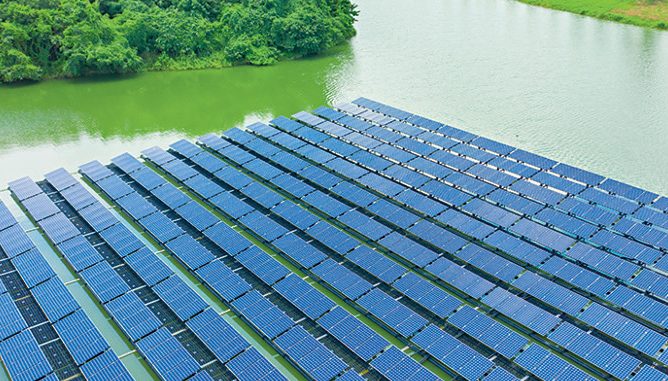
As the demand for clean and sustainable energy sources rises, innovative solutions are emerging to harness the power of the sun. Floating solar, an important segment within the solar industry, is witnessing rapid growth, with multiple large-scale projects in development. The sole distinction between floating and conventional solar installations is that floating solar projects are situated on a body of water, eliminating the need for land. These solar plants are equipped with specialised technologies to float on water. Floating solar panels can be combined with other clean technologies such as hydropower. This helps in providing a steady power supply during often fluctuating weather conditions. Solar can be used during the day, and hydropower can be used when solar is unavailable. Such an innovative fusion and amalgamation of technologies could work wonders in the near future, making the dream of transitioning to 100 per cent renewable energy an achievable reality.
This article explores the technologies in the various components of a floating solar system, key design considerations, operations and maintenance (O&M) considerations and the future outlook…
Technology overview
The electrical configuration of a floating solar system is similar to that of a ground-mounted solar photovoltaic system. Floating solar systems can be installed on various waterbodies, such as industrial ponds, hydropower reservoirs, agricultural ponds and man-made waterbodies, such as flood control reservoirs. These systems can be built offshore or near the coast, even though they are primarily located in inland freshwater bodies. In addition, the design of these systems is comparable with that of a traditional solar plant, with floating solar comprising PV arrays, inverters, combiner boxes, lighting arresters and other components. These components are attached to a floating bed, which is made of fibre-reinforced plastic, high-density polyethylene (HDPE) or metal structures. These floating beds, in turn, are attached to anchoring and mooring systems.
Most large-scale floating PV plants have pontoon-type floats, upon which PV panels are mounted at a fixed tilt angle. The floating structure can consist of floats alone (called pure floats), floats with metal trusses, or special membranes or mats. The platform is held in place by the anchoring and mooring system, whose design depends on factors such as wind load, float type, water depth and water level variations.
Floating solar platforms
Pure floats: Pure-float configurations employ specially designed buoyant structures that directly uphold solar panels, utilising fewer metal parts and facilitating easy assembly and installation. The advantages of a pure floating platform include scalable systems without major design changes and minimal metal parts, reducing the risk of corrosion. The platform can adapt to wave motion, effectively relieving stress. However, the disadvantages of pure floating platforms arise from the proximity of the modules to water, which limits air circulation and diminishes the cooling effects of evaporation. This creates a high-humidity environment for both PV modules and cables. Moreover, the transportation of pure floats over long distances is not cost-effective, necessitating the moulding of these platforms in nearby facilities. The constant movement of the platform may also induce stress and fatigue on joints and connectors.
Membranes and mats: In this type of platform, rubber mats are typically used to entirely cover the water surface. These rubber mats act as a base for solar panel installation. This is particularly suitable for small man-made waterbodies (less than 0.2 km), which are primarily used for water storage and have no aquatic life. The advantages of this type of platform include simplicity in design, easy installation and maintenance, and the ability to accommodate changes in the level of water. It is particularly suitable for areas prone to water scarcity, such as deserts and arid areas.
Pontoons and metal frames: Metal structures, such as frames or trusses, are employed to mount solar panels on pontoons, which serve solely to provide buoyancy. This eliminates the need for specially designed floats, as buoyancy is achieved through the metal structures. The advantage of pontoons with metal frames lies in the simplicity of the concept and the ease of locally sourcing materials. The straightforward manufacturing process of floats contributes to their accessibility. Furthermore, its design minimises the variability of wave movement between PV modules, reducing wear and tear on module connection components and wires. However, there are disadvantages to pontoons combined with metal frames, primarily involving the concentration of stress at certain points due to the increased rigidity of the structures. This stress concentration is a result of the impact of waves, potentially leading to structural challenges. Moreover, these structures are often more challenging to assemble, introducing complexity during the installation process. Access for maintenance can also be problematic in certain designs, adding to the overall complexity of functionality and upkeep of pontoons with metal frames.
Anchoring and mooring systems
An appropriate anchoring and mooring system is a critical component of a floating solar plant. There are three basic ways to hold a floating platform in place: bank anchoring, bottom anchoring and piles.
- Bottom anchoring: Most existing plants primarily utilise bottom anchoring. In contrast to kedge anchors used on ships, which are designed to withstand lateral movement for a limited duration, the anchors for floating solar arrays provide long-term stability for 25 years or more. Broadly, there are two types of permanent bottom anchors: self-seating anchors and installed anchors.
- Bank anchoring: Bank anchoring is particularly suitable for small, shallow ponds where the floating solar plant is close to shore. Whenever feasible, it is advisable to explore bank anchoring, as it frequently proves to be the most economically efficient alternative. This approach facilitates convenient access to anchoring points, both for initial installation and for periodic inspection during O&M.
- Piles: In certain cases, especially for waterbodies with limited depth, it might be feasible to bore or drive piles into the bed of the basin, and then tether the floating platform to these piles. This setup is especially suitable for installations that incorporate unique attributes such as tracking systems and concentration mechanisms.
Key design considerations
Key design considerations for floating solar plants encompass various aspects, emphasising the electrical and mechanical reliability of the system. This involves critical design requirements for components such as anchoring and mooring systems, floaters, inverter installation and cabling. The mooring system, essential for managing water level changes and minimising movement due to environmental forces, requires precise design considerations based on site and system specifications. This includes load calculations and the selection of components such as float attachments, interconnections, mooring lines and anchors. Anchoring systems, comprising aluminium spreader bars and cables, play a crucial role in maintaining stability and securing the island to the seabed or coastlines.
The pontoon or floating structure incorporates HDPE floaters, rigorously tested for buoyancy and durability. The primary floaters must meet specific criteria such as recyclability, resistance to UV, alkali and saltwater, adaptability to water level changes and a long underwater lifespan. Inverter installation follows a similar process to traditional solar power plants, with the choice of central or string inverters depending on capacity and proximity to the coast. Careful planning for cable management and routing is vital in floating PV plants, considering variable cable lengths due to platform movement. During the design phase, crucial electrical safety factors include component location and grounding requirements.
Solar panel selection is a critical element, emphasising durability, weather resistance and efficiency. Bifacial solar panels, capable of capturing sunlight from both sides, are often preferred. Integration with the electrical grid requires suitable technology to ensure smooth electricity incorporation, factoring in grid stability and compatibility as essential design considerations.
O&M considerations
The principal contractor responsible for monitoring the system typically performs three types of maintenance: preventive, corrective and predictive.
- Preventive maintenance: This involves routine inspection and servicing at predetermined intervals, aiming to prevent damage and breakdown. Elements include general site maintenance; cleaning of PV modules and floating pontoons; inspection and management of soiling; midge mitigation; vector control; inspection of equipotential bonding, cables and connectors; periodic recommissioning checks; and upkeep of data acquisition and monitoring systems.
- Corrective maintenance: This addresses component breakdowns that occur on an as-needed basis and are minimised through proper monitoring and preventive measures. Tasks include resetting tripped inverters, replacing blown fuses, tightening cable connections or loosened connectors due to float movement, repairing equipotential bonding wires broken due to float movement and addressing communication issues.
- Predictive maintenance: This requires real-time data to oversee power plant operations and anticipate potential failure scenarios, facilitating task prioritisation and resource allocation. It involves monitoring individual solar panel performance in real time, tracking water quality to detect changes affecting system efficiency, integrating weather forecasts to prepare for adverse conditions, analysing historical data to identify maintenance patterns and reducing downtime, repairs and energy losses for cost savings.
Future outlook
Floating solar technology holds immense promise in India’s journey towards sustainable energy solutions. With advancements in design, materials and maintenance strategies, floating solar projects are becoming more reliable and efficient. As the segment continues to mature, we can expect to see floating solar panels transform India’s waterbodies into hubs of clean energy generation, powering the nation’s sustainability.
By Anusshka Duggal