By Sarthak Takyar
For both global and domestic investors, India remained a priority market for renewable energy growth in 2022, aided by the ambitious climate targets set by the Indian government, supportive policies and rich renewable potential. Renewable Watch covers the key equity and debt deals, green bonds and initial public offering (IPO) issues during the past year (December 2022 to November 2023) in the renewable energy sector…
Key equity deals
With 19 deals (according to Renewable Watch Research), the equity/mergers and acquisitions market remained active during the past year. The biggest equity deal of the year was the acquisition of 30 Mytrah Energy special purpose vehicles (SPVs) with 1,753 MW of renewable energy generation capacity by JSW Energy. The acquisition was valued at around Rs 101.5 billion. JSW Energy’s JSW Neo completed the acquisition in two stages, purchasing a total of 1,449 MW of installed renewable energy capacity across Mytrah Energy’s 15 SPVs and 13 ancillary SPVs. These 28 subsidiaries of Mytrah Energy have now become subsidiaries of JSW Neo and JSW Energy. JSW Neo infused optional convertible debentures, with the right to convert them into equity, in the other two SPVs with 304 MW of renewable energy assets between them, and executed forward sale agreements with them. Mytrah’s 1,753 MW portfolio includes 1,331 MW of wind capacity and 422 MW (487 MWp DC) of solar capacity, located primarily in India’s south, west and centre. The assets are covered by long-term power purchase agreements with an average remaining life of 17 years.
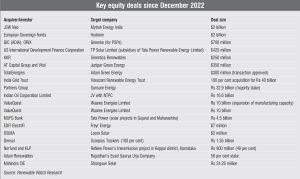
Hydreen, a Luxembourg-based green hydrogen venture and a subsidiary of HLC Holdings, raised $2 billion in funding to build green ammonia and green hydrogen facilities in five states. The company received funding from European sovereign funds. Construction work on two projects in Kerala and Himachal Pradesh is currently ongoing. Plans are being made to replicate these projects in five additional states. Each project will have a capacity of 250 MW, and the ammonia produced from these plants is intended for international export. Additionally, the company is planning to launch two more projects. The initial phases of these four projects are anticipated to be operational by 2024. It could take an additional 24 to 36 months for them to progress to maximum capacity.
Greenko Energy Holdings announced the signing of definitive agreements to raise $700 million in primary equity from GIC, a wholly owned subsidiary of the Abu Dhabi Investment Authority, ORIX Corporation and the founders, to be used for the setting up of pumped storage projects (PSPs). The storage capacity will be more than 25 GWh, enabling 45 billion units of despatchable electricity.
The U.S. International Development Finance Corporation’s board of directors approved the provision of up to $425 million in financing in TP Solar Limited, a subsidiary of Tata Power Renewable Energy Limited, for its upcoming 4.3 GW greenfield solar cell and module manufacturing plant in Tirunelveli district, Tamil Nadu, India. The plant’s first module production is expected by the end of the year, and the first cell production is expected in the first quarter of financial year 2024.
Juniper Green Energy secured $350 million from the AT Capital Group and Vitol as assistance for its operational capacity expansion. The AT Capital Group and Vitol increased their investment two years after their initial commitment of $200 million.
Adani Green Energy Limited (AGEL) and TotalEnergies entered into a binding agreement to create a new 50:50 joint venture (JV) with a 1,050 MW portfolio. This portfolio will comprise operational (300 MW), under-construction (500 MW) and under-development (250 MW) solar and wind power projects. TotalEnergies provided an equity investment of $300 million for this initiative.
Serentica Renewables signed a definitive agreement under which global investment firm KKR will invest $250 million in addition to the $400 million it had already invested in 2022. The funds will be used to help the company install 4,000 MW of renewable energy capacity for large-scale industrial customers.
The board of directors of the India Grid Trust, along with its investment manager and project manager, approved the acquisition of 100 per cent of the units of Virescent Renewable Energy Trust at an enterprise valuation of Rs 40 billion. The acquisition will be funded through a combination of internal accruals, debt and additional capital raising efforts.
Partners Group, a Swiss investment firm, decided to buy a majority stake in Gurugram-based renewable energy company Sunsure Energy for Rs 32.9 billion. The investment will help Sunsure execute its portfolio of renewable projects and provide new services to commercial and industrial (C&I) customers. Further, it will help in the company’s transformation into an independent power producer with 3 GW of operational capacity, which will sell power directly to C&I customers.
The board of Indian Oil Corporation Limited approved a Rs 16.6 billion investment with which it secured a 50 per cent stake in its JV with NTPC Green Energy Limited for the development of renewable power plants. NGEL will set up clean energy-based power projects, including solar photovoltaic (PV) and wind, in order to fulfil the round-the-clock power demands of Refining’s upcoming projects.
Key debt deals
The debt market remained an attractive option for industry players with respect to raising capital (especially from public banks and lending agencies). In addition, international multilateral development banks and private banks lent capital to industry players. Overall, Renewable Watch Research has tracked 15 debt deals in this space in the past year. The biggest was the Power Finance Corporation (PFC) signing an MoU with SJVN Limited for financial assistance for a number of projects, including a 660 MW thermal generation project and three sizeable renewable energy projects with a combined capacity of 12,178 MW, encompassing solar, hydro and pumped storage. The total project cost is expected to be around Rs 1,188.26 billion. PFC has committed to provide financial assistance for these important projects in the form of a term loan of Rs 800 billion-Rs 900 billion.

Adani New Industries Limited, a subsidiary of Adani Enterprises Limited, raised $394 million from Barclays Plc and Deutsche Bank AG for a module manufacturing plant. The company aims to build an overall green hydrogen industry in India, covering the production of solar PV modules, cells, polysilicon, wafers, ingots, electrolysers and wind turbines.
ReNew secured a Rs 27 billion project loan from the State Bank of India for its 403 MW peak power project. The loan has a term of 20 years and an interest rate ranging from 8.75 per cent to 9.25 per cent. Under the terms of the agreement, ReNew will invest around Rs 3.13 billion for 51 per cent ownership of the project, and will provide engineering, procurement and construction; operations and maintenance, and project management services through affiliates.
AGEL, through its subsidiary Adani Solar Energy AP Six, raised a project loan facility of $205.31 million from MUFG Bank and Sumitomo Mitsui Banking Corporation to support the refinancing of its debt. The facility comprises amortising project loans. It will have a 16-year debt structure with a tenor of 10 years. The facility is linked to a Japanese benchmark rate gauge – the Tokyo Overnight Average Rate – and its near-zero yields highlight the appeal of diversifying alternative capital pools that offer relatively competitive interest rates.
EverSource Capital-backed Radiance Renewables secured a green loan project finance facility of approximately $90 million for its 150 MW (AC) greenfield C&I solar power project located in Maharashtra. The loan was jointly arranged by Axis Bank and Standard Chartered Bank. Standard Chartered Bank acted as the sole green loan coordinator, while Axis Bank acted as the escrow bank for the transaction. Catalyst Trusteeship Services Limited acted as the facility agent and security trustee. The facility will provide the necessary financing for a 150 MW (AC) solar project located in Maharashtra. Radiance Renewables, through its subsidiary, also entered into an energy supply agreement with a large global data centre company with operations in Maharashtra to supply solar energy to the consumer’s data centres in the state for the next 25 years. The project will be delivered in two phases, with the first phase of 50 MW (AC) already nearing completion. Financial closure, through definitive agreements, has already been achieved for both phases of the project.
In the domestic debt market, REC Limited was proactive in undertaking many big deals. It partnered with the ACME Group to allocate Rs 160 billion in funding for the establishment of a green hydrogen and ammonia facility. The facility will be set up in Gopalpur, Odisha. Additionally, REC signed an MoU with the Avaada Group, committing Rs 150 billion for the development of a green hydrogen and ammonia facility in Gopalpur. Moreover, REC Limited extended Rs 60.75 billion to Greenko for the development of 1,440 MW of standalone PSPs. Further, at the Green Finance Summit held on July 21, 2023, Apraava Energy signed MoUs with REC Limited and PFC to raise Rs 91.2 billion for its transmission, wind and advanced metering infrastructure projects in India. Meanwhile, Hero Future Energies signed an MoU with REC Limited and PFC to receive Rs 31 billion from each of them for the purpose of funding and developing renewable projects across the country. The company plans to use the funding for utility projects and green hydrogen derivatives, including solar and wind, for C&I customers.
Key green bond issues
To achieve its net zero goals, India is focusing on generating additional global financial resources. With the aim of lowering the carbon emissions of the economy, the Union Budget 2022-23 announced the issuance of sovereign green bonds (SGBs).
In February 2023, the Indian government concluded the sale of Rs 160 billion worth of SGBs. The first tranche was released in January 2023, raising Rs 80 billion. Of this, Rs 40 billion was issued for a five-year tenor (till 2028) at a yield of 7.1 per cent. The remaining Rs 40 billion was issued for a 10-year tenor (till 2033) at a yield of 7.29 per cent. The second tranche of SGBs was released in February 2023, also for Rs 80 billion, divided into two tranches of Rs 40 billion each. The tenors and yield were the same as in the first tranche. A key highlight was that the yields were a few basis points lower than government securities of the same tenor. A lower yield signifies that the green bonds carried a premium – commonly referred to as a “greenium” – thus making the price of the security higher. The Reserve Bank of India (RBI) set the cut-off yields for the two bonds at 7.23 per cent and 7.29 per cent respectively. These proceeds will be used to fund public sector projects that reduce the economy’s carbon intensity. A green finance working committee, led by Chief Economic Adviser V. Anantha Nageswaran, will select the government projects that will receive green financing. The Ministry of Finance has formed a Green Finance Working Committee to help with project evaluation and selection. Under the committee’s supervision, an annual report will be published detailing the allocation of proceeds to eligible projects, descriptions of the projects financed, the status of implementation and unallocated proceeds. The proceeds from the sale of the green bonds will be deposited in the Consolidated Fund of India. The Public Debt Management Cell will track the proceeds and monitor the funds allocated to eligible green expenditures.
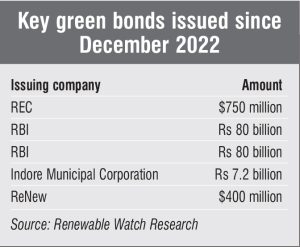
REC Limited undertook an exclusive listing of its recently issued green bonds worth $750 million, raised under its Global Medium Term Programme of $7 billion at GIFT International Financial Services Centre Stock Exchange. According to REC Limited, the issue was oversubscribed approximately 3.5 times by 161 investors, with active participation from quality accounts. Investors from across the globe participated in the issue: Asia Pacific (42 per cent); Europe, Middle East and Africa (26 per cent); and the US (32 per cent). Over 87 per cent of the transaction was allocated to fund managers, asset managers and insurance companies.
The Indore Municipal Corporation raised approximately Rs 7.2 billion through a green bond issue that was oversubscribed 5.9 times. The municipal corporation plans to raise around Rs 2.44 billion through bonds for the construction and operation of a 60 MW solar power plant at Samraj and Ashukhedi, Madhya Pradesh.
ReNew Energy Global Plc’s wholly owned subsidiary Diamond II Limited raised $400 million through the issue of senior secured green bonds. The order book was oversubscribed about four times with a total investor demand aggregating over $1.5 billion, resulting in a tightening of pricing by 35 bps. The notes carry a coupon rate of 7.95 per cent and have been rated Ba3 by Moody’s and BB- by Fitch. The proceeds will be used to refinance existing dollar debt and fund various growth initiatives. The notes have been certified by the Climate Bond Initiative and are aligned with the ICMA Green Bond Principles.
Key IPOs
Three key developments took place in this space. The Cabinet Committee on Economic Affairs approved the listing of Indian Renewable Energy Development Agency Limited (IREDA) on the stock exchanges through an IPO in March 2023. The government planned to sell a part of its stake in IREDA and raise funds through the issuance of fresh equity shares. This IPO, sized at Rs 21.5021 billion, was opened in November 2023. Another key IPO was that of Oriana Power, which was opened for bidding in early August 2023. The company offered a fresh issue of 5,055,600 equity shares at a face value of Rs 10 each and a price band of Rs 115-Rs 118. Of the total fresh issue, 255,600 equity shares were reserved for subscription by the market maker. Meanwhile, International Holding Company (IHC), an Abu Dhabi-based diversified conglomerate, announced an investment of AED 1.4 billion through its subsidiary Green Transmission Investment Holding RSC Limited in Adani Enterprises’ new public offering. This was IHC’s second investment in the Adani Group, following a $2 billion investment in three green-focused Adani Group companies.

Future outlook
According to the Climate Policy Initiative, India’s green finance requirement in order to meet its nationally determined contributions is $170 billion per year, till 2030. The International Energy Agency estimates a slightly lower requirement of $160 billion per year on average between now and 2030, to reach net zero emissions by 2070. The Council on Energy, Environment and Water calculates the green financing need to be $202 billion per year to achieve net zero carbon emissions by 2070. Meanwhile, McKinsey estimates that $44 billion per year in green financing will be required to achieve net zero emissions by 2070; the amount will increase by 3.5 times by 2030, and by 10 times by 2040.
Evidently, the financing need is significant. To attract greater capital (from international pension funds, etc.), the renewable energy industry needs to solve some long-standing issues concerning land acquisition, policy uncertainty and restrictions in terms of trade barriers.