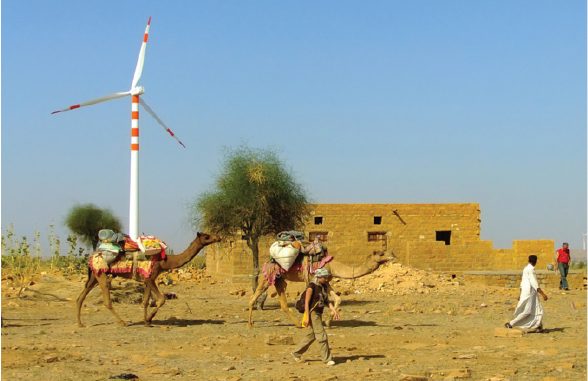
Repowering of old wind projects is a low-hanging fruit to increase wind generation without using extra land. India has a significant number of old wind turbines, with a capacity of less than 1 MW, which have the potential for repowering in wind-rich sites. Among wind-rich states, Tamil Nadu has the oldest wind turbines, which are over 30 years old and ideal for repowering. In the state, around 53 per cent of the turbines are in the sub-550 kW category and were installed prior to 2000. Now, wind turbines of capacity 2-3 MW are available. Therefore, repowering of the old turbines with modern high capacity turbines has the potential to more than quadruple the energy generation at these sites. The capacity utilisation factor (CUF) in wind-rich sites is around 14 per cent and can be improved to around 25 per cent post-repowering.
Key issues with repowering in India
Fragmented ownership of wind farms is one of the key issues with repowering in India. Many owners who have commissioned their projects before 2022 own multiple turbines of less than 500 kW. This issue can be solved by giving stakes in new repowered projects to the existing owners in the ratio of their equity contribution. For existing owners, who are not willing to invest, the repowering project implementer could either buy out their stake or allocate the stake to the new project, as per the value of dismantled assets and the revenue forgone.
The need to upgrade the evacuation infrastructure is another key issue as repowering makes energy generation increase by two to three times. This is especially of concern in wind-rich states such as Tamil Nadu, where the majority of the projects are older than 15 years and connected to 11 kV lines for power evacuation. As a solution, the repowering project implementer could be responsible for upgrading evacuation infrastructure from 11 kV-66 kV, until the pooling substation and the state transmission utility can upgrade the transmission infrastructure beyond the pooling substation.
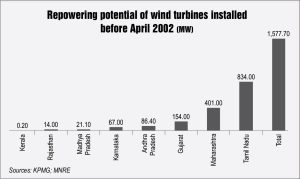
Lack of financial incentives is another major issue that hampers the uptake of repowering projects in India. There is lack of clarity between wind turbine owners and public utilities on the sale and tariff of additional energy procured after repowering. While the Ministry of New and Renewable Energy introduced a repowering policy in 2016 to optimally utilise resources, states have been slow to take the policy initiative forward. Due to lack of financial incentives, upgradation of transmission infrastructure to cater to the enhanced generation may not be viable. Some of the existing fragmented wind turbine owners may not spend on repowering, as it may take over 10 years to recover the additional investments. These owners would prefer their current earnings unless incentives are given for taking the extra hassle of repowering.
As a solution, a generation-based incentive of Re 0.5 per kWh should be introduced for repowering projects. In addition, renewable energy certificates could also be issued to the repowering project implementer.
Sample business model
A sample business model could involve the central government providing incentives to the repowering project implementer, who will be responsible for aggregating the project from fragmented ownership. The repowered project can sell electricity to utilities through a new power purchase agreement (PPA) for additional generation at the current tariff, to captive users through a PPA with the existing terms, or to open access consumers through a subcontracting agreement.
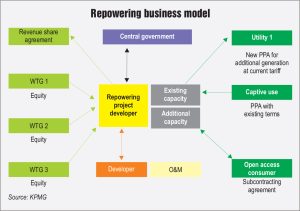
The existing assets are acquired by the repowering project implementer, who could be an existing owner, a third-party independent power producer or any other investor. The transaction will account for the revenue forgone and the market cost of existing projects. The asset acquisition can also be done by offering the individual asset owners some stake in the new project. Owners who are unwilling to be part of the new project can be compensated for buyout of their asset and deemed loss of generation for the assets’ remaining life. Meanwhile, utilities can continue to procure power at the rates prescribed in the existing PPAs. The remaining amount required to cover the unit cost of the repowered project is to be borne by the government.
Denmark case study
Denmark is one of the leaders in repowering wind power projects. The country promoted repowering in two phases by announcing schemes for 2001-03 and 2005-11. Phase I targeted turbines up to a capacity of 150 kW. Owners received a “repowering certificate” equivalent to an additional tariff of Euro 2.3 cents per kWh for the decommissioning of old turbines. The certificates could be traded, which incentivised the installation of larger wind turbines. Besides, an additional tariff was offered for two to three times of the scrapped capacity for 12,000 load hours. Under this scheme, 1,480 old turbines with a combined capacity of 122 MW were replaced with 272 new turbines with a combined capacity of 324 MW.
Phase II targeted larger wind turbines, having a capacity of up to 450 kW. Turbine owners again received repowering certificates equivalent to Euro 1.6 cents per kWh for two times the decommissioned capacity for 12,000 load hours. In addition, wind turbines were given at a general subsidy of Euro 1.3 cents per kWh and a balancing fee of Euro 0.3 cents per kWh and the spot price could not exceed Euro 6.4 cents per kWh. Under this scheme, 811 old turbines, with a combined capacity of 148 MW, were replaced with 146 new turbines with a cumulative capacity of 348 MW by the end of 2011.
At the Nørrekær Enge wind farm, 77 wind turbines of 220 kW capacity were replaced with 13 wind turbines of 2.3 MW capacity, which doubled the energy production. As a result of repowering, large parts of the project area regained their original appearance. The old wind turbines were sold to a buyer for setting up a plant in Cuba. The Klim Fjordeholme wind farm, which was commissioned in 1996, was repowered in 2014. In this case, 35 wind turbines of 600 kW capacity were replaced with 22 wind turbines of 3.2 MW capacity, resulting in an increase in energy production by three times. The old turbines were sold for recycling in Italy, Ireland and other countries.
Germany case study
Germany too has been one of the most progressive countries in terms of repowering. It came with a repowering scheme in 2017. Under this scheme, 387 wind turbines, with a cumulative capacity of 467 MW, were replaced with 315 wind turbines with a cumulative capacity of 952 MW. The country focused on replacing old turbines of 300 kW or lower capacities with turbines of around 2 MW. A particular wind power project in Germany replaced 20 turbines of 200 kW capacity and seven turbines of 2 MW and witnessed an increase in investment by 2.7 times but the plant yield increased by four times. Pre-repowering the investment and yield of the wind project was Euro 6 million and 10 GWh respectively, which increased to Euro 16 million and 40 GWh, respectively, post-repowering.
Conclusion
In sum, it is clear that repowering of wind projects is necessary to increase the efficiency of projects. Also, repowering should not be seen as a one-off event but should be planned for the next 30-40 years, given that the new repowered projects will also need repowering at some point as technology keeps advancing. The grid is underutilised currently and projects with low CUF are present, which can be replaced with projects with high CUF. The key question of who should be responsible for doing this and what financial incentives are needed to take this forward, remains open.
Based on a presentation by Hitesh Sachdeva, Partner, Infrastructure Corporate Finance, KPMG, at the virtual conference, “Repowering of Wind Turbines”, organised by Renewable Watch