


India’s solar sector is entering a new phase of expansion. While record levels of solar and wind capacity continue to be added, challenges related to transmission infrastructure, curtailment, global trade uncertainty and project execution are becoming increasingly prominent. At the 19th edition of the “Solar Power in India” conference organised by Renewable Watch, industry leaders highlighted the growing need to balance solar power growth with grid stability, demand creation and supply chain resilience. They also discussed the progress made in domestic manufacturing, driven by various policy interventions and increasing localisation requirements, the emergence of storage as a critical enabler and the operational challenges facing industry players. Edited excerpts…
Neha Agrawal
Global geopolitical developments, freight market volatility and rising commodity prices have introduced new uncertainties across solar  supply chains. Escalating crude oil prices, fluctuations in aluminium and copper markets, and disruptions in international logistics networks are all influencing raw material costs and procurement strategies. While the Approved List of Models and Manufacturers framework continues to support domestic manufacturers by creating demand for Indian-made modules, the supply chain needs to be made more resilient and competitive.
Traceability across the solar value chain is important. Greater visibility into the origin of cells, wafers and ancillary components could support localisation, while helping manufacturers align with emerging international requirements. At the same time, the sector remains significantly dependent on China for manufacturing equipment used across module, cell and wafer production lines. Indigenous manufacturing of production equipment is still at an early stage and is likely to take considerable time to scale up.
Dr Jatinder Singh Chandok
ONGC NTPC Green Energy, a joint venture (JV) between ONGC Limited and NTPC Green Energy Limited, is growing through a combination of organic development and inorganic asset acquisition. Its portfolio includes solar, wind, pumped storage projects (PSPs), battery energy storage system (BESS) projects and green hydrogen-linked infrastructure.
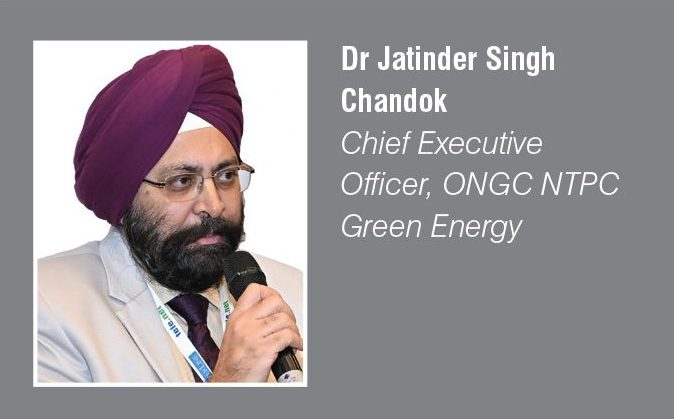 Our aim is to supply renewable energy to emerging demand centres. Efforts are under way to set up captive projects for large-scale industrial applications. Carbon capture and utilisation systems are already being deployed to combine captured carbon with green hydrogen for methanol production, creating additional pathways for renewable consumption.
To improve project execution, tendering approaches have evolved from single engineering, procurement and construction (EPC) models to multi-package structures and are now moving towards integrated EPC contracting to address integration challenges between suppliers and balance-of-system contractors. Land acquisition is also being addressed through JVs with state governments, enabling earlier access to project sites.
Curtailment has emerged as a major concern. As a result, BESS is increasingly being viewed as an integral component of renewable power systems. Storage deployment can help shift surplus daytime generation to evening demand periods, reducing curtailment losses and improving grid utilisation. Alongside lithium-ion batteries, increasing attention is being directed towards alternative storage technologies such as flow batteries and carbon dioxide-based batteries for long-duration energy storage applications.
Prashant Choubey
The sector is facing four significant challenges. One, intermittency is a key concern as renewable penetration continues to rise, making grid  integration increasingly difficult. Even at current penetration levels, balancing renewable generation is creating operational hurdles. Two, there is a need to ensure that capacity installations in the segment are in sync with the growing manufacturing base. In this context, the significant renewable energy capacity with unsigned power purchase agreements (PPAs) is a cause for concern.
Transmission remains the third major bottleneck. A significant share of solar capacity remains concentrated in a handful of states, creating challenges in moving power from generation centres to demand centres. Green corridors and HVDC infrastructure are important, but implementation must keep pace with renewable deployment. Storage is the fourth and perhaps most critical requirement. Higher renewable penetration cannot be sustained without large-scale storage deployment, whether through BESSs or PSPs.
Open access and regulatory consistency also require greater attention. Differences in open access regulations across states, varying approval processes and evolving banking provisions continue to create uncertainty for consumers and developers. As the commercial and industrial (C&I) segment expands, a more uniform regulatory framework will be necessary.
Sujoy Ghosh
We have invested in a vertically integrated semiconductor-to-module manufacturing facility in India. The focus remains on strengthening localisation and adding domestic value across the solar supply chain.
Thin-film technology offers certain advantages in terms of intellectual property (IP) ownership and supply chain independence. As global 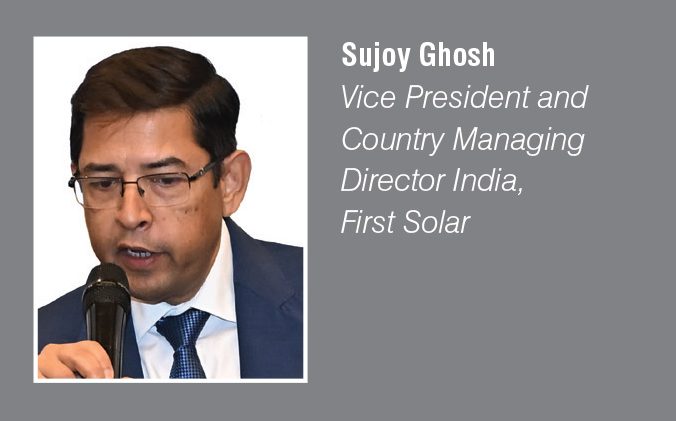 solar technologies continue to evolve and manufacturers increasingly develop proprietary semiconductor architectures, IP considerations are expected to play a more important role in shaping competitiveness and supply chain security in the sector. Hence, the ownership of core technology is an important factor.
Our operations remain largely decoupled from China, reducing exposure to several geopolitical and trade-related uncertainties affecting the global solar industry.
At the same time, localisation will require greater supply chain traceability in order to prevent circumvention. With quality control orders increasingly extending beyond modules to cells, glass, frames and other balance-of-material components, ensuring genuine domestic value addition is becoming critical. Such traceability measures could also enhance export opportunities in markets such as the US, where demand for transparent and diversified non-Chinese supply chains continues to grow.
However, localisation does not eliminate all risks. Recent disruptions in global energy and commodity markets continue to influence manufacturing costs. Solar glass is one example. Further, energy constitutes a significant share of production costs and rising gas prices have directly affected upstream suppliers. Similar pressures are visible in encapsulant materials, where supply chains remain linked to international shipping routes, particularly the Strait of Hormuz.
Moreover, while supply chain resilience remains an important consideration, a more immediate concern is demand visibility. A substantial volume of renewable PPAs remains unsigned. Grid availability remains another challenge affecting project execution.
Sivaprasad M.
From a manufacturing perspective, while module manufacturing growth is expected to moderate, investments in backward integration across cells, wafers and ingots remain a priority. Long-term manufacturing investments will depend on sustained demand visibility, a stable  policy framework and timely resolution of challenges affecting developers. A clear five- to ten-year road map remains critical for supporting further capacity expansion.
The timing of protection measures such as basic customs duty and localisation requirements for BESS manufacturing must strike a balance between industry maturity and project economics. Premature restrictions can constrain developers, similar to how it is currently happening with domestic content requirements, while delayed interventions can discourage domestic manufacturing investments. Cost competitiveness also remains a key consideration as manufacturers continue to face challenges in matching global benchmarks.
C&I demand is expected to become a major growth engine alongside utility-scale projects. Increasing demand for hybrid renewable solutions, particularly from large consumers and data centre developments, is creating new opportunities. However, inconsistent state-level policies, evolving regulations and delays in implementation continue to affect investment decisions. As a result, renewable investments are increasingly gravitating towards states offering clearer policy frameworks and more supportive regulatory environments.
Mahesh Paranjape
From a project execution perspective, curtailment has emerged as one of the most significant challenges impacting renewable energy  generation. The issue is not specific to either solar or wind but stems from broader renewable energy integration constraints. While transmission expansion through green energy corridors is progressing, the pace of renewable capacity addition has outstripped the availability of transmission and storage infrastructure.
The accelerated deployment of transmission infrastructure and storage solutions across the generation, transmission and distribution segments will therefore be critical. Alongside grid-related challenges, land acquisition, right-of-way issues, fragmented land parcels, rising security concerns and increasing project costs continue to pose challenges. Policy uncertainty is another area of concern. Changes in banking regulations and deviation settlement mechanism norms are affecting project economics, particularly for group captive projects that depend on banking provisions.
Goutam Samanta
An emerging focus area for us is merchant renewable energy, where solar generation is coupled with BESS to capture value from time-of- day electricity pricing. This involves charging batteries using daytime solar generation and discharging power during evening and early morning demand periods when tariffs are significantly higher.
Land acquisition and grid connectivity still remain the most significant challenges in the sector. As capacity continues to scale rapidly, grid integration is becoming challenging, with curtailment risks already emerging in high-renewable states such as Rajasthan and likely to extend to other major renewable energy markets. Storage solutions will therefore become essential for managing intermittency. While BESSs will play an important role, PSPs are expected to remain a key solution as well given their maturity and cost competitiveness.
There are significant imbalances across India’s solar value chain. Although domestic module manufacturing capacity has expanded beyond 200 GW, cell manufacturing capacity remains at around 30 GW, creating supply-side gaps. Further, the production-linked incentive scheme has witnessed accelerated growth, but domestic manufacturing of wafers and ingots remains limited.
Strengthening upstream manufacturing will be critical as the sector is expected to require 100-150 GW of integrated domestic manufacturing capacity to support future growth. At present, 90-95 per cent of the solar value chain remains dependent on China. Similar dependencies are visible across wind and BESS supply chains.
