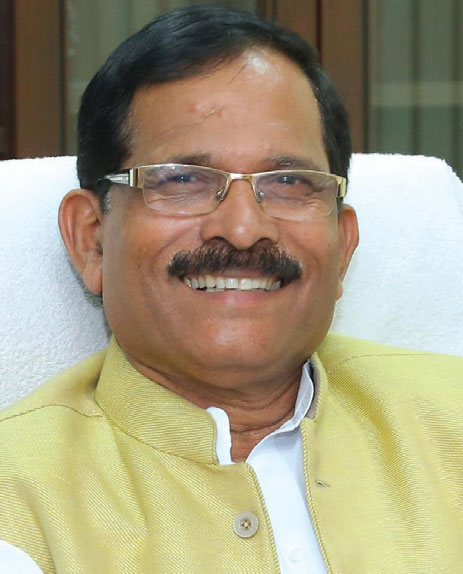
 India’s renewable energy sector has witnessed remarkable progress over the past decade, emerging as one of the world’s fastest-growing clean energy markets. With record capacity additions, declining tariffs, expanding manufacturing capability and a maturing ecosystem of developers and financiers, the sector today stands at a pivotal juncture. This growth has been supported by robust policy frameworks, concerted grid integration efforts and a strong focus on ease of doing business for the industry. Minister of State for Power and New and Renewable Energy Shripad Yesso Naik has played an important role in sustaining this momentum. He has actively engaged with stakeholders to understand on-ground challenges and drive timely interventions. His proactive approach has helped solve sector challenges and build confidence among stakeholders. In an interview with Renewable Watch, Naik talked about the key achievements of the renewable energy sector, the policy initiatives undertaken by the government, the status of domestic manufacturing, and the major challenges and opportunities in the sector. Edited excerpts…
What have been the key achievements in the renewable energy sector in the past year?
In line with the honourable prime minister’s announcement of the Panchamrit goals at COP26, the Ministry of New and Renewable Energy (MNRE) is working towards achieving 500 GW of non-fossil fuel-based installed power capacity by 2030.
In June 2025, India already achieved the target of having 50 per cent of its cumulative installed capacity based on non-fossil fuels, which is five years ahead of our Nationally Determined Contributions commitment. As of October 31, 2025, a total of 259.42 GW of non-fossil fuel-based capacity has been installed in the country, which includes 129.92 GW of solar power, 53.6 GW of wind power, 11.61 GW of biopower, 50.35 GW of large hydro, 5.15 GW of small-hydro and 8.78 GW of nuclear power. Further, 188.83 GW of projects are at various stages of implementation, and 58.42 GW of capacity is at various stages of bidding.
India stands fourth globally in renewable energy installed capacity, fourth in wind power capacity and third in solar power capacity (as per the International Renewable Energy Agency’s [IRENA] Renewable Energy Statistics 2025, with data as of December 2024).
India’s renewable energy growth has been guided by a mix of near-term programmes and long-term planning initiatives undertaken by the government. In the short term, the focus has been on implementing already-notified schemes and mechanisms, such as the competitive bidding guidelines for solar, wind and hybrid projects; schemes for rooftop solar and decentralised renewable energy; promotion of storage technologies, including batteries and pumped hydro; and support measures like the production-linked incentive (PLI) scheme for high-efficiency solar PV modules. These instruments have provided the framework within which industry and states are scaling up renewable deployment.
In the longer term, the direction is informed by national targets and studies undertaken by bodies such as the Central Electricity Authority and NITI Aayog. These identify the role of renewables in achieving energy security, diversifying supply sources and decarbonising hard-to-abate sectors through new avenues such as green hydrogen. The emphasis remains on strengthening transmission systems, advancing domestic manufacturing and creating enabling markets that can integrate higher shares of renewable power in a reliable and affordable manner.
The roadmap, therefore, combines the implementation of notified schemes in the immediate horizon with system-level planning exercises for the future. Together, these provide a clear and adaptive policy environment for advancing renewable power, without needing additional commitments beyond what is already in place.
What are the key initiatives and policies that your ministry is implementing to accelerate the transition to renewable energy?
The government has taken several steps and initiatives to promote and accelerate renewable energy development in the country to realise the commitment of 500 GW of non-fossil energy capacity by 2030. These include the following:
- Notification of a trajectory for renewable power bids of 50 GW per annum, to be issued by renewable energy implementation agencies such as the Solar Energy Corporation of India, NTPC Limited, NHPC Limited and SJVN Limited from 2023-24 to 2027-28.
- Up to 100 per cent foreign direct investment has been permitted under the automatic route.
- Interstate transmission system charges have been waived for the interstate sale of solar and wind power for projects to be commissioned by June 30, 2025, for green hydrogen projects till December 2030, and for offshore wind projects till December 2032.
- To boost renewable consumption, the renewable purchase obligation (RPO) trajectory has been notified till 2029-30, including a separate RPO for decentralised renewable energy.
- Standard bidding guidelines for tariff-based competitive bidding have been issued for procuring power from grid-connected solar, wind and wind-solar projects.
- Schemes such as the Pradhan Mantri Kisan Urja Suraksha evam Utthaan Mahabhiyan (PM-KUSUM), the PM Surya Ghar: Muft Bijli Yojana, the National Programme on High Efficiency Solar PV Modules, the National Green Hydrogen Mission (NGHM) and the VGF scheme for offshore wind energy have been launched.
- The scheme for setting up ultra mega renewable energy parks is being implemented to provide land and transmission to renewable energy developers for installing large-scale renewable projects.
- The laying of new transmission lines and creation of new substation capacity have been funded under the Green Energy Corridors scheme for the evacuation of renewable power.
- The Electricity (Rights of Consumers) Rules, 2020, have been issued for net metering up to 500 kW or the electrical sanctioned load, whichever is lower.
- The National Repowering and Life Extension Policy for Wind Power Projects, 2023, has been issued.
- The Strategy Paper for Establishment of Offshore Wind Energy Projects has been issued, indicating a bidding trajectory of 37 GW by 2030 and identifying various business models for project development.
- The Offshore Wind Energy Lease Rules, 2023 have been notified by the Ministry of External Affairs on December 19, 2023, to regulate the grant of lease of offshore areas for developing offshore wind energy projects.
- The procedure for the uniform renewable energy tariff mechanism has been issued.
- Standard and Labelling programmes for solar PV modules and grid-connected solar inverters have been launched.
- A transmission plan has been prepared till 2030 to augment the transmission infrastructure needed to meet the steep renewable trajectory.
- The Electricity (Late Payment Surcharge and related matters) Rules, 2022 have been notified.
- The Green Energy Open Access Rules, 2022 have been notified to promote renewable energy.
- The green term-ahead market has been launched to facilitate the sale of renewable energy through exchanges.
- The government has issued orders for power to be despatched against a letter of credit or advance payment to ensure timely payment by distribution licensees to renewable energy generators.
The key initiatives and policies mentioned above have attracted private investments and enabled capacity addition. India has witnessed a significant shift in the investment dynamics of renewable energy projects. The majority of renewable projects in the country are being set up by private sector developers selected through a transparent bidding process.
What is the status of domestic manufacturing of renewable energy components? What further steps are being taken by the government in this space?
Since 2014, India’s installed solar PV module manufacturing capacity has grown by around 48 times, from 2.3 GW to approximately 110 GW as of September 30, 2025.
Incentivising domestic solar manufacturing in the country is one of the key focus areas of the government. Several measures have been taken by the union government to promote domestic solar PV manufacturing. The government’s efforts span financial, fiscal and policy measures aimed at bolstering domestic production. Financial incentives include the PLI scheme for setting up fully or partially integrated manufacturing units for solar PV modules and upstream components. Fiscal incentives include concessional customs duties on inputs needed for domestic manufacturing, waivers on import duties for specific capital goods needed for solar PV cell and module production, and imposition of basic customs duties on imports of solar PV modules and cells.
Since 2014, India’s installed solar PV module manufacturing capacity has grown by around 48 times, from 2.3 GW to approximately 110 GW as of September 30, 2025. This increase has enabled India to meet domestic demand while also catering to exports.
Furthermore, over 48 GW of fully or partially integrated solar PV module manufacturing projects are currently under implementation under the solar PLI scheme, and some segments of the awarded projects have even started production. Including the additional capacities set up by the PLI beneficiaries beyond those awarded under the PLI scheme, as of October 31, 2025, the capacities that have started production include around 24 GW of solar PV module manufacturing, around 10 GW of solar PV cell manufacturing and around 2 GW of ingot wafer manufacturing. The solar cell and module manufacturing capacities include a fully integrated thin-film manufacturing capacity.
Once the projects under the solar PLI scheme are completed, they will attract an investment of approximately Rs 1.1 trillion and create direct employment for around 45,000 people. The solar PLI scheme will also bring cutting-edge solar PV module manufacturing technology to India, reducing the country’s dependence on imports.
Further, wind turbine generator technology has evolved over the past three decades, and state-of-the-art manufacturing technologies are now available in the country. About 70-80 per cent indigenisation has been achieved, with a total manufacturing capacity of about 20 GW per annum. The MNRE has put in place a procedure to enlist type- and quality-certified wind turbines under the Revised List of Models and Manufacturers (RLMM), which also mandates that the hub and nacelle assembly/manufacturing facility should be within India. Wind turbines of individual capacities from 225 kW to 5.2 MW are being manufactured in the country and enlisted in the RLMM, including 31 different models being manufactured by 14 different companies. The Indian wind turbine manufacturing industry is maturing, with the presence of all major global players, including Vestas, Siemens Gamesa, GE, Senvion, Nordex and Envision, along with domestic players such as Suzlon, Inox and Pioneer Wincon.
What are the challenges and opportunities you anticipate in achieving India’s renewable energy goals, and how does your ministry plan to address them?
As we scale up solar and wind power, ensuring grid stability and flexibility is critical. We are tackling this by strengthening transmission infrastructure and investing in smart grids and energy storage solutions.
India is well on track to achieve its renewable energy targets. However, like any large-scale transformation, there are challenges that need to be addressed. One of the primary challenges is grid integration. As we scale up solar and wind power, ensuring grid stability and flexibility is critical. We are tackling this by strengthening transmission infrastructure and investing in smart grids and energy storage solutions.
Land acquisition and infrastructure development also require focused attention. The government is working closely with states to streamline land allocation for renewable energy parks and expedite transmission network expansion.
In terms of supply chains, while India has made remarkable progress in manufacturing, the country still relies on imports for some raw materials/components, such as solar wafers and battery materials. Backward integration of initiatives like the PLI scheme would further strengthen domestic manufacturing capabilities and reduce dependence on imports.
Despite these challenges, India is uniquely positioned to lead the global energy transition, and there are immense opportunities that we are actively exploring.
First, the country has a strong policy ecosystem and investor-friendly regulations, which make it one of the most attractive destinations for renewable energy investment. Second, India is opening up new sectors in the renewables space in the country:
Under the NGHM, India is proposed to be developed as a hub for green hydrogen production. With our abundant solar and wind resources, India has the potential to produce the world’s cheapest green hydrogen, which will drive industrial decarbonisation and create new economic opportunities.
Another major opportunity is in offshore wind energy. The government has launched the VGF scheme for offshore wind with a total outlay of Rs 74.53 billion, including an outlay of Rs 68.53 billion for commissioning 1 GW of offshore wind energy projects (500 MW each off the coast of Gujarat and Tamil Nadu), and a grant of Rs 6 billion for upgrading two ports to meet the logistics requirements of offshore wind energy projects. This will not only help in developing offshore wind projects in India, but also help in building offshore wind turbine manufacturing capacity in the country.
The renewables sector is also creating opportunities for the general public by creating jobs and driving skill development as part of the broader energy transition. Through initiatives like the Surya Mitra/Vayu Mitra initiatives, we are equipping the workforce with the expertise needed for solar, wind and storage technologies, ensuring a seamless shift to a green economy. As per IRENA’s Annual Renewable Energy Jobs Review 2024, India had over a million renewable energy jobs in 2023. This number will increase multifold as we approach the target of 500 GW.