

By Preeti Wadhwa
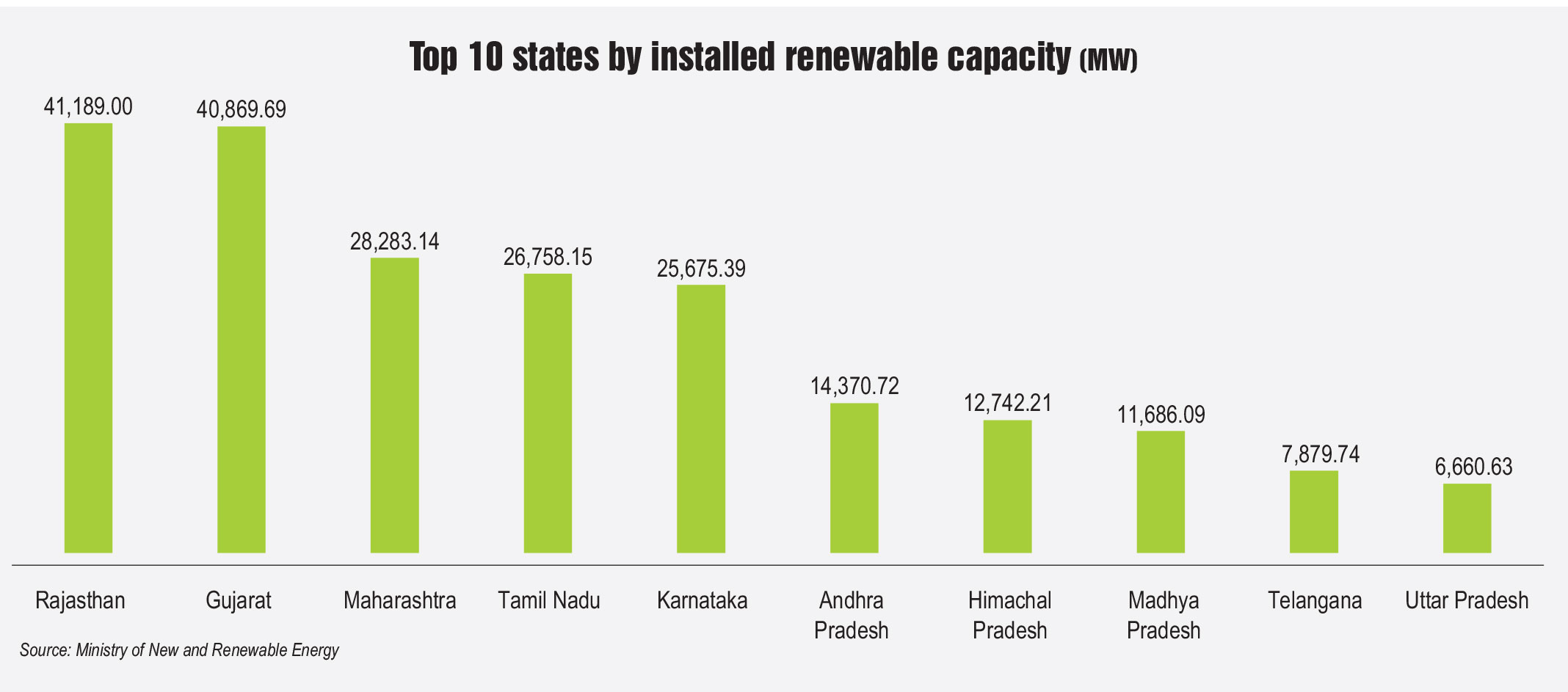
India’s renewable energy transition is advancing unevenly across states, with each charting its own path based on resource potential, policy ambition and investment momentum. As of October 2025, India’s total renewable energy capacity, including large hydro, stood at 250,643.45 MW, accounting for around 50 per cent of the country’s total power capacity of 505,023.06 MW. The top 10 states in terms of installed renewable capacity account for over 85 per cent of India’s total renewable energy capacity.
Renewable Watch provides an overview of the current status of renewables in these states and the future outlook…
Rajasthan
With a total installed renewable energy portfolio of 41,189 MW as of October 2025, Rajasthan now holds the top position. Solar power continues to dominate the state’s clean energy landscape with 35,337.88 MW of capacity, which accounts for nearly 85 per cent of its non-fossil fuel-based capacity. This includes 30,639.93 MW of ground-mounted projects, 1,912.5 MW of rooftop installations, 805.45 MW of off-grid systems and 1,980 MW of hybrid solar capacity. The development of 10 solar parks aggregating over 11 GW is currently under way, with several projects already operational.
Rajasthan has also made progress in leveraging its wind potential. With 5,208.75 MW of installed wind power capacity, it ranks fifth among Indian states. The state’s hydropower assets include 23.85 MW of small hydro and 411 MW of large hydro installations.
Over the past year, Rajasthan has attracted significant interest across segments. The government introduced the Rajasthan Integrated Clean Energy Policy, 2024, outlining an ambitious target of 125 GW of renewable energy capacity by 2030, including 90 GW of solar, 25 GW of wind and hybrid resources and 10 GW of hydro, pumped storage and battery energy storage systems.
Gujarat
Gujarat’s renewable energy sector recorded another year of accelerated expansion, with the state’s total installed renewable capacity rising to 40,869.69 MW as of October 2025, up from 29,814 MW in October 2024, marking an impressive year-on-year growth of 37.9 per cent. The state accounts for nearly 16 per cent of India’s total renewable energy portfolio. Its capacity mix is led by 24,143.16 MW of solar power, followed by 14,493.38 MW of wind power (the highest among all states), 129.85 MW of biopower, 113.30 MW of small hydro and 1,990 MW of large hydro.
Gujarat also maintains its position as the second largest solar state after Rajasthan. Its solar portfolio comprises 16,649.19 MW of ground-mounted capacity, 6,185.3 MW of rooftop solar, 173 MW of off-grid systems and 1,135.6 MW of hybrid solar, reflecting sustained uptake across all segments.
Gujarat’s renewable energy potential is substantial. As per NITI Aayog, the state has an estimated solar potential of 36 GW and wind potential of 142.6 GW at 120 metres and 180.8 GW at 150 metres. In addition, the National Institute of Wind Energy has assessed India’s offshore wind potential at 71 GW, with 36 GW identified along Gujarat’s coastline.
At the Vibrant Gujarat Global Summit 2024, the government reinforced its clean energy ambitions by introducing a dedicated land allocation policy, earmarking 0.2 million hectares of wasteland in Kutch and Banaskantha specifically for green hydrogen production. The state has also announced financial support amounting to Rs 518.71 billion to accelerate the development of green hydrogen projects.
Bioenergy is emerging as another area of opportunity. According to a government press release issued on January 16, 2025, Gujarat’s organic resource base has the potential to produce nearly 4,000 tonnes of compressed biogas per day, a sizeable opportunity that remains largely untapped. The state currently has 52 operational biogas plants, with eight additional projects yet to begin construction as per the GOBARdhan portal.
Maharashtra
Maharashtra, with a total installed renewable energy capacity of 28,283.14 MW, ranks third in the country’s clean energy landscape in terms of installed capacity. The state’s renewables portfolio comprises 5,716.31 MW of wind power, 16,137.25 MW of solar power, 2,998.30 MW of biopower, 384.28 MW of small hydro and 3,047 MW of large hydro. Within this installed capacity, solar power leads with a share of 57 per cent, followed by wind power with a 20 per cent share. Notably, Maharashtra has the highest installed biopower capacity in India, which includes 2,907 MW of biomass power and bagasse cogeneration, 16.4 MW of non-bagasse biomass cogeneration, 12.59 MW of waste-to-energy (WtE) and 62.01 MW of off-grid WtE.
To promote rooftop solar adoption, the state government has approved the Swayampurna Maharashtra Residential Rooftop Solar Scheme with a total outlay of Rs 6.55 billion. The scheme aims to provide subsidies to eligible consumer categories, thereby accelerating rooftop deployment across the state. Solar irrigation remains a key priority segment for Maharashtra. Recently, the Asian Development Bank sanctioned a $460 million results-based loan to modernise rural power infrastructure and support distributed renewable energy generation. The investment is expected to improve daytime access to reliable solar power for irrigation, enhancing agricultural productivity across the state.
Green hydrogen and pumped storage development have emerged as major areas of activity. Maharashtra has signed an MoU with the Avaada Group for two pumped storage projects (PSPs) with a combined capacity of 3,650 MW – the 2,400 MW Pawana Falyan PSP and the 1,200 MW Sirsala PSP. Additionally, the government has signed an MoU worth Rs 80 billion with GSC PSP Maha Private Limited for the 1,500 MW Panchmauli-Devalipada PSP in Dhule and Nandurbar districts. The state is also exploring green hydrogen export opportunities through ports such as the Jawaharlal Nehru Port Trust. In another notable development, the government has approved a joint venture between Mahagenco and SJVN Limited to develop 5,000 MW of renewable energy projects. This follows an MoU signed in June 2023 between the two entities for the development of pumped storage, solar-wind hybrid, floating solar and green hydrogen-based projects, further strengthening Maharashtra’s clean energy ecosystem.
Tamil Nadu
Tamil Nadu’s renewable energy sector continued its steady expansion over the past year. As of October 2025, the state’s total installed renewable energy capacity stood at 26,758.15 MW. This comprises 11,938.34 MW of wind power, 11,471.94 MW of solar power, 1,046.62 MW of biopower, 123.05 MW of small hydro and 2,178.2 MW of large hydro.
Solar capacity in the state includes 10,173.14 MW of ground-mounted solar, 1,225.1 MW of rooftop solar and 73.7 MW of off-grid systems. The biopower segment consists of 969.1 MW of biomass power and bagasse cogeneration, 43.55 MW of non-bagasse biomass cogeneration, 6.4 MW of WtE plants and 27.57 MW of off-grid WtE installations.
With 11,938.34 MW of installed wind capacity, Tamil Nadu remains one of the leading wind power states in the country. The government also plans to tap the state’s estimated offshore wind potential of 35 GW as part of its strategy to increase the share of renewable energy in overall generation to 50 per cent by 2030.
To strengthen grid reliability and support round-the-clock renewable supply, Tamil Nadu is working towards the development of a South Asian renewable energy corridor. Over the next five years, it aims to add 10,000 MW of solar and 2,000 MW of wind capacity. It has set a target of meeting 43.33 per cent of its energy requirement from renewable sources by FY 2030. Capacity additions are being supported by the repowering of ageing wind turbines, the development of new hybrid wind-solar parks and a series of enabling policies.
The manufacturing ecosystem is also expanding, with an increasing number of companies choosing the state for solar equipment production. The existing annual production capacity includes about 500 MW of wind blades and turbines and 3,000 MW of solar panels, wafers and related components. Recently, Vikram Solar commissioned a fully automated 5 GW module manufacturing facility in Vallam, while in February 2025, TP Solar inaugurated its 4.3 GW solar cell and module manufacturing plant in Tirunelveli.
Karnataka
Karnataka is among the top five states in terms of renewable energy deployment. As of October 2025, the state’s total installed renewable energy capacity stood at 25,675.39 MW, accounting for about 10 per cent of the country’s overall portfolio. This includes 10,592.12 MW of solar power, 8,193.29 MW of wind power, 1,916.05 MW of biopower, 1,284.73 MW of small hydro and 3,689.2 MW of large hydro. Solar power has been the primary growth driver, accounting for roughly 41 per cent of Karnataka’s renewable energy capacity. The state’s solar portfolio comprises 9,562.41 MW of ground-mounted installations, 773.8 MW of rooftop solar, 43.66 MW of off-grid systems and 212.5 MW of hybrid projects.
The key highlight of Karnataka’s solar segment is the 2,000 MW solar power park in Pavagada, Tumkur, which was commissioned in 2018. Several megawatt-scale solar parks have been approved by the state at various locations, including Bidar and Madhugiri. Karnataka has set an ambitious target to add 38 GW of new renewable energy capacity by FY 2035.
The government is also advancing initiatives to tap solar potential on waterbodies. The Minor Irrigation and Water Resources Department and Karnataka Renewable Energy Development Limited are working together to establish floating solar parks. Although still at an early stage, the initiative has attracted strong interest and is seen as a promising opportunity to enhance renewable energy supply and support energy self-sufficiency in smaller communities.
Andhra Pradesh
Andhra Pradesh remains a strong performer in India’s clean energy transition. As of October 2025, the state’s total renewable energy capacity stood at 14,370.72 MW, comprising 4,397 MW of wind, 5,925.61 MW of solar, 594.02 MW of biopower, 163.31 MW of small hydro and 3,290 MW of large hydro. Renewables now account for nearly half of Andhra Pradesh’s total installed power capacity.
The state has announced ambitious expansion plans backed by supportive policies such as the ICE Policy, 2024, which targets the addition of 78,500 MWp of solar and 35,000 MW of wind capacity. Andhra Pradesh is also stepping up its green hydrogen ambitions. In July 2025, the state government announced the Green Hydrogen Valley Declaration, 2025, setting goals to establish 5 GW of electrolyser manufacturing capacity and produce 1.5 million metric tonnes of green hydrogen annually by 2029.
Andhra Pradesh holds significant potential in pumped storage as well. As per the Central Electricity Authority, the state has 30,350 MW of PSP potential, the highest in southern India and around 45 per cent of the region’s total. This includes four on-river sites with 4,750 MW of potential and 21 off-river sites with 25,600 MW. The 2024 ICE Policy further aims to develop up to 22,000 MW of pumped hydro storage capacity by 2030.
Himachal Pradesh
As of October 2025, Himachal Pradesh’s total installed renewable energy capacity stood at 12,742.21 MW. This includes 310 MW of solar power, 10.2 MW of biopower (comprising 9.2 MW of biomass cogeneration [non-bagasse] and 1 MW of off-grid WtE), 1,000.71 MW of small hydro and 11,421.02 MW of large hydro. Large hydro alone accounts for nearly 90 per cent of the state’s renewable portfolio. Notably, the state also has the highest installed large hydropower capacity in the country.
Himachal Pradesh has set an ambitious goal of becoming India’s first green energy state by 2026. Announcing this during the state budget, Chief Minister Sukhvinder Singh Sukhu highlighted the government’s emphasis on scaling up clean energy, particularly solar power. Himachal Pradesh Power Corporation Limited plans to develop 500 MW of solar capacity by 2026-27.
For 2025-26, the government has allocated Rs 9.05 billion to the energy sector, with a strong focus on expanding renewable energy, enhancing green mobility and building sustainable infrastructure. At present, roughly 626 MW of solar capacity is under development. Alongside solar, Himachal Pradesh is accelerating the execution of major hydroelectric projects. The 450 MW Shongtong hydropower project, delayed for more than 15 years, is now targeted for commissioning by December 2026. Similarly, the state is advancing the 130 MW Integrated Kashang project, which is expected to be completed by June 2026.
Madhya Pradesh
Madhya Pradesh is steadily reshaping its power mix by expanding solar, wind and pumped storage infrastructure to reduce its dependence on thermal generation. As of October 2025, the state’s total installed renewable energy capacity stood at 11,686.09 MW. Solar power forms the largest share at 5,723.77 MW, followed by wind at 3,448.15 MW. The remaining capacity comprises 155.46 MW of biopower, 2,235 MW of large hydro and 123.71 MW of small-hydro installations.
To accelerate its clean energy transition, the state government has introduced the Madhya Pradesh Renewable Energy Policy, 2025. The five-year policy aims to meet 50 per cent of the state’s annual power consumption through renewables by 2030. It covers all renewable energy projects of 500 kW and above, excluding decentralised systems. The policy outlines phased renewable purchase targets of 20 per cent in FY 2024, 30 per cent in FY 2027 and 50 per cent in FY 2030.
Madhya Pradesh has also set ambitious project development goals, including 10,000 MW of renewable and hybrid energy parks under central and state schemes by FY 2027. In addition, it plans to establish 4,000 MW of renewable power for export to other states by FY 2024, increasing this to 10,000 MW by FY 2027. The policy further identifies investment targets of Rs 150 billion by 2024 and Rs 500 billion by 2027 for renewable energy generation, along with Rs 40 billion and Rs 100 billion for renewable equipment manufacturing over the same periods.
Telangana
As of October 2025, Telangana’s total renewable energy capacity stood at 7,879.74 MW, consisting of 128.1 MW of wind power, 5,033.50 MW of solar power, 221.67 MW of biopower, 90.87 MW of small hydro power and 2,405.6 MW of large hydro. The solar capacity comprises ground-mounted solar (4,360.49 MW), rooftop solar (664.3 MW) and off-grid solar (8.71 MW). Its biopower capacity encompasses biomass power/bagasse cogeneration (158.1 MW), biomass cogeneration (non-bagasse) (3.3 MW), WtE (45.8 MW) and off-grid WtE (14.47 MW).
Telangana has unveiled its Clean and Green Energy Policy, 2025, which targets the addition of 20,000 MW of renewable energy by 2030. The state also aims to promote green hydrogen and energy storage to support the state’s long-term decarbonisation goals going forward.
Uttar Pradesh
Uttar Pradesh is steadily strengthening its position in the country’s renewable energy landscape, supported by efforts across multiple segments to meet its rising power demand. As of October 2025, the state’s total installed renewable energy capacity stood at 6,660.63 MW, comprising 3,798 MW of solar power, 2,310 MW of biopower, 50.60 MW of small hydro and 501.60 MW of large hydro.
Uttar Pradesh is exploring new avenues such as floating solar. In April 2025, it issued guidelines for allocating select reservoirs for floating solar projects under the Solar Energy Policy, 2022. In the first phase, six water bodies totalling 440 MW will be offered to developers.
Bioenergy is also gaining traction, driven by the state’s vast agricultural base. In May 2025, Uttar Pradesh approved compressed biogas projects worth about Rs 60 billion. The Gram-Urja Model, launched in July 2025, further aims to strengthen rural energy systems.
The state has an estimated renewable energy potential of about 22,830 MW of solar, 7,726 MW of biopower and 13,440 MW of pumped storage capacity. However, capacity addition remains modest due to infrastructure constraints and implementation challenges.
Outlook
India’s renewable energy sector is witnessing robust growth, driven by supportive policies, declining technology costs and a rising commitment to decarbonisation. As per the International Renewable Energy Agency’s Renewable Energy Statistics 2025, India ranks 5th worldwide in total electricity generation from renewable energy sources. During 2024-25, the country’s total electricity generation reached 1,824.12 BUs, marking a significant increase of 65.02 per cent over the 1,105.38 BUs generated in 2014-15. Renewable energy emerged as a key contributor, generating 403.64 BUs and accounting for 22.13 per cent of India’s total electricity output. This reflects the accelerating pace at which India is integrating clean energy into its power mix.
The state-level developments covered in the article underscore India’s growing maturity in the renewable energy sector. Strong policies, large-scale parks, emerging storage solutions and rising interest in green hydrogen are reshaping regional portfolios. A sustained focus on grid readiness, balanced capacity distribution and timely project execution across states will be critical in determining how effectively India meets its long-term renewable energy commitments.
