By Karan Sharma
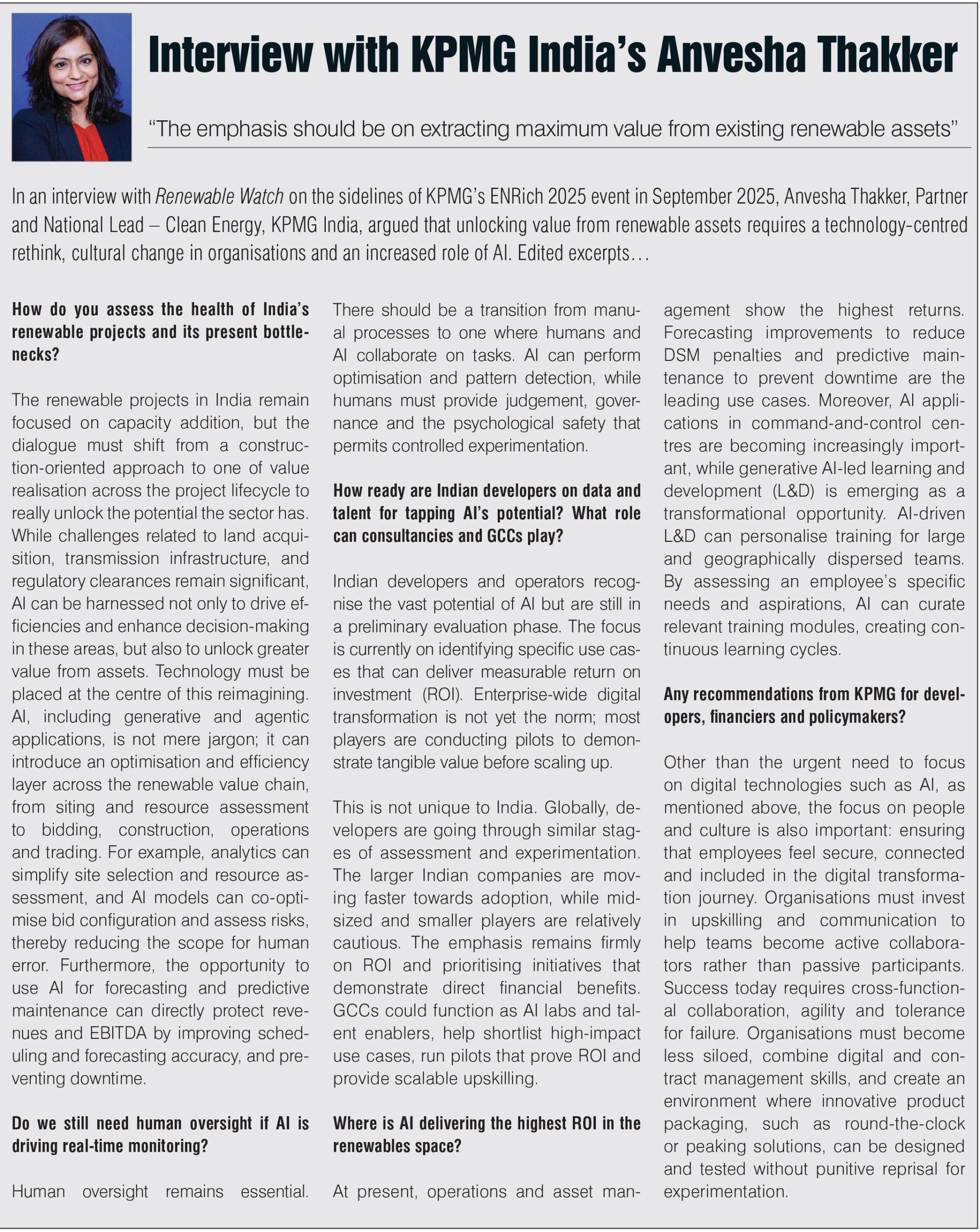
India’s renewables sector has entered a phase where simply building capacity is no longer sufficient; extracting value from existing assets has become equally critical. In this context, technology and organisational agility matter more than ever. Global capability centres (GCCs) located in India and the rising maturity of artificial intelligence (AI) across the renewable value chain are becoming essential drivers of optimisation.
In this article, Renewable Watch delves into how AI and GCCs are being deployed to infuse data intelligence across the renewable value chain a nd reduce operating costs in India’s renewable projects.
Role of AI in renewables
India’s renewables sector is already witnessing clear AI use cases that generate measurable returns, especially in the operations and maintenance (O&M) segment. Operators like ENGIE India, using AI-driven supply and energy management platforms, have reduced gaps in renewable generation vis-à-vis grid demand. In forecasting and trading, AI models allow developers to reduce error bands in generation estimates, thereby lowering deviation settlement mechanism (DSM) penalties and improving bidding accuracy. Wind original equipment manufacturers have deployed AI-based condition monitoring systems that can detect gearbox failures up to 45 days in advance, reportedly capturing over 80 per cent of potential faults before they cause downtime. This predictive insight helps avoid the high costs of unscheduled outages, which, in many wind farms, constitute 20-25 per cent of the project’s levellised cost of energy.
At the AI in Renewables conference organised by Renewable Watch in April 2025, industry estimates suggest AI could reduce O&M costs by 5-50 per cent, depending on scale and baseline maturity. ReNew targets to improve the energy efficiency of assets by 1.5-2 per cent through digital analytics and machine learning (ML), having already maximised the output of their wind and solar assets above optimal levels. On the manufacturing side, solar module manufacturers have integrated AI to make modules weather-smart – smart tracker systems driven by AI controllers adjust tilt angles dynamically for diffuse irradiance conditions, boosting yields by 5-6 per cent annually.
Role of GCCs in assisting the integration of AI in renewables
A GCC is a subsidiary of multinational corporations to build in-house capabilities across technology, analytics and business operations. The GCC market in India already exceeds $64 billion in value, growing at a compound annual growth rate of nearly 9.8 per cent over FY 2019-2024 as per EY. India hosts over 1,700 centres, employing nearly 1.9 million professionals and accounting for 55 per cent of the global share. By 2030, the country will have an estimated 2,200-2,500 GCCs, with the market size projected to surge to $110 billion and total employment rising to 2.8 million.
GCCs are evolving from support units to strategic innovation hubs that embed AI by design, providing cloud-native platforms, high-performance analytics and integrated IT-OT fabrics with AI/ML adoption. AI adoption in India’s GCCs reportedly increased from 65 per cent in FY 2019 to 86 per cent in FY 2024, as per KPMG’s “From cost centre to nerve centre of the energy enterprise” report.
Integrating AI into renewable projects has also become the scope of GCCs in India. These are helping accelerate AI adoption for renewable companies, especially mid-size players that lack in-house capacity. These mid-market segment firms are scaling 1.2 times faster than firms outside the segment.
Outlook
Despite advancements across AI use and the establishment of GCCs, structural barriers do remain. Many organisations still treat AI as a series of pilots rather than an enterprise capability. Additionally, skilled specialists who understand both AI and renewables are scarce. High implementation costs and the limited availability of domain-specific AI tools remain barriers for small and mid-scale developers. Regulatory clarity on the role of AI in grid operations and standardisation for data is still ambiguous.
Looking ahead, three enablers may promote further success in AI uptake in renewables. One, policy and regulatory support, open data platforms, research and development incentives, and standards for AI in grid systems are key. Two, culture and leadership must prioritise data-driven decisions, embed cross-team collaboration and reward risk-taking. Three, investment in talent pipelines, through dedicated training programmes in renewables plus AI, will sustain long-term capabilities.
If India can combine its trajectory in renewable deployment with its strength in GCCs and AI talent, it can further improve efficiency in the renewables sector through innovations. In that transition lies the next phase of India’s clean energy journey: extracting maximum value from every single MW, not simply building new ones.