

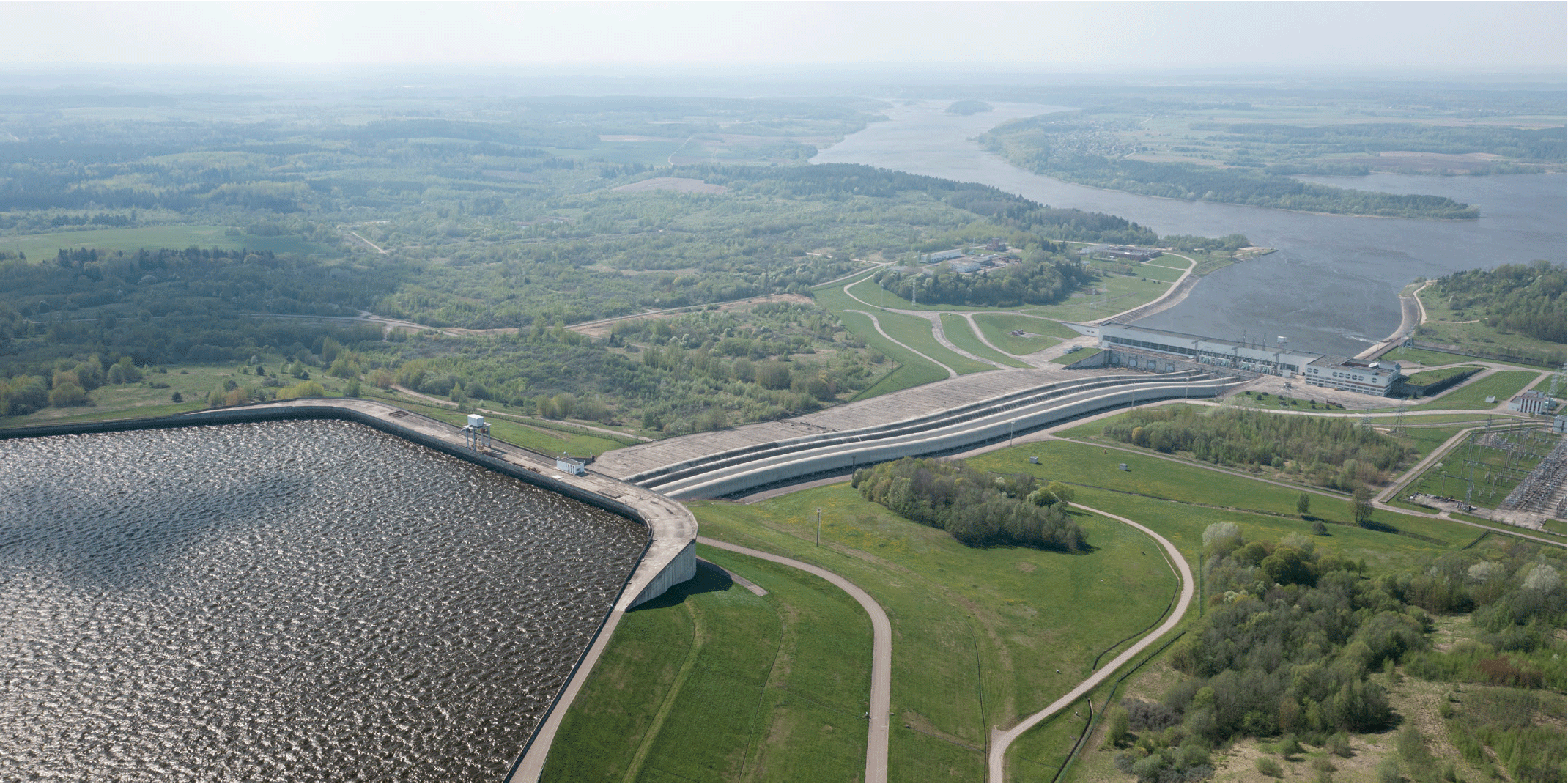
 India is rapidly expanding its renewable energy capacity, but this growth brings a critical challenge – how to store intermittent renewable energy. Pumped storage projects (PSPs) are now being recognised as a viable and scalable solution. PSPs operate by using surplus electricity to pump water to an upper reservoir during off-peak periods and releasing it to generate power during peak demand, thereby providing much-needed flexibility to the grid. As India moves towards integrating higher shares of renewable energy, while ensuring grid stability and reliability, PSPs are set to play a key role.
With variable renewable energy capacity expected to grow by over 280 per cent by 2032 and peak electricity demand shifting to evening hours, India’s pumped storage requirement is set to rise sharply to 175 GWh by 2032, according to the Central Electricity Authority’s (CEA) National Electricity Plan. In response, the government has introduced policy measures to support the sector; private developers are committing large-scale investments; and states are actively identifying and preparing suitable sites for project development.
This article explores the emerging landscape of PSPs in India, highlighting policy developments, challenges, financing trends and the evolving market outlook based on discussions at the Renewable Watch’s third edition of Pumped Hydro Storage in India conference…
Policy environment
The CEA and the Ministry of Power (MoP) have set a target of 26.6 GW of PSP capacity by 2031-32. This represents a massive scale-up from current levels and requires significant policy changes to remove barriers and attract investment. More than 200 GW of PSP capacity has been identified across India, with nearly 70 per cent being off-stream projects.
In February 2025, the MoP released tariff-based competitive bidding (TBCB) guidelines for PSPs, which provide a standardised framework for discoms to issue competitive bid tenders.
Also, the CEA has revised guidelines for detailed project reports (DPRs) to speed up approvals. The changes include shorter documentation requirements, online submissions, and elimination of mandatory cost and financial chapter approvals. For off-stream projects, developers no longer need to submit alternative reservoir layouts or certain geological studies, which could reduce approval time by four to five months.
Further, the MoP introduced guidelines in April 2023, which waive interstate transmission system charges for 25 years for PSPs awarded before June 30, 2028. This single change significantly improves project economics and encourages faster development. State governments can now allot sites through nomination, competitive bidding, or on a first come, first served basis. The Jalvi Store online portal provides real-time visibility into project development stages.
Financial support is also given for enabling infrastructure. It is capped at Rs 10 million per MW for projects up to 200 MW and Rs 2 billion plus Rs 7.5 million per MW for projects exceeding 200 MW, with a potential increase to Rs 15 million per MW for exceptional cases. This funding covers transmission systems, ropeways, rail sidings and communication systems. PSPs are also exempt from free power obligations, water cess and upfront royalties if sites are allotted transparently.
Environmental clearances have been streamlined through the Parivesh portal. Standalone off-stream PSPs can qualify for reduced data collection requirements and may be treated as B2 category projects if they avoid forest clearances, do not create new reservoirs and involve no additional land submergence. Developers can now carry out compensatory afforestation in advance and survey permissions in forest areas have been simplified.
Market dynamics
As per CEA, India currently has over 87 GW of PSP capacity at various development stages. This includes 6 GW operational, 8 GW under construction and 5.7 GW with approved DPRs. Another 64 GW is undergoing survey and investigation as of June 2025.
The PSP market is expected to witness a sharp rise as costs decline and revenue opportunities grow. PSPs are more cost-effective than battery storage for applications requiring six to eight hours of storage or longer. The levellised cost of storage for PSPs is around Rs 7.87 kWh to 8.15 per kWh compared to Rs 8.59 per kWh for equivalent battery systems. This cost advantage increases with longer-duration applications, where PSPs have an advantage due to their 40-60-year operational life.
Trends in tariff bid amounts are also showing market maturation. From around Rs 16,700,000 per MW per year in December 2022, tariffs have dropped to Rs 7,600,000 to Rs 7,700,000 per MW per year in mid-2025. These tariffs typically cover storage durations of six to eight hours, matching system needs for peak demand management.
Revenue opportunities for PSPs are expanding beyond simple energy arbitrage. Regulatory changes allow participation in ancillary services markets and resource adequacy mechanisms. The high price day-ahead market (HP-DAM) and green DAM create new ways for PSPs to earn revenue from price volatility and system shortfalls. Under the new ancillary services framework, PSPs can earn money through both market-based tertiary reserves and administered secondary reserves. The ability to earn revenue from multiple services, including energy arbitrage, frequency regulation, spinning reserves and voltage support creates a more stable income foundation.
Further, long-term revenue certainty will improve going forward, as state utilities are now signing 40-year power purchase agreements with PSP developers. These extended contracts give developers the cash flow predictability needed for project financing, while showing institutional confidence in PSP technology.
Developer strategies
Major developers are restructuring their business models around energy storage rather than just renewable generation. Developers understand that variable renewable energy alone cannot provide reliable power as India transitions away from coal. PSPs and battery storage are now being seen as complementary, rather than competing technologies, with each serving different applications.
Commercial strategies focus on diversified revenue streams. Many PSPs are being developed as standalone storage assets. This approach allows developers to sell services to multiple customers, including merchant markets, commercial and industrial users, captive consumption, and long-term contracts with distribution companies. Overall, according to developers, capital costs typically range from Rs 50 million to Rs 55 million per MW, although actual costs vary significantly, based on site conditions.
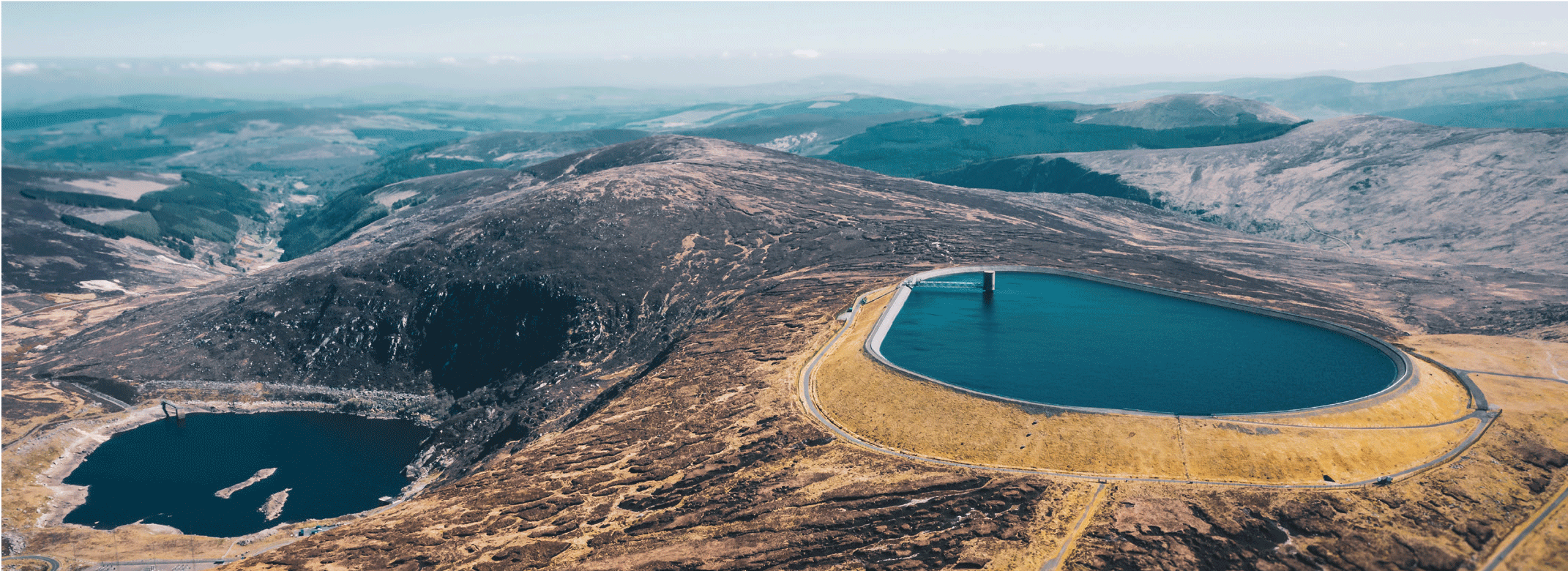
Technical considerations drive site selection towards compact, off-stream, closed loop configurations that minimise resettlement and environmental impacts. Developers use detailed analysis, including wildlife mapping and water availability studies, to identify optimal locations. They prefer sites with favourable ratios of distance to head elevation and avoid complex tunnelling or river diversions.
Despite growing investments, developers face significant challenges. Approval timelines from the CEA, the Ministry of Environment, Forest and Climate Change, and various state agencies often take two to three years. Policy inconsistencies across states create different allocation mechanisms and varying levels of government support. Some states apply hydro era policies such as free power obligations to PSPs, which is a concern for developers.
Infrastructure incentives, while being helpful to the segment, need administrative reforms. The current system requires validation of each expenditure item to claim support, creating administrative burdens. Developers suggest that milestone-based direct support will be more efficient and transparent.
State-level initiatives
State governments are taking the lead in PSP development through proactive policies and institutional support. Andhra Pradesh has emerged as a key state, identifying over 60 GW of pumped storage potential across 48 sites. Under the Integrated Clean Energy Policy 2024, Andhra Pradesh offers comprehensive support from project identification through execution. The state aims to bring 5-6 GW online by 2027 and transform its entire 60 GW pipeline into operating projects by 2030. Chhattisgarh has identified around 18 GW of potential, with 7.3 GW progressing through pref-easibility studies. The state utility Chhattisgarh State Power Generation Company Limited is leading implementation through joint ventures with THDC, SJVN, NTPC and NHPC.
Both states offer single-window clearance mechanisms and proactive land acquisition support. However, they acknowledge difficulties such as finding qualified consultants and long timelines for forest and environmental clearances.
Urban utilities are also integrating PSPs into their planning. As air conditioning and electric vehicle adoption increas peak demand, utilities are planning to use PSPs and batteries for managing peak load. PSPs handle four to five hours of peak power management, while batteries provide targeted relief for network congestion in space-constrained urban areas.
 Financial landscape
As capital expenditure varies by site conditions and project configuration, a key concern for lenders is cost escalation during construction, which remains common due to project-specific complexities and lack of standardised benchmarks. Financiers prefer off-river, closed-loop configurations because they have lower environmental and resettlement risks.
Further, project viability depends on long-term revenue agreements. Projects without firm contracts face significant financing challenges, especially given perceptions that battery storage is cheaper and faster to deploy, even though it is able to provide only short-term storage solutions.
According to financiers, the main obstacle to large-scale financing is the absence of dedicated markets for storage services. While pension funds and sovereign wealth funds have money available for long-term infrastructure investments, they need robust markets that support revenue from multiple services and diverse customers. Regulatory changes allowing revenue stacking across distribution companies, green hydrogen producers and industrial consumers are critical for reducing investment risks.
Proposed solutions include establishing a hydropower development fund for early-stage site investigations, enhanced tax incentives for difficult locations and stronger state guarantee frameworks. Accelerated depreciation and flexible design standards could further improve project attractiveness.
Challenges and the way forward
Despite strong policy support and growing investment, PSPs face ongoing challenges that require coordinated solutions. Overall, project risks include complex site conditions, long development timelines, land acquisition difficulties and cost uncertainties from geological surprises during construction.
Going forward, the regulatory framework needs further refinement to address implementation bottlenecks. Approval processes involving multiple departments create coordination problems that extend timelines and increase costs. Inconsistent policies across states result in different allocation mechanisms and varying levels of government support, creating complexity for developers working in multiple locations.
Several interventions could accelerate PSP deployment. Stronger payment security, including enhanced state guarantees and stricter contract termination provisions, will reduce investment risks and improve financing conditions. Indexing operations and maintenance costs to inflation, combined with milestone-based infrastructure support, can provide more predictable cost recovery, while reducing administrative burdens. Developing standardised cost benchmarks and technical specifications can reduce project uncertainties, while enabling more efficient procurement. Further, enhanced capacity building for environmental and forest clearances will address one of the most significant timeline bottlenecks.
Net, net, the segment has huge untapped potential as the current installed capacity is less than 5 GW, while the CEA has mapped India’s potential to be about 200 GW. Going forward, proactively addressing the concerns of the stakeholders to leverage this potential will be key to enhancing the installed capacity.
