The uptake of distributed solar projects in the agriculture space has gained traction over the years. The need for an alternative to diesel-powered irrigation, along with the goal of providing reliable and affordable energy access to farmers while improving their income levels, has been a key driver for its uptake.
Recognising the need for a dedicated policy framework to scale such interventions, the government had launched Pradhan Mantri Kisan Urja Suraksha Evam Utthaan Mahabhiyan (PM-KUSUM) in 2019. The scheme aims to replace diesel pumps with solar-powered alternatives, promote the installation of decentralised solar plants near agricultural loads and encourage grid-connected solar pumps usage.
This article provides an overview of the PM-KUSUM scheme’s components, the current status of adoption across states, challenges faced by stakeholders and the path forward…
Components of PM-KUSUM
The scheme has three core components. Component A focuses on the development of decentralised, grid-connected renewable energy power plants. These solar plants, ranging from 500 kW to 2 MW, can be set up by individual farmers, groups of farmers, cooperatives, panchayats or farmer producer organisations. Alternatively, farmers may lease their land to developers if they are unable to invest directly. The renewable energy plants must be located on barren, fallow or cultivable land and should be situated within a 5 km radius of an electricity substation to minimise transmission losses and associated costs. The electricity generated from these plants is purchased by local discoms at a pre-fixed tariff. This model creates an assured income stream for landowners, ranging from Rs 25,000-Rs 65,000 per acre annually. To support discom participation, the government provides an incentive of Re 0.40 per kWh, or Rs 660,000 per MW per year, for five years.
Component B targets the installation of standalone solar pumps in off-grid agricultural areas, primarily aiming to replace diesel-powered irrigation pumps. Under this component, farmers are supported to install solar pumps of up to 7.5 HP, with the capacity extended to 15 HP in certain designated regions. The central government provides financial assistance of 30 per cent of the benchmark or tendered cost, whichever is lower. An additional 30 per cent of the cost is covered by the state government, and the farmer contributes up to 40 per cent. Importantly, farmers opting for bank financing are required to pay only 10 per cent of the cost upfront, making the transition more affordable. For farmers in special category states and union territories (UTs), the central financial assistance (CFA) is increased to 50 per cent, while the state government’s share remains at 30 per cent, and the farmer’s contribution is limited to 20 per cent. The component not only reduces operational costs for farmers but also ensures consistent access to irrigation power, contributing to sustainable and diesel-free agriculture.
Component C has a dual focus: individual pump solarisation (IPS) and feeder-level solarisation (FLS). Under the IPS sub-component, financial support is extended to farmers for solarising their existing grid-connected agricultural pumps of up to 7.5 HP. The solar PV system installed can be up to twice the capacity of the pump, enabling farmers to not only meet their irrigation needs through self-consumption but also export surplus power to the grid under a net metering arrangement. This provides a dual benefit of reducing electricity bills and generating additional income from the sale of power to discoms. The cost-sharing pattern includes 30 per cent CFA, 30 per cent state subsidy, and up to 40 per cent contribution from the farmer. For special category states and UTs, the CFA is increased to 50 per cent, while the farmer’s share is capped at 20 per cent.
The FLS sub-component takes a broader approach by targeting the solarisation of entire agricultural feeders instead of individual pump sets. This model is especially suitable where feeder separation has already been carried out, allowing a uniform daytime power supply to a large number of farmers. In cases where feeders are not separated, states may avail of financing from institutions such as the National Bank for Agriculture and Rural Development, PFC Limited and REC Limited, or seek support under the Revamped Distribution Sector Scheme. Solar plants are designed to match the aggregate load of the feeder and can be developed under either the capex or renewable energy service company mode with a 25-year contract period. The CFA under FLS is 30 per cent of the eligible cost, capped at Rs 10.5 million per MW of installed solar capacity. For special category states, the CFA is enhanced to 50 per cent, with an upper limit of Rs 17.5 million per MW. This arrangement ensures that farmers receive reliable, daytime solar power for irrigation either free of cost or at a nominal, state-regulated tariff, thereby improving agricultural productivity while contributing to discom load management and renewable energy integration.
Current status of CFA disbursements and capacity additions
The off-grid solar sector, particularly under the PM-KUSUM scheme, has gained significant prominence in recent years, as reflected in the sharp rise in CFA disbursements. Between 2019-20 and 2024-25 (up to December 2024), the CFA allocation for the scheme has increased twelvefold, with a total disbursal of Rs 44,050.5 million over six financial years. This subsidy push has supported considerable capacity addition, with India’s total installed capacity under off-grid solar/PM-KUSUM reaching 5,014 MW as of May 31, 2025, according to the Ministry of New and Renewable Energy (MNRE). Maharashtra leads with 1,576 MW, followed by Haryana (981 MW), Rajasthan (805 MW) and Chhattisgarh (390.73 MW), together accounting for 75 per cent of the total off-grid solar installations in the country.
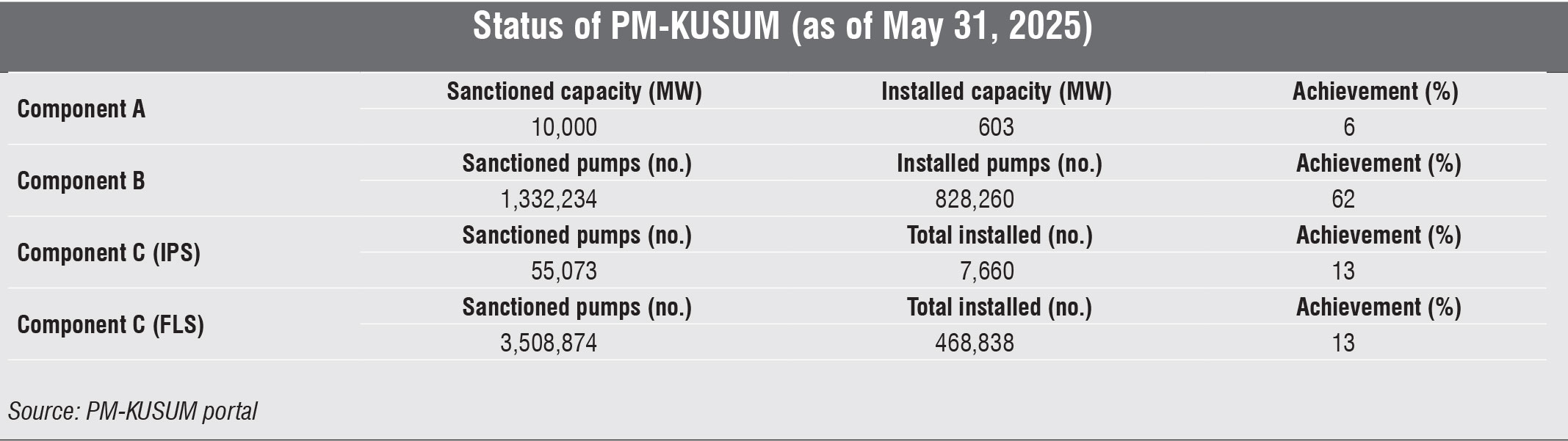
However, despite this momentum, implementation progress across the scheme’s three components remains uneven, as shown in the table. Component B has witnessed the most traction with over 828,260 pumps installed out of the sanctioned 1.3 million, translating to around 62 per cent achievement. Maharashtra leads this effort, accounting for 415,147 installed pumps. In contrast, Component A has seen limited success, with just 603 MW capacity installed, marking a modest 6 per cent completion. Rajasthan has emerged as the top performer under this component with 454.75 MW installed. Component C has also recorded slow progress, as only 7,660 individual pump sets have been solarised out of the 55,073 sanctioned, with Uttar Pradesh leading at 3,493 pumps. Additionally, FLS under Component C has reached just 13 per cent, with only 468,838 FLS completed against a target of over 3.5 million.
Challenges and the way forward
Despite the ambitious targets of the PM-KUSUM scheme, its on-ground implementation has been hindered by several challenges. A major constraint is the limited availability of domestically produced solar pumps that comply with the domestic content requirement. Moreover, the focus on pumps of 3 HP and above excludes nearly 85 per cent of Indian farmers, who are small or marginal and operate below this capacity threshold. Financial barriers further hamper adoption. Many farmers are hesitant to invest due to a lack of collateral for bank loans or perceive limited economic gains, particularly when compared to existing subsidies for electricity and diesel.
Water management issues also complicate matters. The low operational cost of solar pumps may incentivise over-pumping of groundwater, leading to unsustainable extraction. Retrofitting for deeper borewells is technically and financially demanding, especially as the water table continues to recede. Additionally, Component C faces execution hurdles ranging from land acquisition near substations and terrain-related difficulties to community resistance for transmission corridors and delays in statutory approvals. Remote locations suffer from accessibility issues, a lack of skilled manpower and logistical complications, further exacerbated by poor telecom connectivity that hinders remote monitoring and operations and maintenance activities. Theft, vandalism, vegetation overgrowth and animal intrusion add to the complexity of maintaining decentralised solar installations in rural areas.
At the 18th Edition of the Solar Power in India conference organised by Renewable Watch, Sridhar Gadde, Chief Executive Officer, Renewable Energy (Solar), Megha Engineering and Infrastructure Limited, highlighted that addressing these challenges requires a multi-pronged approach. He noted that design standardisation, investment in rural skill development and robust remote monitoring systems powered by artificial intelligence can enhance implementation efficiency. Simplifying approval processes through single-window clearances and easing forest/tree-cutting permissions will reduce project delays. Financially, discoms should be enabled to release CFA and collect it later from the MNRE to expedite execution. Moreover, states need to take a proactive role in land allocation and conversion policies to facilitate solar plant development. Further, introducing robotic module cleaning technologies can reduce the water footprint in water-scarce regions.
All in all, the PM-KUSUM scheme holds immense potential. It is not just a solar irrigation initiative but also a catalyst for decentralised energy generation, farmer empowerment, emissions reduction and rural economic revitalisation. With timely course corrections, robust institutional coordination and sustained policy support, the scheme’s and the sector’s outlook remains promising.