Pictures of rooftop solar plants across Delhi have been clicked by Gursimran Kaur
Rapid population growth, rising living standards and soaring temperatures in Delhi have led to a significant year-on-year surge in electricity consumption. According to the Central Electricity Authority, Delhi’s peak power demand stood at 8,656 MW between April 2024 and March 2025, a 16 per cent increase over the previous year. The state load despatch centre projects that the city’s power consumption will soon exceed this figure, marking a staggering 300 per cent rise since 2002, when peak demand stood at just 2,879 MW. Meeting this growing demand will require a corresponding expansion in power generation capacity.
As per the Central Electricity Authority, Delhi has an installed power generation capacity of 7,884.84 MW as of March 2025. Of this, thermal sources (coal and gas) account for approximately 82 per cent, hydropower 10.72 per cent and renewable energy 5.7 per cent. Of the 397.4 MW of installed renewable energy capacity, excluding large hydro, solar constitutes 313.4 MW, including 302.1 MW from rooftop solar, 9.84 MW from ground-mounted systems and 1.46 MW under the PM-KUSUM scheme, as per the Ministry of New and Renewable Energy. Waste-to-energy (WtE) contributes the remaining 84 MW.
With persistent air pollution and severe health risks due to toxic air quality throughout the year, expanding thermal capacity would only exacerbate the environmental crisis. In view of this, the Delhi government is actively working to increase the share of renewables in the region’s energy mix.
Solar power uptake
Under the Delhi Solar Policy, 2023, notified in March 2024, the government aims to scale its solar capacity to 4,500 MW by 2027. This ambitious target includes 750 MW from rooftop solar within the city and approximately 3,750 MW from utility-scale solar sourced from outside Delhi. To overcome challenges such as limited rooftop space, the policy introduces innovative implementation models including group net metering, community solar and peer-to-peer energy trading. For consumers facing capital constraints, models such as renewable energy service company (RESCO) and hybrid RESCO have been proposed to enable solar adoption without upfront investment. Additionally, the policy introduces capital subsidies for the first time, alongside generation-based incentives. It also mandates the installation of rooftop solar systems on all government buildings with a rooftop area of 500 square metres or more.

At the time of the policy announcement, Delhi’s installed rooftop solar capacity stood at 237 MW, which has increased to 313.4 MW, as of March 31 2025, indicating a 32 per cent increase in a year. This growth reflects the early impact of the policy, which catalysed a surge in rooftop solar adoption across the capital.
Since the policy came into effect, nearly 10,700 rooftop solar systems of various capacities have been installed across residential, commercial and institutional buildings. An additional 2,500 connections were expected to be added by the end of 2024-25, underscoring the growing momentum and public response to the city’s push for cleaner energy.
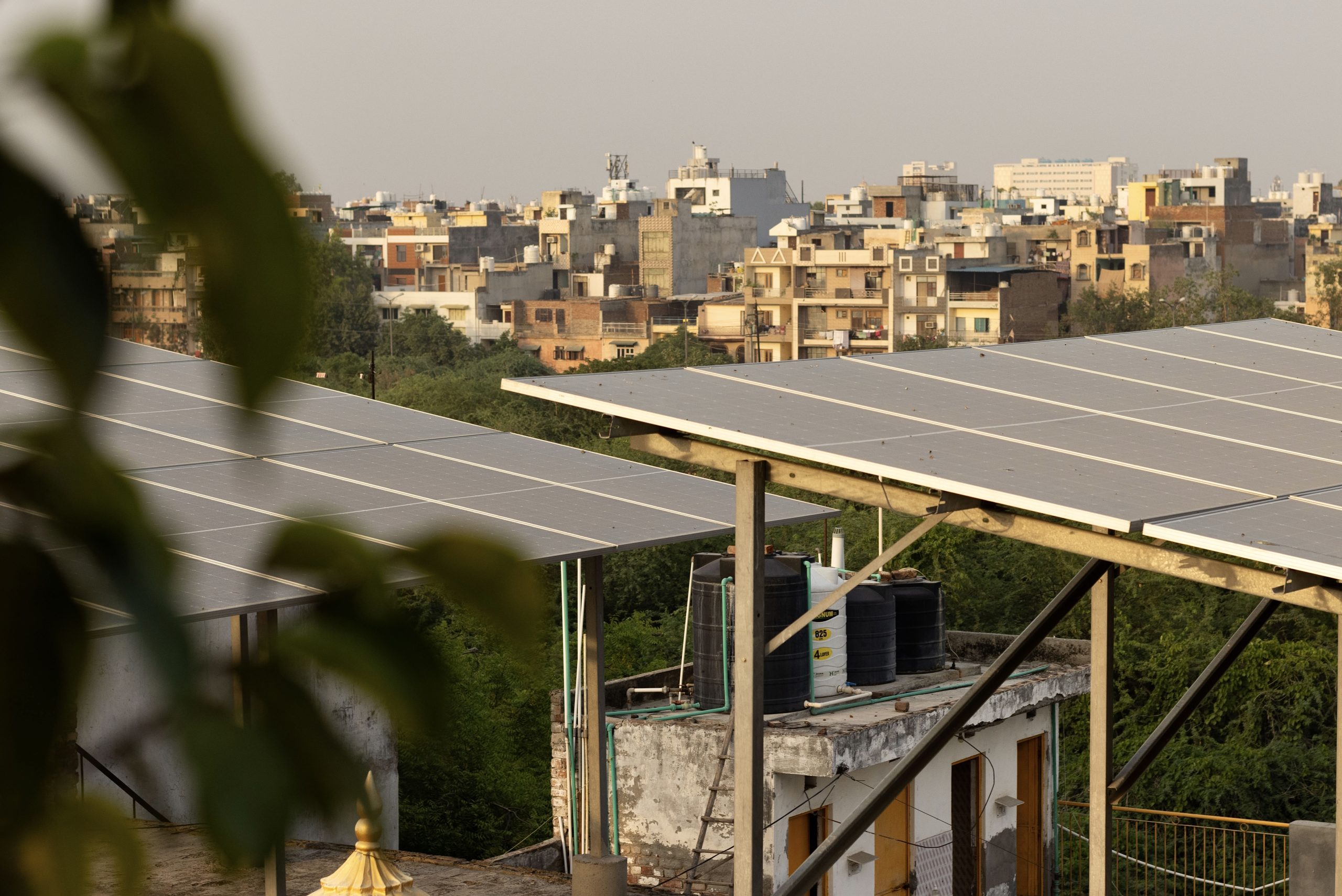
Moreover, the state government’s efforts to increase the uptake of rooftop solar led to the approval of the PM Surya Ghar: Free Electricity – State Top-Up Scheme in May 2025. The Delhi Cabinet has raised the total subsidy for 3 kW rooftop solar installations to Rs 1,08,000. This includes an additional Rs 30,000 provided by the state, on top of the Rs 78,000 already offered by the central government under the PM Surya Ghar: Muft Bijli Yojana.
In order to support the policy targets, the discoms are also actively accelerating solar adoption across the city. According to media reports, under its “Green Push” initiative, BSES, through its subsidiaries – BSES Yamuna Power Limited (BYPL) and BSES Rajdhani Power Limited – has facilitated the installation of over 7,100 rooftop solar connections with a cumulative capacity of 180 MW across South, West, East and Central Delhi.

In addition to efforts by discoms, the Delhi government has announced several new initiatives and agreements to promote solar adoption across the city. In April 2025, the Delhi assembly introduced a plan to install a 500 kV rooftop solar system within 100 days. Currently, the assembly has two 100 kW solar plants. The proposed expansion is expected to cut electricity costs by approximately Rs 1.5 million per month.
Earlier, in May 2024, a power purchase agreement (PPA) was approved between the Solar Energy Corporation of India (SECI) and Avikiran Surya India Private Limited, allowing BSES Yamuna to procure 90 MW of solar power. Similarly, the New Delhi Municipal Council (NDMC) has finalised preliminary arrangements with SECI to receive 200 MW of solar power over a 25-year period.
The Delhi Metro Rail Corporation (DMRC) is playing a transformative role in expanding its solar footprint. In February 2025, it inaugurated its first vertical bifacial solar plant at the Okhla Vihar metro station. This innovative installation captures sunlight from both sides and is mounted on the metro viaduct structure, eliminating the need for additional land. Additionally, a 1 MW rooftop solar plant was commissioned at the Khyber Pass metro depot. These installations bring DMRC’s total on-site rooftop solar capacity to 51 MW, spread across 93 stations and 15 depots. Looking ahead, DMRC has set a target to generate 60 MW of solar power as part of its Phase IV expansion. Notably, DMRC pioneered large-scale solar procurement in 2019 by becoming the first commercial entity of its size to source solar energy through open access from the Rewa Ultra Mega Solar Park in Madhya Pradesh.
Overall, with such comprehensive initiatives aimed at accelerating rooftop solar adoption, it remains to be seen whether these efforts will position Delhi as a leader in the residential rooftop solar space.
Focus on WtE
Delhi, one of the world’s most populous cities, grapples with an enormous waste management burden, often leading to hazardous landfill fires and serious environmental risks. However, there is growing optimism as the city ramps up its investment in WtE projects, which offer a dual benefit: reducing landfill dependency while generating electricity from waste. To address this challenge, the Delhi government is actively developing WtE infrastructure aimed at converting the city’s towering waste heaps into usable power.
According to a Lok Sabha response dated December 11, 2024, Delhi currently operates several WtE plants, including a 1,300 tonnes per day (tpd) facility generating 12 MW in Ghazipur; a 2,400 tpd plant producing 24 MW in Narela-Bawana; a 2,000 tpd plant with 20 MW of capacity in Tehkhand; and another 2,000 tpd plant generating 21 MW in Okhla. Despite these developments, Delhi’s landfills continue to be overwhelmed by vast amounts of garbage, prompting plans for additional WtE facilities.
To this end, the MCD, in May 2025, proposed expanding its WtE facilities at Tehkhand and Okhla to process an additional 1,000 tonnes of fresh waste daily. With this, the total waste processing capacity will rise to 3,000 TPD at Tehkhand, enabling power generation of 45 MW per day; and to 2,950 TPD at Okhla, generating 40 MW per day. The MCD has shared a status update with the Delhi government, outlining plans to complete the Tehkhand expansion by December 2027 and the Okhla upgrade by March 2027.
Going forward, among the key planned initiatives in Delhi’s WtE space are a 3,000 tpd plant at Narela-Bawana and a 2,000 tpd facility at Ghazipur. The Municipal Corporation of Delhi (MCD) is particularly focused on expediting its fifth WtE plant at Narela-Bawana to augment the city’s waste processing capacity. To facilitate this, a tripartite agreement has been signed between MCD, Power Grid Corporation of India and Delhi Transco Limited to remove high voltage transmission lines passing through the project site. The project, estimated to be built at a cost of Rs 6.04 billion, will process 3,000 tpd of municipal solid waste and will be operated by the same agency currently managing the Okhla WtE plant, under a 25-year contract. Once operational, these new WtE facilities are expected to play a critical role in bridging Delhi’s waste management gap by 2026.
Adopting green transport
Vehicular emissions continue to be a major contributor to Delhi’s air pollution. To address this, the Delhi government has been promoting the adoption of electric vehicles (EVs) and other low-carbon alternatives to bring down emissions in the transport sector. In August 2020, the Delhi government launched the EV Policy, 2020, to encourage the adoption of EVs among residents and commercial enterprises in the state. Furthermore, in February 2021, the government launched the “Switch Delhi” campaign as a mass movement for the adoption of EVs in the city.
With focused efforts to expand charging infrastructure and attractive incentives to boost adoption, Delhi has made significant progress in advancing electric mobility. According to a joint report by FICCI and Yes Bank titled “Driving ZEV Transition – From Centre to State”, released in November 2024, Delhi currently leads India in EV adoption. The city recorded an EV penetration rate of 11.5 per cent in 2023-24. While Delhi did not meet its ambitious target of 25 per cent EV penetration by 2023–24, it was the first state to surpass the 10 per cent mark back in 2022-23.
This achievement has been powered by widespread adoption across vehicle segments, supported by the city’s progressive EV Policy. The policy included a range of incentives such as purchase subsidies, tax exemptions, scrapping benefits for replacing older vehicles with EVs, and support for retrofitting enterprises. Notably, Delhi was also the first state to officially incorporate battery swapping stations into its EV framework, and it provided direct financial assistance for setting up public and private charging infrastructure.
This has led to strong EV penetration in specific segments: passenger electric three-wheelers (including e-rickshaws) account for 86 per cent of all three-wheeler sales, electric cargo three-wheelers make up 77 per cent of their category, electric buses constitute 57 per cent of the city’s bus fleet, electric cabs represent 38 per cent of all taxis, and electric two-wheelers account for 9.85 per cent of the their category. Electric cars, though still growing, hold a 3 per cent share in the overall car market.
In order to further accelerate the adoption of EVs in the state, in December 2024, the Delhi government renewed its EV Policy, introducing fresh incentives such as road tax exemptions for EV buyers. These measures have not only boosted EV sales but also significantly expanded the city’s charging infrastructure. As per a Lok Sabha response dated March 28, 2025, Delhi now hosts 1,951 public EV charging stations.
To build on this momentum, in May 2025, the Delhi government launched a new initiative, the Delhi Electric Vehicle Interconnector (DEVi) scheme, with a substantial budget allocation of Rs 90 billion. The scheme aims to fast-track EV adoption while strengthening the city’s charging networks and depot infrastructure. As part of this effort, 400 new DEVi electric buses were launched from the Kushak Nallah Depot. This initiative is part of Delhi’s evolving EV ecosystem, with more than 2,000 electric buses in operation.
Additionally, the government has announced plans to introduce 2,080 more e-buses under the DEVi scheme within the year. With these initiatives, Delhi is on track to achieve its target of fully electrifying public transport by the end of 2026.
Future outlook
Delhi holds significant potential to scale up its renewable energy infrastructure, particularly through solar power, which is crucial for meeting the city’s high energy demand while minimising carbon emissions. Recent developments signal positive momentum on this front. In November 2024, the Delhi government launched the Delhi Solar Portal, a comprehensive one-stop platform enabling consumers to connect with empanelled rooftop solar vendors, apply for subsidies and incentives, and calculate both their rooftop solar potential and estimated earnings. Moreover, in alignment with the Delhi Solar Policy, 2023, the government has also approved the installation of 50 MW of grid-connected rooftop solar systems across 645 government and MCD buildings, each with a built-up area of more than 500 square metres. In addition, the government has issued directives to equip all government buildings, including schools, hospitals and offices, with rooftop solar panels. This large-scale roll-out is currently in the tendering phase and marks a decisive step towards institutional solarisation in the capital.
While some progress has been made in reducing landfill waste, several environmental concerns remain to be addressed. WtE plants pose the risk of generating toxic fumes if air pollution control systems are not in place, posing a massive health hazard to residents in surrounding areas. Further, there are concerns regarding poor waste segregation at the household level, leading to huge costs for waste separation. This gap should be addressed to ensure the viability of projects.
Apart from solar, WtE and EVs, Delhi is exploring clean energy options such as battery energy storage systems (BESS), hybrid and hydro power. In April 2025, IndiGrid announced the commissioning of India’s first regulated utility-scale standalone BESS project with a capacity of 20 MW/40 MWh in Kilokari, Delhi. Apart from this, NDMC is expected to sign a PPA with NHPC for the procurement of 120 MW of hybrid power comprising wind, solar and BESS. Another proposal to secure 50 MW of hydropower for a 40-year term is also awaiting approval.
Net, net, the state government is making steady and effective efforts to increase the share of renewables in the city’s power mix. However, the responsibility for scaling up renewables and reducing overall emissions in the city does not lie with the government alone. Residents should consider adopting rooftop solar systems, switching to EVs and using more public transport. A people’s movement can truly make Delhi a cleaner and more sustainable city.
By Sakshi Bansal