Cross-border electricity trade (CBET) is emerging as a key driver of regional energy integration in South Asia. It is fuelled by low per capita electricity consumption, power shortages, poor access to electricity and uneven distribution of energy resources. By leveraging seasonal and resource complementarities across countries, CBET enables optimal utilisation of generation capacity, avoids power wastage and curtailment, and enhances energy security.
At a time when global energy security concerns are rising and the clean energy transition is accelerating, CBET presents an opportunity to enhance renewable energy integration, improve grid stability and reduce dependence on imported fossil fuels. As the world transitions to a more sustainable energy system, cross-border transmission lines are playing an increasingly significant role in enabling efficient and reliable exchange of energy among countries, which is equally relevant for India.
Against this backdrop, the article explores India’s existing cross-border interconnections, recent developments and the future outlook for regional electricity trade…
Current scenario
The National Electricity Plan (NEP) – Transmission (Volume 2) outlines that power exchange between India and neighbouring countries (Nepal, Bangladesh, Bhutan and Myanmar) is taking place in both synchronous and asynchronous modes. Transmission links at various voltage levels (33 kV, 132 kV and 400 kV) have been established in the border states of India (Bihar, Uttar Pradesh, Uttarakhand, Tripura, West Bengal and Assam) with neighbouring countries. Electricity from about 4,100 MW of projects is being exchanged through these cross-border links as of 2024, with expectations of increasing this to approximately 7,000 MW by the end of 2026-27, according to the NEP. Key developments in CBET with neighbouring countries are as follows:
India-Bhutan: Following a 2006 cooperation agreement for hydroelectric development, India currently imports electricity from about 2,070 MW of Bhutan’s major hydroelectric projects, including Chukha, Kurichu, Tala, Dagachu and Mangdechu. Multiple transmission links connect these projects to India through West Bengal and Assam, with power from Bhutan also being transmitted across India via high capacity high voltage direct current (HVDC) links.
To facilitate more imports from Bhutan, in November 2024, Tata Power and Druk Green Power Corporation partnered to develop 5,000 MW of clean energy in Bhutan. This includes 2,000 MW of hydropower, 2,500 MW of pumped storage and 500 MW of solar energy, providing reliable energy to both Bhutan and India. Key projects include the 1,125 MW Dorjilung hydroelectric project, the 740 MW Gongri reservoir, the 1,800 MW Jeri pumped storage and the 364 MW Chamkharchhu IV hydropower project.
Meanwhile, with respect to exports, in March 2025, Juniper Green Energy commissioned a 100 MW solar project to facilitate cross-border electricity supply to Bhutan. This project will enable Bhutan to directly import power from an Indian generator under a bilateral trade framework, with 50 per cent of the generated power being supplied to Bhutan during winter months.
India-Bangladesh: Since the 2010 MoU on power sector cooperation, India has been supplying electricity from 1,160 MW of projects to Bangladesh through the Baharampur-Bheramara 400 kV lines with HVDC back-to-back stations, as well as the Surajmaninagar-Comilla line. Future plans include the development of the Katihar-Parbotipur–Bornagar 765 kV D/C upgrade line.
India-Nepal: Following their 2014 agreement on power trade, India and Nepal have developed several interconnections, including the Muzaffarpur-Dhalkebar 400 kV line and Tanakpur-Mahendra Nagar 132 kV line. Development is ongoing for the Gorakhpur-New Butwal and Arun-3-Dhalkebar-Sitamarhi lines, with multiple lower voltage connections linking Nepal to Indian border states.
In January 2024, India and Nepal signed a landmark pact for electricity trade encompassing 10,000 MW of projects. More recently, India has allowed Nepal to export electricity from an additional 251 MW across 12 hydropower projects to Bihar, under a medium-term sales agreement. This will take Nepal’s total hydropower exports to 941 MW from 28 projects.
India-Nepal-Bangladesh: One of the most significant milestones in CBET is the tripartite agreement signed by Nepal, India and Bangladesh. This agreement allows Nepal to export hydropower to Bangladesh using Indian transmission corridors from June 15 to November 15 every year selling 40 MW of hydroelectricity in the first phase. This is the first instance of trilateral electricity trade in South Asia.
India-Sri Lanka: India and Sri Lanka have been exploring a $1.2 billion grid connectivity project via an overhead transmission line, linking Anuradhapura in Sri Lanka with Chennai in India, followed by an undersea line emerging via undersea cable at Thiruketheeswaram in Mannar, Sri Lanka. The two countries have signed an agreement for implementing an HVDC interconnection between the two countries to facilitate power exchange and are also exploring an offshore wind energy transmission link.
India-Myanmar: Since the 2016 MoU on power sector cooperation, India has been supplying 2-3 MW to Myanmar via an 11 kV line from Moreh (Manipur) to Tamu. Both countries have agreed to establish a 500 MW HVDC interconnection between Imphal and Tamu, with discussions ongoing for additional low voltage connections.
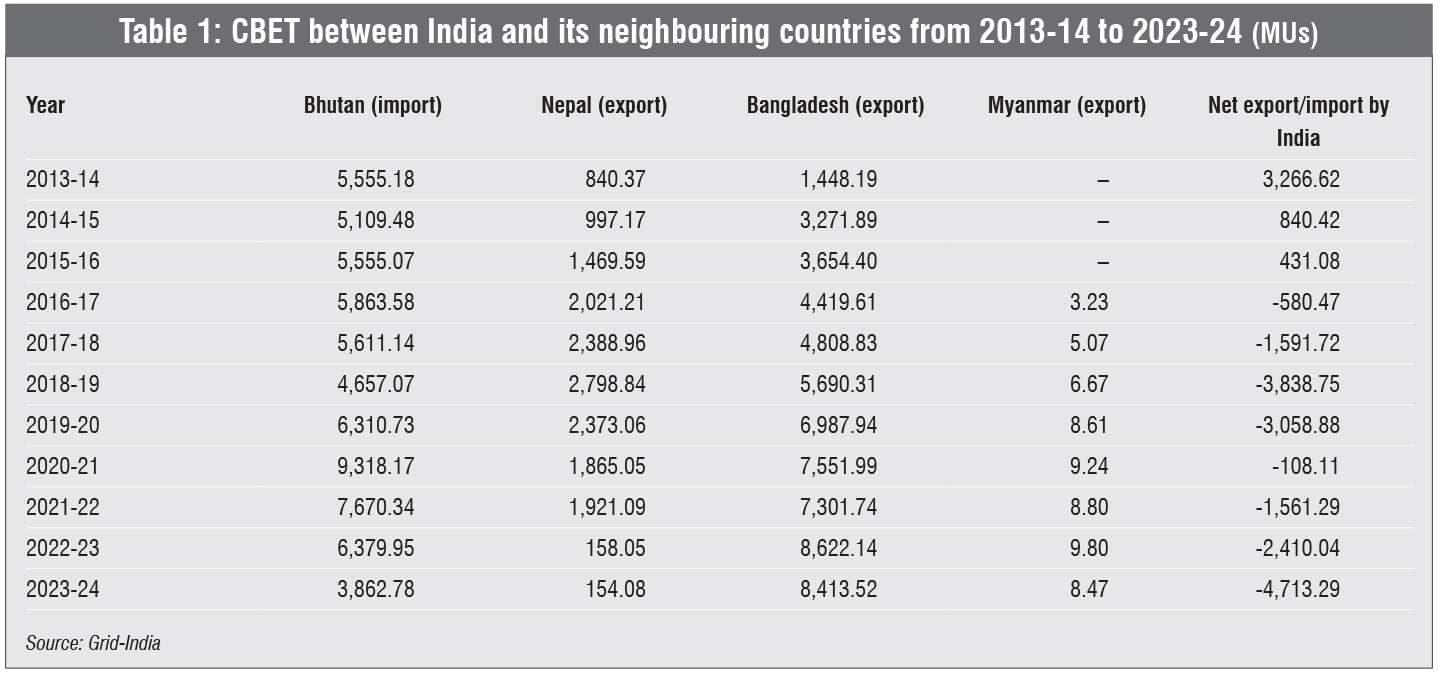
Overall, in terms of electricity exchange volume during 2023-24, India has imported 3,862.78 MUs from Bhutan, while exporting 154.08 MUs to Nepal, 8,413.52 MUs to Bangladesh and 8.47 MUs to Myanmar. As of 2023-24, India remains a net exporter of 4,713.29 MUs of electricity. Historically, India was a net importer of electricity from 2013-14 (importing 3,266.62 MUs) to 2015-16 (importing 431.08 MUs), before transitioning into a net exporter from 2016-17 (exporting 580.47 MUs) onwards. Before the onset of the Covid-19 pandemic, India had been steadily increasing its electricity exports to neighbouring countries, with combined exports to Nepal, Bangladesh and Myanmar rising from 2,288.56 MUs in 2013-14 to a peak of 8,495.82 MUs in 2018-19. In 2019-20, exports totalled 9,369.61 MUs, with 2,373.06 MUs to Nepal, 6,987.94 MUs to Bangladesh and 8.61 MUs to Myanmar. However, during 2020-21, when the pandemic hit, although total export volume increased slightly to 9,426.28 MUs with 1,865.05 MUs to Nepal, 7,551.99 MUs to Bangladesh and 9.24 MUs to Myanmar, India’s net exports fell sharply due to an increase in imports from Bhutan, which rose to 9,318.17 MUs. From 2021-22 onwards, exports have steadily increased year on year, from 1.561.29 MUs in 2021-22, to 2,410.04 MUs in 2022-23 to 4,713.29 MUs in 2023-24. These trends can be seen in Table 1.
While CBET is primarily being conducted through mutual arrangements, the share of power exchanges has also gradually increased. Currently, CBET is witnessing a gradual shift, with increasing volumes being traded through the Indian Energy Exchange (IEX). At the exchange market, Nepal’s electricity imports from India grew from 785.84 MUs in 2021-22 to 1,310.81 MUs in 2023-24, while its exports surged from just 32.04 MUs to 1,556.33 MUs during the same period. Bhutan’s imports also rose sharply from 240.11 MUs to 1,299.42 MUs, and notably, it entered the market as a seller for the first time in 2023-24, trading 40.28 MUs. These trends can be seen in Table 2.

Future outlook
While the potential for regional energy integration in South Asia is huge, challenges and geopolitical complexities must also be acknowledged. For instance, significant geopolitical tensions make it almost impossible to foresee any CBET between India and Pakistan, thus, making electricity trade with Afghanistan a mirage as well. In fact, the current political tensions within Bangladesh may possibly threaten future growth of CBET with India’s eastern neighbour.
Apart from geopolitical reasons, another key challenge for CBET is payment disputes. For instance, the Adani Group supplies power to Bangladesh from a 1,600 MW thermal power plant in India through a 25-year contract. Due to payment delays, the Adani Group halved the power supply to Bangladesh in November 2024. According to media reports, the Adani Group resumed the full power supply in March 2025, after receiving regular payments.
Despite these challenges, the future of CBET looks promising, especially with the ongoing efforts to strengthen energy cooperation across the region. Proactive work is already under way to establish more robust transmission links and agreements to ensure energy security and reliability in the region.
As the South Asian power grid slowly gets connected, the ultimate goal will be to create a seamless global energy network through the One Sun One World One Grid (OSOWOG) initiative, proposed by the Indian prime minister. The OSOWOG initiative seeks to connect diverse grids across countries and continents through a common platform, primarily focused on renewable energy sources such as solar, wind and hydro. The initiative acknowledges that renewable resources such as solar and wind have different peak times and availability across regions, making cross-border energy flows even more beneficial. Through transnational interconnections, excess renewable energy from one region can be transmitted to areas with shortages, optimising the use of clean energy and reducing reliance on fossil fuels.
While the OSOWOG initiative is futuristic and worth pursuing, low-hanging fruits within South Asia should be simultaneously tapped. According to the United Nations Economic and Social Commission for Asia and the Pacific, South Asia possesses a vast hydropower potential of 350 GW, of which only 20 per cent has been tapped so far. The key contributors to this potential include Bhutan with 30 GW, Nepal with 83 GW and India with 150 GW. Additionally, South Asia has a vast solar and wind energy potential, including 940 GW of solar and 1,290 GW of wind. Thus, the scope for CBET, especially for renewable electricity, is immense. Overall, given this potential, it is estimated that South Asia’s cross-border transmission capacity will expand from around 4,700 MW today to 43.7 GW by 2036.
All in all, power trade in South Asia presents a win-win opportunity, backed by the immense untapped potential and the ongoing developments to enhance regional energy security.