

The Damodar Valley Corporation (DVC) is a statutory corporation formed under a special act of Parliament with joint capital contribution from the Indian government, the West Bengal government and the Jharkhand government (erstwhile Bihar) for driving development in the valley. Established in July 1948, it was conceived as the first multipurpose river valley project of independent India, modelled after the Tennessee Valley Authority of the US.
Since its inception, DVC has achieved several significant milestones. In 1953, DVC commissioned its first dam at Tilaiya, marking a major step towards water resource management and hydroelectric power generation. A milestone in India’s thermal power industry was achieved in 1963 when DVC commissioned the first reheat unit at the Chandrapura thermal power station (TPS) (3×140 MW).
Between 2011 and 2016, DVC made remarkable progress in the development of greenfield power projects with capacities totalling 3,200 MW at Koderma, Durgapur and Raghunathpur. In 2018, the corporation extended its operations internationally by initiating its first-ever cross-border power supply to Bangladesh, exporting 300 MW of electricity.
Currently, the company has a vast portfolio of thermal (6,540 MW), hydro (147.2 MW) and renewable energy projects (13.82 MW), besides overseeing hydro dams. It also owns and operates a transmission and distribution network, including extra high voltage transmission lines of up to 400 kV and 33 kV distribution lines. It also owns a coal mine in Jharkhand.
In line with the increasing demand in the country, DVC is gearing up for significant expansion till 2032 – which includes adding thermal, pumped storage and renewables, as well as installing flue gas desulphurisation (FGD) systems and augmenting transmission and distribution infrastructure. It is also investing in electric vehicle (EV) charging infrastructure.
Current operations
DVC has built a total thermal generation capacity of 6,540 MW, spread across six TPSs – three located in West Bengal and three in Jharkhand. This capacity includes 500 MW from the Bokaro TPS (BTPS), 500 MW from the Chandrapura TPS (CTPS) and 1,000 MW from the Koderma TPS (KTPS) in Jharkhand. In West Bengal, the capacity comprises 1,000 MW from the Durgapur Steel TPS (DTPS), 2,340 MW from the Mejia TPS (MTPS) and 1,200 MW from the Raghunathpur TPS (RTPS).
In addition to thermal power, DVC has a hydroelectric and renewable energy generation capacity of 161.12 MW, which includes three hydroelectric power stations (147.2 MW) and 13.82 MWp of rooftop and ground-mounted solar installations.
DVC has also established key joint ventures to enhance its power generation capabilities. Maithon Power Limited, a partnership between DVC (26 per cent) and Tata Power (74 per cent), operates a 1,050 MW power plant. Bokaro Power Supply Company Limited, a 50:50 joint venture between DVC and Steel Authority of India Limited has a generation capacity of 338 MW. Additionally, Green Valley Energy Limited is a collaboration between DVC (49 per cent) and NTPC Renewable Energy Limited (51 per cent).
DVC also supplies power to high tension customers (state power utilities, the railways and industrial consumers), thereby safeguarding the corporation from the burden of cross-subsidy to low tension customers and associated distribution losses. Its transmission network comprises 8,634 ckt km of transmission lines with voltage levels reaching up to 400 kV. The corporation also manages 60 substations, supplying power at 400/220/132/33/11 kV, with a total transformation capacity of 11,900 MVA. During 2023-24, the availability of transmission and distribution systems was 99.78 per cent.
Further, DVC oversees four major dams with a combined dam length of 15.25 km. These dams play a crucial role in flood moderation and maintain an extensive 2,500 km canal network that supplies water to 162 entities.
DVC is also engaged in mine development, operating the Tubed Coal Block in Latehar district, Jharkhand. It started production from its coal mine in February 2023, which has a capacity of 6 million tonnes per annum.
Operational and financial performance
Over the past five years, the average plant availability factor of its plants stood at 80.61 per cent. In FY2022-23, this improved to 83.54 per cent, and further increased to 88.8 per cent in FY2023-24.
DVC has also improved the plant load factor (PLF) of its non-pithead thermal power plants (TPPs) over the years. In 2017-18, the PLF stood at 56.04 per cent, which improved to 59.05 per cent in FY 2018-19 (36,677 MUs), 60.52 per cent in 2019-20 (36,998 MUs), 2020-21, with the PLF reaching 62.39 per cent and generation rising to 38,039 MUs, 68.96 per cent (40,775 MUs) in FY 2021-22, followed by 74.22 per cent in FY 2022-23 (43,085 MUs) and by 2023-24, DVC achieved its highest-ever PLF of 76.81 per cent, with a record thermal generation of 44,128 MUs.
DVC has 98 per cent of its thermal generating capacity tied up with power purchase agreements (PPAs). Of this, 49.34 per cent is tied to bilateral PPAs with various discoms, while the remaining capacity is under pooled PPAs.
The corporation achieved its highest revenue of Rs 264.16 billion in FY2022-23, with a profit after tax (PAT) of Rs 7.04 billion. In FY2023-24, while revenue slightly declined to Rs 255.76 billion, PAT surged to Rs 8.11 billion, marking DVC’s strongest financial performance to date.
 Key initiatives
DVC is undertaking significant measures to improve the environmental compliance of its thermal portfolio through the implementation of FGD technology. So far, it has successfully commissioned FGD systems for eight units with a total capacity of 4,200 MW. Additionally, seven more units, totalling 1,840 MW, are scheduled for FGD commissioning by May 2025. The investment in these projects is approximately Rs 46 billion.
DVC has also completed the installation of de-NOx systems in 500 MW, 600 MW and 250 MW units, with a total investment of Rs 1.28 billion. It is also implementing electrostatic precipitator (ESP) augmentation in its older thermal units. Specifically, ESP upgrades are being carried out for three units (210 MW each) at MTPS (Units 1, 2 and 3), which have been in operation for over 25 years. The augmentation for MTPS Unit 3 is scheduled to begin with an estimated cost of Rs 3 billion.
DVC has started biomass co-firing, with its first operation at DSTPS in February 2023. This initiative has been extended to all 500 MW and 600 MW units. It is also advancing sustainability efforts through a township sewage treatment plant project, aimed at enhancing water utilisation and conservation.
DVC procures the coal required for power generation from various subsidiaries of Coal India Limited, with which it has fuel supply agreements. The current coal consumption is around 80,000 mt per day, generating 36,000 mt of ash daily. DVC has managed to evacuate 56,000 mt of ash per day, surpassing the generation rate.
Another key initiative is facilitating flexible operation across multiple power units, enhancing efficiency and adaptability. In the pilot phase, MTPS Unit 8 and CTPS Unit 7 (ball and tube mill) achieved successful flexible operations, demonstrating improved operational control. Additionally, advanced process control systems were installed at MTPS Unit 8 and CTPS Unit 7, further optimising performance.
Flexible trial operations were also conducted at DSTPS and KTPS. Both 500 MW and 600 MW units successfully ran at a technical minimum load of 55 per cent of their maximum continuous rating or nameplate capacity. Further advancing flexible operations, DVC has issued a work order to Bharat Heavy Electricals Limited (BHEL) for the implementation of flexible operation at BTPS Unit A (500 MW).
DVC is also dismantling old TPPs to set up more efficient and sustainable energy infrastructure. BTPS-A, with a capacity of 247.5 MW, and BTPS-B, with 630 MW, were decommissioned as part of this modernisation effort. Additionally, CTPS Units 1-6, with a total capacity of 780 MW, and Durgapur TPS, with 340 MW, were also decommissioned. In total, DVC has phased out 1,997.5 MW of old thermal capacity from its portfolio.
Road map to 2032
DVC has outlined an ambitious energy road map for 2032, focusing on thermal capacity expansion and a significant shift towards renewable energy.
On the thermal side, the corporation plans to add a significant 5,320 MW of thermal capacity through supercritical and ultra-supercritical units, at RTPS (2×660 MW), DTPS (800 MW), KTPS (2×800 MW) and CTPS (2×800 MW). By FY2031, supercritical and ultra-supercritical units at RTPS, KTPS and DTPS will constitute 32 per cent of the installed capacity.
DVC has already started work on these projects and awarded major contracts. In February 2025, BHEL received a letter of intent from DVC for the steam generator island package of the 2×660 MW RTPS project. Additionally, in August 2024, BHEL secured the contract from DVC for the 2×800 MW Koderma super TPP, Jharkhand.
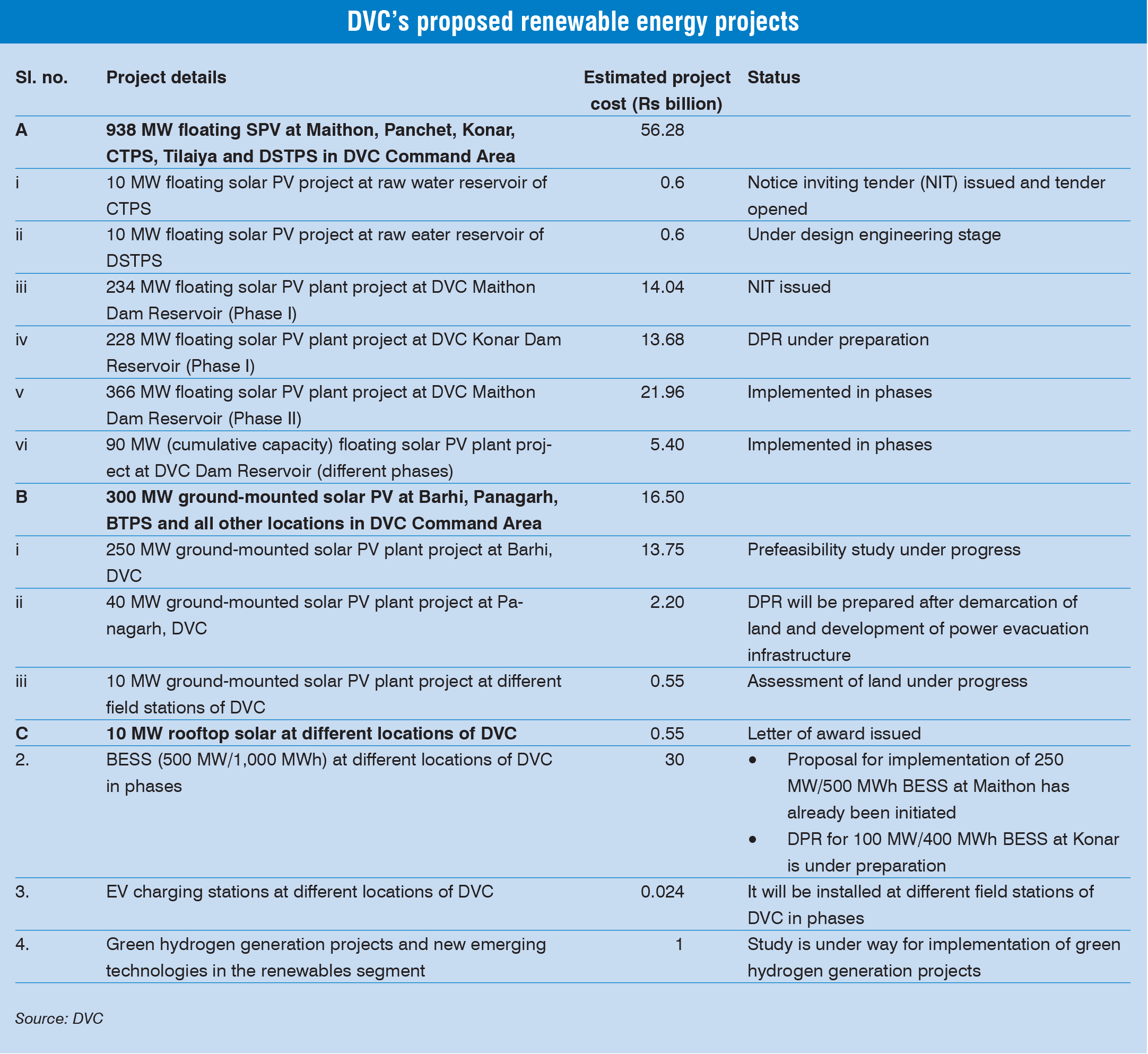
DVC also aims to generate 4,433 MW from renewable energy sources, ensuring that 27 per cent of its installed capacity comes from clean energy by integrating renewable energy solutions such as floating and ground-mounted solar projects. Renewable energy projects will contribute 27 per cent of the total installed capacity, operating at full potential as per the Ministry of Power’s designated status.
A key project under way is the setting up of around 1,000 MW of pumped storage hydro capacity at Panchet Hill in West Bengal. The project is proposed to be a 50:50 joint venture between DVC and the West Bengal government.
DVC is also exploring opportunities in battery energy storage systems (BESSs) and green hydrogen production. A proposal for the implementation of a 250 MW/500 MWh BESS at Maithon has already been initiated, while a detailed project report (DPR) for a 100 MW/400 MWh BESS at Konar is currently under preparation. In addition, a study is under way for the implementation of a green hydrogen generation project.
Efforts are also under way to develop EV infrastructure, which will be installed in a phased manner at different field stations of DVC.
Additionally, DVC has outlined a proposed transmission system expansion plan with an estimated investment of Rs 76.89 billion by 2031-32. This includes Rs 25 billion for new substations, Rs 15 billion for the reconductoring of transmission lines, and Rs 12 billion for the renovation and modernisation of existing substations, among other projects.
DVC is embracing digital transformation to enhance operational efficiency and reliability. It is set to implement an asset management system through a digital platform, ensuring streamlined monitoring and maintenance of critical infrastructure. A real-time centralised monitoring system will be introduced for generation stations, while transmission asset management systems will optimise the transmission network. Two centralised control rooms are being established at Kalyneswary and Koderma, enabling real-time monitoring.
Challenges and the way forward
DVC faces operational constraints due to the integration of a higher proportion of renewables. It has secured 550 MW of renewable energy bundling for FY2023-24, but further integration requires operating its thermal plants at substantially reduced capacities, which is technically challenging. The corporation is required to bundle 3,296 MW of renewable energy, with 400-500 MW shifting to green power through open access. This will lead to a renewables injection of 1,500-1,800 MW during solar hours, causing significant fluctuations in the net schedule. Other challenges include stringent water consumption norms for its TPPs, higher capex due to environmental retrofits, cost recovery gap for DVC as a discom, as well as coal quality management issues due to grade slippages.
These challenges notwithstanding, DVC’s ambitious thermal and renewable energy expansion plans, along with operational and environmental sustainability initiatives, are expected to ensure the delivery of reliable and affordable power to consumers in the next few years.
Based on a recent presentation by DVC at a Power Line conference

