By Mohammed Ali Siddiqi
Every year, the progress of the economy and its trajectory is shaped by the release of the Economic Survey followed by the Union Budget. This year, too, the finance minister began her budget speech with an emphasis on the government’s commitment to accelerating growth, fostering inclusive development and invigorating private sector investments.
As per the first advance estimates published by the National Statistics Office, India’s real and nominal GDP growth rates have been pegged at 6.4 per cent and 9.7 per cent, respectively, in 2024-25, positioning the country for further economic expansion. To sustain the growth trend, Union Budget 2025-26 strongly committed to capital investments, with effective capex projected to rise to Rs 15.5 trillion (4.3 per cent of GDP) in 2025-26, according to the fiscal policy statements (presented in February 2025) under the Fiscal Responsibility and Budget Management Act, 2003.
For the power and renewables sector, the Ministry of New and Renewable Energy’s (MNRE) budget has surged to Rs 265.49 billion and the Ministry of Power’s (MoP) allocation has increased to Rs 218.47 billion. This rise in budgetary allocations sends a very clear policy signal – that India is committed to achieving its growing power demand and meeting a significant share of this demand through non-fossil fuel sources.
As we dive into the budget allocations for these ministries, the two key questions that we must ask are – one, what are the key priority areas for the central government, including targets and funds allocated for centrally sponsored schemes; and two, what has been the past trend in the utilisation of funds allocated to the MNRE and the MoP? This article aims to map and answer both these questions…
What are the key priority areas for the central government, including targets and funds allocated for centrally sponsored schemes?
A key reference document for answering this question is the Output-Outcome Framework 2025-26 in the Outcome Budget 2025-26 of the Ministry of Finance (February 2025). According to this document, the budget for solar power (grid) is Rs 15 billion, which has been allocated for grid-connected solar power initiatives (excluding schemes such as the Pradhan Mantri Kisan Urja Suraksha evam Utthaan Mahabhiyaan [PM KUSUM] and PM Surya Ghar: Muft Bijli Yojana) and for scaling domestic manufacturing capacity. As per the Outcome Document, by 2025-26, India aims to commission 5,000 MW of solar capacity in solar parks and an additional 5,000 MW under the Central Public Sector Undertaking [CPSU] Scheme. On the manufacturing front, the government plans to procure 6,500 MW, 4,880 MW and 10,500 MW of solar modules and cells under the MNRE’s domestic content requirement initiative of the CPSU Scheme II, PM KUSUM Components B and C, and the PM Surya Ghar scheme respectively. This is a welcome move, as the emphasis on domestic manufacturing is slated to reduce import dependency, leading to estimated savings of Rs 130 billion from solar panel and cell manufacturing and Rs 48 billion from solar module production.
The PM KUSUM scheme’s budget allocation has risen from Rs 11 billion in Budget 2023-24 and Rs 14.96 billion in Budget 2024-25 to Rs 26 billion in Budget 2025-26. However, its allocations have been surpassed by the PM Surya Ghar: Muft Bijli Yojana, which aims to install rooftop solar panels for residential consumers. From Rs 62.5 billion in actual expenditure in 2023-24, the allocation went up to Rs 111 billion in Budget 2024-25 and was significantly revised to Rs 200 billion in Budget 2025-26. Unlike other renewable programmes where revised estimates have often been lower than budget expectations, PM Surya Ghar’s revised estimate for 2024-25 has actually doubled. The segment has become a key priority for the government, as evident from the significant budget outlay.
For the wind energy segment, the MNRE has been allocated Rs 242.25 billion, up by 32 per cent from the previous year’s budget allocation of 163.95 billion. The green energy corridor (GEC) scheme, focusing on transmission infrastructure, has also received a significant allocation of Rs 6 billion, signalling a well-intended focus on renewable energy integration. The National Green Hydrogen Mission (NGHM) has received an allocation of Rs 6 billion for the year 2025-26. This programme entails a high-level target, to produce 5 million metric tonnes (mmt) of green hydrogen annually by 2030, thereby reducing fossil fuel imports and decarbonising hard-to-abate industries. As per the output table, the government plans on producing 1.03 million tonnes per annum of green hydrogen once the projects become operational this year. To accelerate domestic production, 3,000 MW of electrolyser manufacturing capacity will be awarded, with the aim of reducing import dependence and strengthening supply chains by establishing a local manufacturing base. Additionally, pilot projects are anticipated to be launched in hard-to-abate sectors, including steel, shipping, refining, bunkering and mobility. Simultaneously, the government has plans to award research projects and establish centres of excellence focused on advancing technologies such as more efficient electrolysers and improved hydrogen storage methods.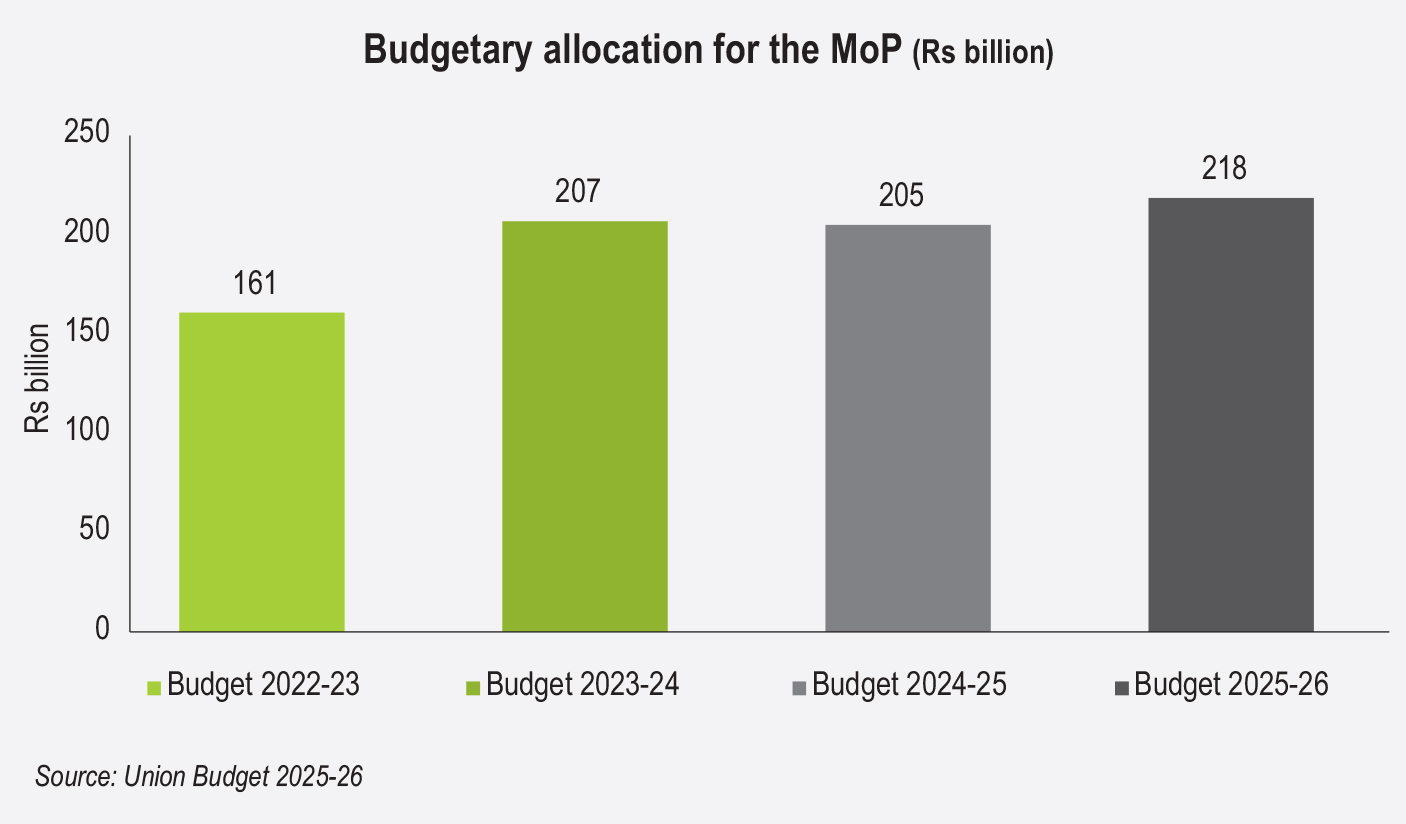
What has been the past trend in the utilisation of funds allocated to the MNRE and the MoP?
MNRE
Budget allocation for the MNRE has seen a significant increase, rising from Rs 102.22 billion in 2023-24 to Rs 265.38 billion in 2025-26, reflecting the government’s commitment to accelerating renewable energy deployment. However, a key question remains: how much of this will actually be spent? To understand the past trends in fund utilisation, we refer to the Notes on Demands for Grants, 2025-2026, for the MNRE (Demand no. 71).
The numbers show an unfortunate trend of underutilisation of funds over the years for different segments. In 2023-24, actual expenditure was Rs 79.29 billion, 22.4 per cent lower than the allocated budget, indicating possible delays in fund disbursement or project execution. In 2024-25, the initial budget of Rs 191 billion was later revised down to Rs 172.98 billion. Despite these challenges, the sharp increase to Rs 265.49 billion in 2025-26 signals a renewed push towards achieving India’s renewable energy targets, including expansion in solar, wind, hydrogen and storage technologies.
The NGHM had initially announced an investment of over Rs 200 billion, signalling a strong government commitment towards green hydrogen development. However, budgetary allocations and actual expenditures indicate a significant gap between projected and actual spending. In Budget 2023-24, an allocation of Rs 2.97 billion was made; however, the actual expenditure was only Rs 1 billion. Similarly, for Budget 2024-25, an allocation of Rs 6 billion was announced, while the revised estimate was reduced to Rs 3 billion, suggesting that expenditure did not match initial expectations. Given this trend, it remains to be seen if the Rs 6 billion allocation for 2025-26 may again face a downward revision, raising possible concerns about the pace and scale of the NGHM’s implementation.

Another negative trend has been the underutilisation of funds in the research and development (R&D) of clean technologies. In Budget 2023-24, an allocation of
Rs 700 million was made for R&D, but actual spending was a mere Rs 19.6 million. This suggests that planned research initiatives did not progress as expected, possibly due to delays in project approvals, fund disbursement bottlenecks or lack of viable research proposals.
For Budget 2024-25, the initial allocation was Rs 460 million, but the revised estimate was lowered to Rs 300 million. Budget 2025-26 has an allocation of Rs 460 million. However, based on past trends, there is a possibility that actual spending may once again fall short, unless structural improvements are made in fund utilisation mechanisms.
This persistent underutilisation raises concerns about India’s ability to develop indigenous clean technologies, especially in areas such as electrolyser production. If R&D investments are not effectively realised, India may remain dependent on imported technology, which may slow our progress towards renewable energy innovation.

Going forward, effective fund management will be key in maximising the impact of increased allocations and ensuring the timely execution of critical renewable energy projects.
MoP
The budget trends of the MoP also reveal a similar pattern, alongside steady growth in allocations. In 2022-23, the budgeted Rs 160.74 billion saw an actual expenditure of only Rs 93.13 billion, a 42 per cent shortfall, indicating significant underspending. In 2023-24, the budget increased to Rs 206.71 billion (28.6 per cent higher than 2022-23), but actual spending remained 21 per cent below budget at Rs 163.27 billion, though it marked a 75 per cent improvement over the previous year’s expenditure. The 2024-25 budget was relatively stable at Rs 205.02 billion, with a revised estimate of Rs 198.45 billion, reflecting a 3.2 per cent downward adjustment. For 2025-26, the budget allocation has been raised to Rs 218.47 billion, a 10 per cent increase over the revised estimate of 2024-25 and a 34 per cent rise compared to actual spending in 2023-24, signalling sustained investment in power sector reforms.
The data highlights a recurring trend of fund underutilisation, despite year-on-year spending improvements. While budget allocations have stabilised at around Rs 205 billion for two consecutive years, the 2025-26 increase suggests renewed efforts to drive power sector modernisation and infrastructure upgrades.

Further, in terms of investments in public sector enterprises, we see that NTPC Limited witnessed the largest share with an allocation of Rs 260 billion. This was followed by NHPC Limited with over Rs 130 billion. Further, SJVN Limited, Damodar Valley Corporation, and Chenab Valley and Power System Operations received Rs 120 billion, Rs 33.95 billion and Rs 3 billion respectively.
Conclusion
The significant jump in allocation for the PM Surya Ghar scheme highlights the government’s focus on promoting rooftop solar adoption. Unlike other renewable programmes, where revised estimates often fall short of initial allocations, this scheme has seen an upward revision, suggesting strong implementation momentum. Meanwhile, the PM KUSUM scheme also continues to play a vital role in promoting solar adoption in the agricultural sector, though its funding has now been surpassed by the rooftop solar initiative.
Union Budget 2025-26, for the MNRE and the MoP, reflects a strong policy push toward expanding clean energy, boosting domestic manufacturing, securing critical minerals and modernising the power sector. With the MNRE’s budget surpassing that of the MoP, the government has signalled its commitment to scaling up renewable energy and enhancing grid infrastructure along with renewable integration.
However, the persistent underutilisation of funds remains a major challenge, particularly in R&D allocations, where actual spending continues to fall far below projections. Delays in project approvals, fund disbursement and execution bottlenecks risk slowing progress despite ambitious budgetary commitments. The success of these allocations depends on streamlined implementation and stronger mechanisms to ensure that funds are utilised properly.
All in all, the 2025-26 budget lays a solid foundation for India’s energy transition and will be key to transforming these investments into real-world progress.